


Vietnamese Card Games: Every Major Game, Deck and Rule Set
August 22, 2026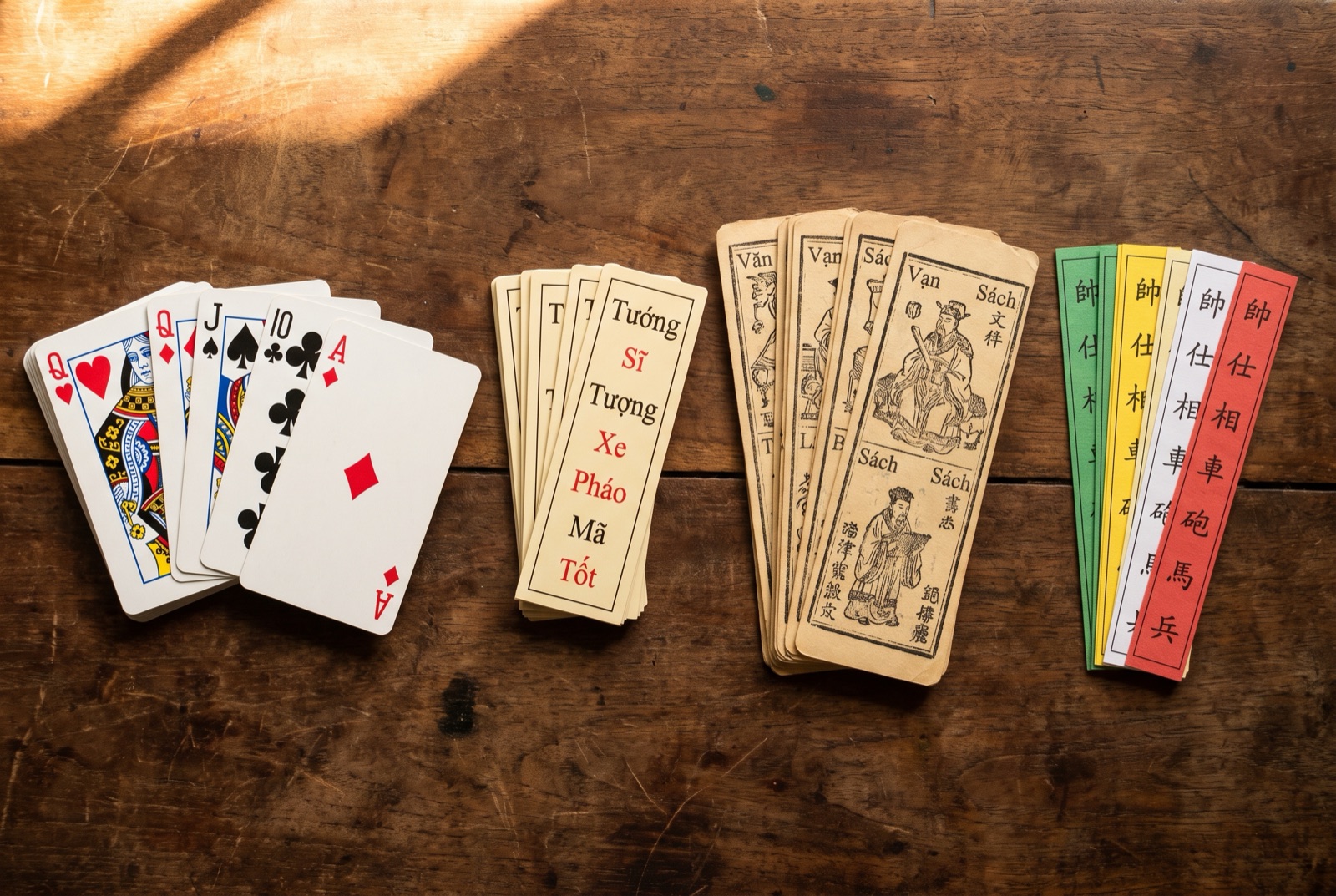
If you have watched a Vietnamese family play cards at Tết and had no idea what was happening, this page is the map. Vietnam has a deep card-playing culture — some games borrowed, some entirely its own — and English-language coverage of it is thin, usually a paragraph per game on a travel blog.
Two things trip up English speakers more than anything else, and both are worth settling before you read any individual guide:
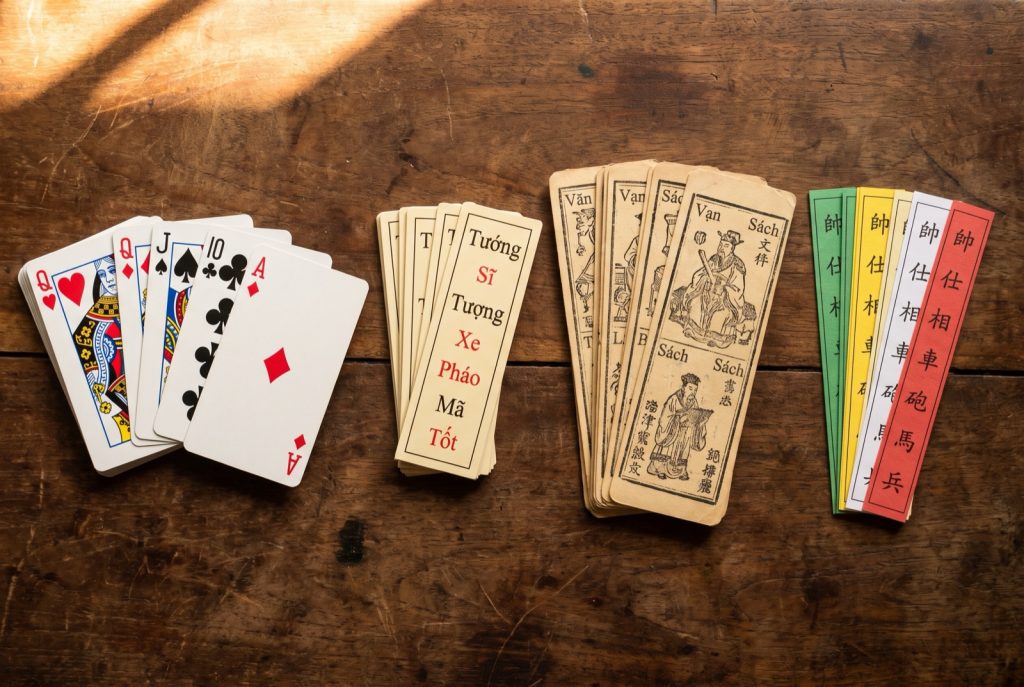
- These games do not all use the same deck. Four of the most culturally important ones are not played with the 52-card pack at all. They use traditional decks of 32, 100, 112 and 120 cards that look nothing like Western playing cards.
- Most of them have several names — a Vietnamese name, sometimes a regional variant name, and often an English or diaspora name that sounds unrelated. Tiến Lên is “Thirteen”. Mậu Binh is “Chinese Poker”. Bài Tấn is the Russian game Durak.
Every Vietnamese card game at a glance
The quick reference. Player counts are the usual range — most of these games are flexible, and house rules vary considerably from table to table.
| Game | Also known as | Deck | Cards each | Players | Family |
|---|---|---|---|---|---|
| Tiến Lên | Thirteen; Viet Cong / VC | Western 52 | 13 | 4 | Shedding |
| Sâm Lốc | Sâm, Xâm | Western 52 | 10 | 2–5 | Shedding |
| Phỏm | Tá Lả | Western 52 | 9 (first player 10) | 2–4 | Melding |
| Mậu Binh | Binh Xập Xám; Chinese Poker | Western 52 | 13 | 4 | Showdown |
| Liêng | Cào Liêng | Western 52 | 3 | 2–6 | Showdown |
| Bài Cào | Ba Cây | Western 52 (sometimes 36) | 3 | 2+ | Showdown |
| Xì Tố | Vietnamese stud poker | Reduced 32 | Varies | 2+ | Showdown |
| Xì Dách | Vietnamese blackjack | Western 52 | Varies | 2+ | Showdown |
| Cát Tê | Cắt tê, cạc tê, “bài 6 lá” | Western 52 | 6 | 2+ | Trick-taking |
| Bài Tấn | Durak | Western 52 | — | 2–4 | Attack / defend |
| Tam Cúc | 三菊 | Own 32-card deck | — | 2–4 | Trick-taking |
| Tổ Tôm | — | Own 120-card deck | — | 5 | Melding |
| Chắn | Bài chắn | 100 of the tổ tôm deck | 19 (dealer 20) | 4 | Melding |
| Tứ Sắc | “Four colours” | Own 112-card deck | — | — | Melding |
The four decks that are not a deck of cards
This is the part that surprises people. A Vietnamese card cabinet may contain four completely different things.
The Western 52-card pack (bài tây)
Most modern Vietnamese card games use the same pack you already own — Tiến Lên, Sâm Lốc, Phỏm, Mậu Binh, Liêng, Bài Cào and Cát Tê all deal from it. Bài tây means, literally, “Western cards”.
The Tam Cúc deck — 32 cards
Tam Cúc uses its own small deck of 32 narrow cards printed with the pieces from cờ tướng, Chinese chess: tướng (general), sĩ (advisor), tượng (elephant), xe (chariot), pháo (cannon), mã (horse) and tốt (soldier), in red and black. There are no suits and no numbers in the Western sense — the ranking is the chess hierarchy.
The Tổ Tôm deck — 120 cards
Tổ Tôm is played with a deck of 120 long, narrow cards printed with Chinese characters and small woodblock figures, in three suits: Văn, Vạn and Sách. It has a reputation as the hardest traditional Vietnamese card game, and the terminology alone takes a few sessions to absorb. It also has a genuine curiosity attached to it: the figures on the cards are drawn in Japanese dress, which is not what most players expect on a Vietnamese deck.
The Chắn deck — 100 cards from the tổ tôm pack
Chắn is not a separate deck so much as a reduced one. It is played with the tổ tôm cards, with certain cards removed, leaving 100. Chắn is the more approachable of the pair — fewer cards, tighter rules and faster rounds — which is why far more people play it than play full tổ tôm. The usual format is chắn bí tứ: four players, dealt 19 cards each, with the dealer taking a twentieth.
The Tứ Sắc deck — 112 cards in four colours
Tứ Sắc means “four colours”, and that is exactly what the deck is: 112 small, very narrow paper cards printed with cờ tướng characters and divided into green, yellow, white and red. It belongs to central and southern Vietnam, and it rewards memory and careful hand-building more than luck.
The four families of Vietnamese card game
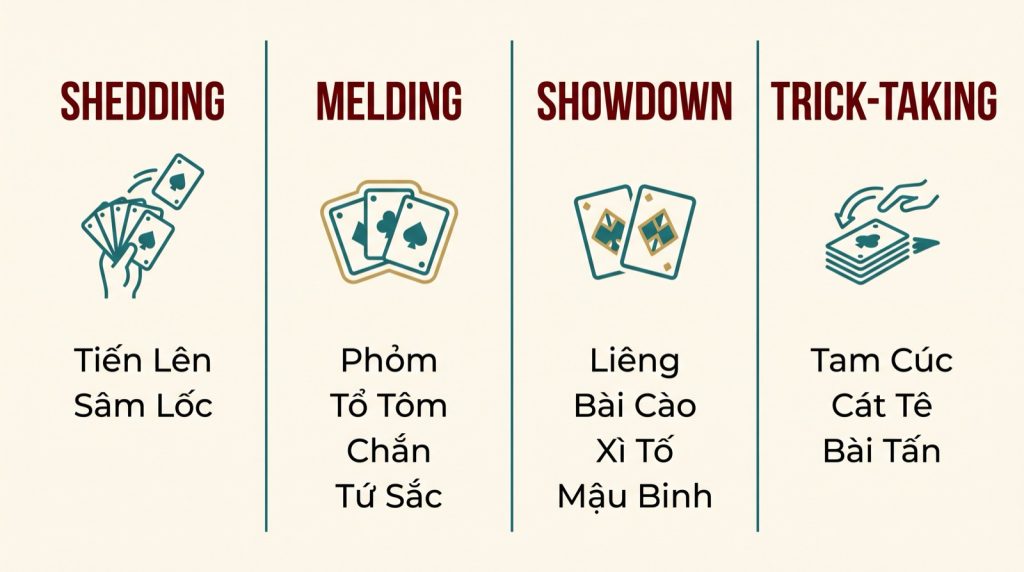
Grouping the games by what you are actually trying to do is more useful than grouping them by region, because it tells you which ones will feel familiar once you have learned one.
Shedding games — get rid of your hand first
Tiến Lên is the one to learn first, and the one most likely to be on the table. Four players, thirteen cards each, and the whole 52-card deck is dealt out; the winner is whoever empties their hand first. It is called Thirteen in English, and Viet Cong or VC in Vietnamese-American circles — a different game in practice, because the American form uses noticeably different rules. There are also two Vietnamese regional rulesets: the southern game (Tiến Lên Miền Nam) is the common one, while the northern game requires runs and sets to be the same suit or colour, which changes how you build a hand from the first deal. Our full Tien Len rules guide covers the combinations, the bomb rules and the variant conflicts in detail.
Sâm Lốc is Tiến Lên’s quicker cousin, popular in the north. Same deck, same objective, but only ten cards each and two to five players, so rounds finish fast and the swings are sharper.
Melding games — build valid sets
Phỏm (also called Tá Lả) is Vietnam’s rummy. You draw and discard to build valid melds, and you want to finish holding as little unmelded deadwood as possible. Unlike Tiến Lên you are not racing to empty your hand — you are managing what is left in it.
Tổ Tôm, Chắn and Tứ Sắc are melding games too, but on their own traditional decks. All three revolve around assembling valid combinations and declaring a completed hand. Tổ Tôm and Chắn share the same cards and the same core idea; Tứ Sắc runs on colour-matching across its four-colour pack.
Showdown games — best hand wins
These are the fast gambling games, and they are the ones most associated with money changing hands at Tết.
Liêng deals three cards and compares hands; two to six players. Bài Cào (also ba cây, “three cards”) also deals three, but it is simpler still — you total the cards and the higher score wins. Bài Cào is worth being plain about: it involves no decisions at all once the cards are dealt, so it is pure chance. Mậu Binh, known internationally as Chinese Poker, is the most strategic of the group: you get thirteen cards and must split them into three separate hands, each compared against the same opponent’s, using poker rankings. Xì Tố is a Vietnamese stud poker played on a reduced 32-card deck, and Xì Dách is the local relative of blackjack.
Trick-taking and attack–defend games
Tam Cúc is the northern Tết game, played on its 32-card chess deck, traditionally on a mat while the bánh chưng boils. Cát Tê has an unusual objective for a trick-taking game: you do not need to win the most tricks — the winner is whoever takes the last one, and the earlier rounds mostly decide who is still in contention for it. Bài Tấn is the odd one out entirely: it is the Vietnamese version of Durak, the Russian attack-and-defend game — played in Vietnam on an ordinary 52-card deck, with each turn having one player attacking and another defending rather than everyone playing into a common round.
The dice games played alongside them
Two of the games you will see at a Vietnamese Tết table are not card games at all, and they are worth knowing because they usually share the table.
Bầu cua cá cọp is the six-symbol dice game played on a printed mat — gourd, crab, shrimp, fish, rooster and deer — and it is probably the single most recognisable Tết gambling game in Vietnam. Our guide to bầu cua rules and odds works through the payouts and the real probabilities. Xóc đĩa is the other one: a dealer shakes four two-sided discs under a bowl and players bet on how many land red face up. Our xóc đĩa rules and odds guide works through all sixteen possible arrangements and the house edge on each bet, which ranges from 1.5% to 37.5% on the same table.
Which one should you learn first?
If you want to join in at a family gathering, learn Tiến Lên. It is the most widely played, the rules are quick to pick up, and every table has someone who can correct you. If you already know rummy, Phỏm will feel immediately familiar. If you know poker, start with Mậu Binh, where your hand-ranking knowledge transfers directly.
Tổ Tôm is not a good first game and nobody should pretend otherwise — an unfamiliar 120-card deck, Chinese characters, five players and a dense vocabulary is a steep start. Chắn is the sensible way into that family.
House rules come first
One warning that applies to every game on this page: Vietnamese card games are governed by house rules to an unusual degree. Scoring, penalties, whether particular combinations are legal, what happens on the final card — all of it varies by region, by family and sometimes by table. There is no national rulebook for most of these games. Settle the disputed points out loud before the first deal, not in the middle of a hand.
Play responsibly
Many of these games are traditionally played for money, usually small amounts, as part of a social occasion. Treat that as entertainment with a cost attached rather than a way to earn anything — the games with the shortest rules, like bài cào, are also the ones with no skill component whatever. Betting services are for adults aged 18 or over. If gambling has stopped being fun, BeGambleAware and Gambling Therapy both offer free, confidential help.
Our Vietnamese-language guides go into far more depth on the individual games — including tổ tôm, chắn, tam cúc and tứ sắc, which have no full English equivalent anywhere.
Most of these games are rarely found in international online casinos; the card games there are mainly baccarat, blackjack and poker. If you want to play cards for real money, read our casino game guides first, then try 20Bet’s live casino. 18+ only — set a time limit and a budget before you start.
Vietnamese card games — frequently asked questions
What is the most popular Vietnamese card game?
Tiến Lên, known in English as Thirteen. It uses a standard 52-card deck, deals thirteen cards to each of four players, and the winner is the first to play out their whole hand. It is the game most likely to be on the table at a family gathering, and the one most Vietnamese players learn first.
What card games do Vietnamese people play?
The most common are Tiến Lên, Sâm Lốc, Phỏm (Tá Lả), Mậu Binh, Liêng, Bài Cào, Cát Tê, Xì Tố and Xì Dách, all played with Western playing cards (Xì Tố strips the deck to 32). Alongside them are four traditional games played on their own decks: Tam Cúc, Tổ Tôm, Chắn and Tứ Sắc. Bài Tấn, the Vietnamese form of the Russian game Durak, is also widely played.
Do Vietnamese card games use normal playing cards?
Most do, but not all. Tam Cúc uses its own 32-card deck printed with Chinese chess pieces, Tổ Tôm uses a 120-card deck printed with Chinese characters, Chắn uses 100 cards from that same tổ tôm pack, and Tứ Sắc uses a 112-card deck divided into four colours. These four decks look nothing like Western playing cards.
What is the Vietnamese card game called Thirteen?
Thirteen is the English name for Tiến Lên. It is called that because each player is dealt thirteen cards. In Vietnamese-American communities the same game is often called Viet Cong or VC, though the American form uses somewhat different rules from the standard Vietnamese game.
What is Vietnamese Chinese Poker?
That is Mậu Binh, also called Binh Xập Xám. Each player receives thirteen cards and arranges them into three separate poker hands, which are then compared hand-by-hand against every opponent’s. Standard poker hand rankings apply, so the game is easy to pick up if you already play poker.
Why are there Japanese figures on Tổ Tôm cards?
The figures printed on the 120-card tổ tôm deck are drawn in Japanese dress, which surprises most people who encounter the deck for the first time given that the game is Vietnamese and the text on the cards is in Chinese characters. It is one of the better-known curiosities of traditional Vietnamese card playing.
What is the hardest Vietnamese card game to learn?
Tổ Tôm, by common consent. It combines an unfamiliar 120-card deck, text in Chinese characters, five players and a large specialist vocabulary. Chắn, which uses 100 cards from the same deck with simpler rules, is the usual way into that family of games.
Are Vietnamese card games games of chance or skill?
It varies widely. Bài Cào is pure chance — once the three cards are dealt there are no decisions left to make. Tiến Lên, Phỏm, Mậu Binh, Tứ Sắc and Tổ Tôm all reward memory, hand management and judgement, though every one of them still deals random cards. None of them can be beaten reliably, and any claim otherwise is worth ignoring.