


Tu Sac Rules: How to Play Tứ Sắc, the Vietnamese Four-Colour Card Game
October 8, 2026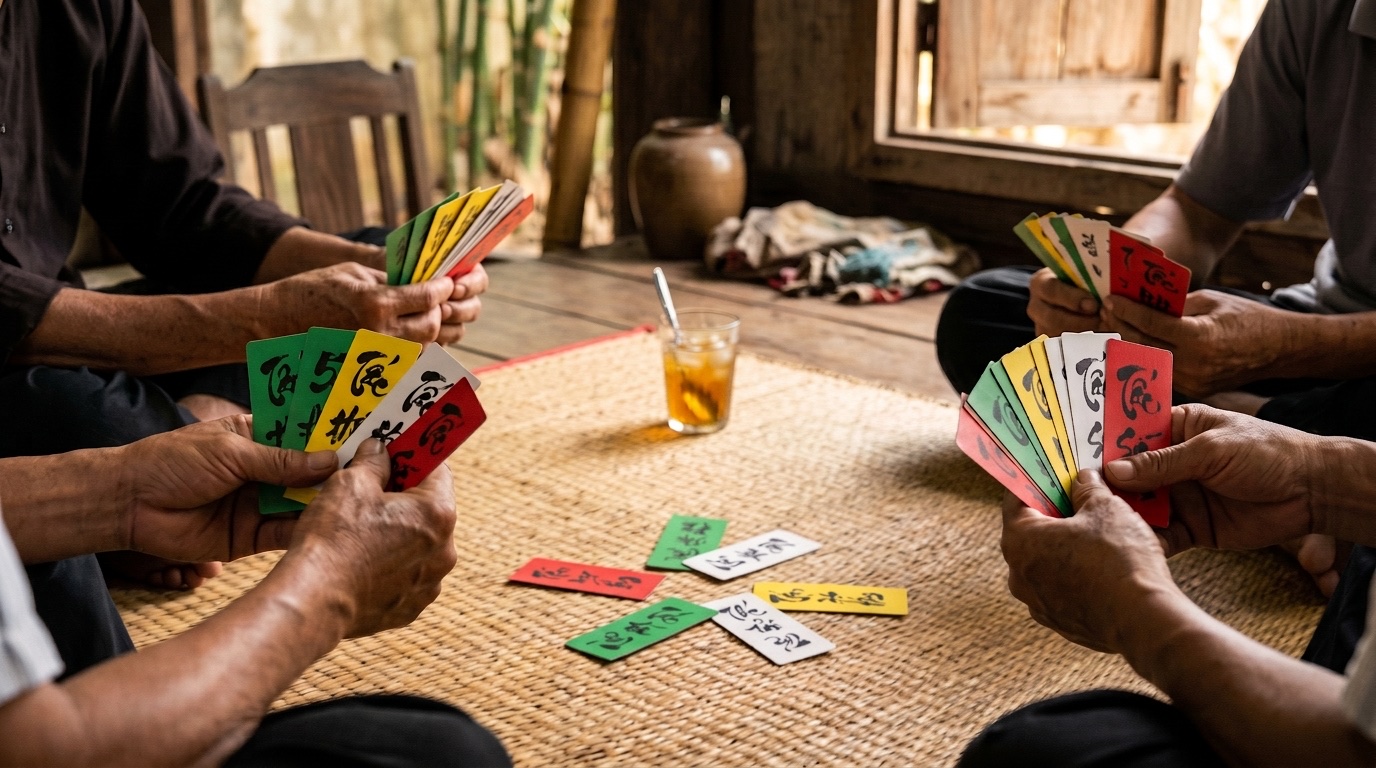
Tứ Sắc — “four colours” — is a traditional card game from central and southern Vietnam. Instead of the Western 52-card pack it uses its own deck of 112 small, narrow cards marked with the pieces of Chinese chess (cờ tướng) in four colours. It is a rummy-style game: you build your hand into valid groups and go out first. It is the Vietnamese form of the Chinese game Sì Sè Pái (四色牌, “four colour cards”), and it rewards memory and careful hand-building more than luck. This guide covers the deck, the deal, the valid groups, how play works and how the score (lệnh) is counted.
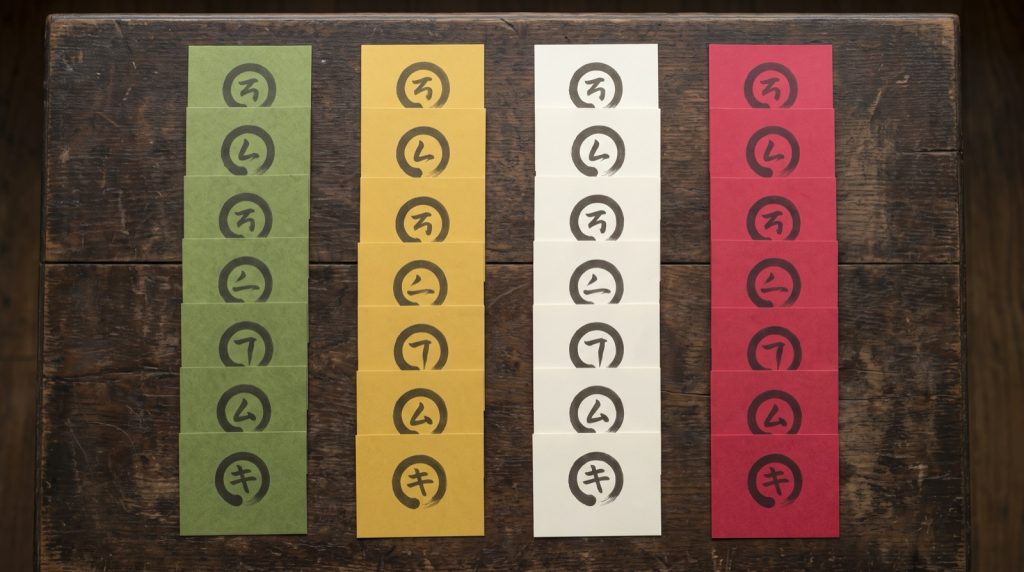
The 112-card Tứ Sắc deck
- Seven pieces, named after the Chinese chess pieces: Tướng (general), Sĩ (advisor), Tượng (elephant), Xe (chariot), Pháo (cannon), Mã (horse) and Tốt or Chốt (soldier).
- Four colours: green (blue in some sets), yellow, white and red.
- Four copies of every piece in every colour.
That makes 7 × 4 × 4 = 112 cards, 28 in each colour and 16 of each piece. The cards carry only the character of the piece — no pictures like Tam Cúc or Tổ Tôm — and colours of the same piece are worth the same.
Players and the deal
- Players: four is standard; two- and three-player versions exist.
- Deal: the dealer takes six cards in the first round, then deals five at a time until everyone has 20 cards. The dealer ends with 21 and plays first by discarding one.
- Stock: the rest of the deck goes face down in the middle as the stock (nọc).
A quằn (four identical cards) dealt to you has to be laid face up straight away so the table knows.
Valid groups: chẵn and lẻ
To go out, every card in your hand has to belong to a valid group. There are two families:
- Chẵn (even groups): two to four identical cards of the same colour. Three identical cards held in your hand are a khạp; four are a quằn. Two exceptions: Tướng counts on its own, one to four cards; and Tốt can also make a group of three or four in different colours.
- Lẻ (odd groups): Tướng–Sĩ–Tượng in one colour, or Xe–Pháo–Mã in one colour.
Cards that fit no group are rác (rubbish). You cannot go out while you hold any.
How play works
- The dealer discards one card to start.
- Each player in turn may take (ăn) the card just discarded if it completes a valid group with cards in hand. Even groups take priority over odd groups.
- If nobody takes it, the next player draws from the stock.
- After taking or drawing, the player discards a card they cannot use. Groups made from taken cards are laid face up in front of the player.
- Play goes on until someone has no rubbish left and completes the hand — that is tới, going out — and wins. There is no second or third place.
Scoring: counting lệnh
The player who goes out shows their hand and counts lệnh (points). The common Vietnamese scale:
| Group | Lệnh |
|---|---|
| Pair (đôi) | 0 |
| Each Tướng | 1 |
| Laid-down group of three (Xe–Pháo–Mã, Tướng–Sĩ–Tượng, three of a card, or three Tốt in different colours) | 1 |
| Laid-down group of four | 6 |
| Khạp (three of a card, still in hand) | 3 |
| Quằn (four of a card, still in hand) | 8 |
| Four Tốt in different colours | 2 |
| Bonus for going out | +3 |
The key rule: the final total must be odd — 15 and 21 are the usual marks. An even total means something was counted wrong, and the player can be penalised. Going out on a quằn (tới quan) doubles the score at many tables.
The odd-total rule works as a built-in check that nobody is holding too many or too few cards. Chinese Sì Sè Pái uses the same rule, though Chinese write-ups score some groups differently — four soldiers of different colours, for instance, are often counted as 4 rather than 2. Scoring and the special cases for Tốt and Tướng vary by region and table, so agree them before you play.
Tứ Sắc odds: what a 20-card hand usually holds
With 28 different cards, four copies of each, the deal is easy to count exactly:
| In your 20-card hand | Chance |
|---|---|
| At least one khạp or better (three or four identical cards) | 42.0% |
| At least one quằn (all four copies of a card) | 2.17% (about 1 deal in 46) |
| At least one quằn in the dealer’s 21 cards | 2.68% |
| No Tướng at all | 3.31% |
On average a hand holds 2.86 of the 16 Tướng cards, each worth a point on its own — which is why a Tướng is almost never discarded.
Tips from the table
- Track what has been discarded and taken: with exactly four copies of each card, you can work out what is left in the stock and in other hands.
- Keep flexible combinations, such as a Xe–Pháo–Mã in one colour, and think twice before breaking a group that is nearly complete.
- A lone Tốt is easy for others to use, so the traditional advice is to discard it early rather than late.
- Count your lệnh as you build: going out on an even total is a mistake, not a win.
See the other Vietnamese card games, including Tổ Tôm and Phỏm, the other two melding games.
Can you play Tứ Sắc at an online casino?
No. Tứ Sắc needs its own 112-card deck and is played at home, so it is not in the lobbies of the online casinos we list. The card games they carry are baccarat, blackjack, poker and a handful of Asian three-card games. 22bet’s casino lobby has three versions of Bài Cào from King Midas Games plus live Teen Patti tables, and 20Bet’s live casino lists Three Card Poker and Teen Patti. If you play for real money, set a budget first.
Play responsibly
Tứ Sắc is often played for small stakes at family gatherings. Played for money it is gambling, with a real risk of losing it. Treat it as entertainment, set limits on time and money, and stop when you reach them. For adults 18 and over only.

22bet

20Bet
Tu Sac FAQ
How many cards are in a Tứ Sắc deck?
112: seven Chinese-chess pieces (Tướng, Sĩ, Tượng, Xe, Pháo, Mã, Tốt) in four colours (green, yellow, white, red), with four copies of each — 28 cards per colour.
How many players and cards are there in Tứ Sắc?
Four is standard, with two- and three-player versions. Everyone gets 20 cards; the dealer gets 21 and plays first. The rest is the stock.
What are chẵn and lẻ in Tứ Sắc?
Chẵn are two to four identical cards of the same colour (Tướng can stand alone, and Tốt can group across colours). Lẻ are Tướng–Sĩ–Tượng or Xe–Pháo–Mã in one colour.
What is the difference between khạp and quằn?
A khạp is three identical cards of the same colour held in hand (usually 3 lệnh); a quằn is all four (usually 8 lệnh). About 2% of 20-card hands are dealt a quằn.
Why must the score be odd when you go out?
It is the rule: the total lệnh on going out must be odd, usually 15 or 21. An even total means a counting error, and the player can be penalised. Scoring details vary by table.
Is Tứ Sắc the same as the Chinese four colour cards game?
It is the Vietnamese form of Sì Sè Pái (四色牌). The deck and the odd-total rule are the same, but scoring for some groups, such as four soldiers in different colours, differs between Vietnamese and Chinese descriptions.