Keno Casino Bonuses
Most online keno casinos offer fantastic rewards to entice new players and retain existing patrons. Let’s walk you through the most popular keno bonus offers to look out for when searching for an online casino.
No Deposit Keno Bonus
No-deposit bonuses are credited to your casino account without an initial deposit. Although rare, these offers can increase your bankroll considerably. Hence, they are in huge demand among casino veterans.
Keno Match Bonus
The casino matches your initial deposit up to a specific amount. This is the most common type of casino deposit. Hence, don’t forget to compare a few casino offers before settling for a deal.
Keno Casino Safety
Reputable keno casinos are licensed by reputable global organizations like the UK Gambling Commission, the Malta Gaming Authority, and the Curaçao Gaming Control Board. You must verify the casino licenses before signing up. Regulated casinos must follow the strictest security protocols to protect user data. Hence, they offer strong safety standards online.
The next thing to watch out for when signing up for a new keno casino is the website’s security certificates. These verify that the site actively protects user credentials with 128-bit encryption. Unlicensed websites might have expired certifications. So, you must always verify the casino’s license, permission, and certificates before signing up.
Keno Deposits and Withdrawals
Reputable keno casinos accept all the popular payment methods, like debit and credit cards, bank transfers, mobile wallets, prepaid cards, etc. Find a casino that accepts your preferred payment modes for a good experience. Every online casino has unique payment terms. Don’t forget to familiarize yourselves with the rules before signing up.
Deposits are usually instant, while withdrawal times depend on the casino and the payment method. Some payment modes process payouts quicker than others. You might consider signing up with these transaction methods if you hate waiting for the casino to credit winnings.
Keno Odds, House Edge and RTP
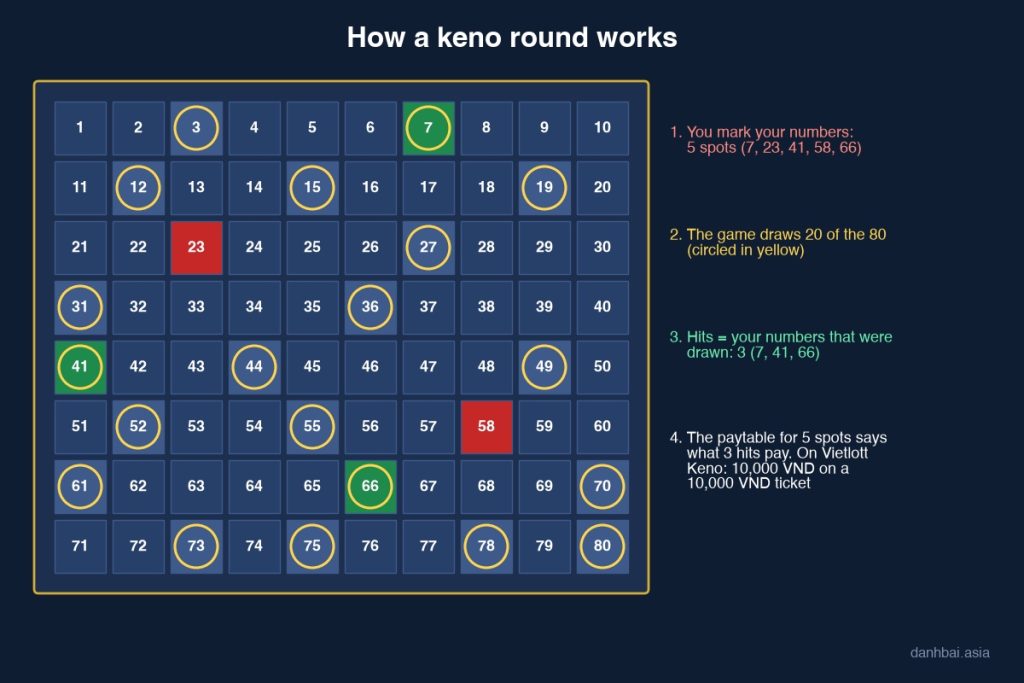
Classic keno draws 20 balls from 80, and you mark 1 to 10 numbers before the draw (some casinos allow up to 15 or 20). Those two numbers fix every probability on this page — they are identical at every casino, in every country, in the live version and the RNG version alike.
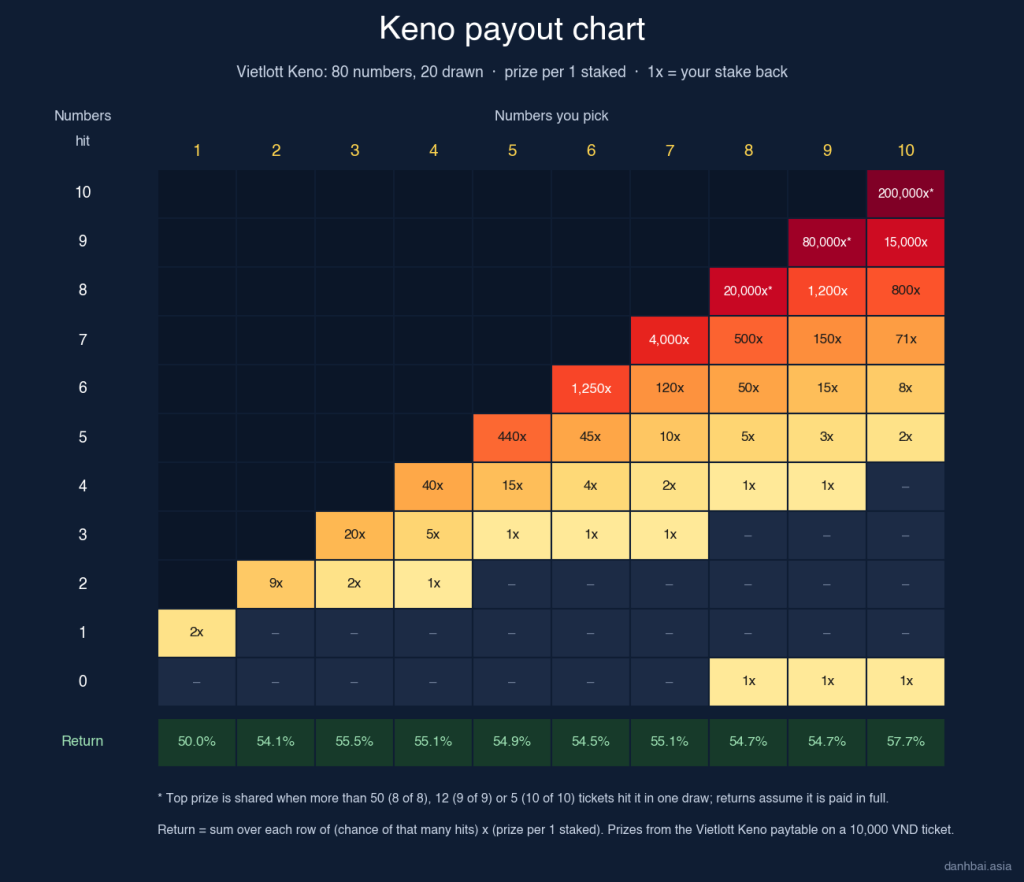
The only thing an operator changes is the paytable, and the paytable is what sets the house edge. That is why keno’s return varies more than any other casino game: the same draw, priced completely differently from one game to the next. Everything below is counted from the 80-ball draw so that you can price the ticket in front of you yourself.
Your Chance of Hitting Every Number You Pick
The last column is the payout a full hit would need for that part of the ticket to break even. Hitting 10 out of 10 happens once in 8.9 million tickets, and a fair game would pay 8,911,710 to 1. Keno tickets top out several orders of magnitude below that — which is precisely where the house edge on a 10-spot ticket comes from, and why the big prize is the worst-value part of the ticket rather than the best.
What Actually Happens When You Play
The full-hit row is the headline; these are the results you will really see. Each column is one ticket size, and the rows are how many of your numbers come out of the drum.
Two numbers is the most likely result on both an 8-spot and a 10-spot ticket. On a 10-spot ticket, 78.80% of draws end with three hits or fewer; on an 8-spot ticket it is 89.77%. Paytables on those ticket sizes commonly pay nothing until four or five hits, so a large share of rounds returns nothing at all — which is what makes keno feel streaky even though every draw is independent.
Marking more numbers does not improve your chances. It moves the whole distribution up and the paytable moves with it, so a 10-spot ticket needs 5 or 6 hits to pay where a 4-spot ticket needs 2 or 3. Whether that trade is worth taking is decided by the paytable, not by the number of spots.
How to Read Any Keno Paytable
The RTP of a keno ticket is one sum: add up (the chance of each hit level) × (what that level pays) across every paying row. The table below gives you the first half of that sum, and the break-even column tells you instantly whether a row is generous or not — it is simply 1 divided by the chance.
A worked example. Five hits on an 8-spot ticket lands once in 54.6 tickets, so a paytable offering 20x for it returns 20 ÷ 54.6 = 37% of what that row is worth. Do the same for every paying row, add the results, and you have the ticket’s RTP — no casino has to tell you, because the draw is public and the paytable is printed on screen.
Doing this once shows where a paytable puts its money. On Vietlott Keno’s 10-spot ticket, the 2,000,000,000 VND prize for 10 of 10 adds just 2.2 points to a 57.7% return, while the rows from 5 to 9 hits add about 10 points each. On its 5-spot ticket the full hit is worth 28.4 of 54.9 points. So read the rows you will actually see: a paytable that looks generous at the top and thin in the middle is the expensive kind.
Where Keno Sits Against Other Games
Because the paytable is the variable, keno does not have one house edge the way roulette does. The crypto-original versions are the cheap end: BC.GAME’s Keno draws 10 balls from 40 rather than 20 from 80, lets you mark 1 to 10 numbers across four risk settings, and states a 2.00% house edge and 98% RTP on its own game panel. Classic 80-ball tickets are usually a great deal dearer, and the break-even table above is how you find out by how much.
Note that the first eight rows are fixed by the rules of those games, while the last one is a decision the operator makes. That is the single most useful thing to know about keno: in every other game on the list you choose a bet, and in keno you choose a paytable. The casino games section covers the rest of the list in the same detail. For the lottery side of the comparison, our Vietlott guide works out what Vietnam’s state lottery games pay back: about 13.7% of stakes in fixed prizes on Mega 6/45, with the rest of a ticket’s value in the jackpot.
Online Keno Conclusion
Keno is a lottery with a casino’s pace: a draw every minute or so, a ticket you can mark in seconds, and a top prize far out of proportion to the stake. The rules take no learning, which is most of its appeal, and the one skill it rewards is reading the paytable before you play — a 10-spot ticket paying 3x for four hits and one paying 6x for the same four hits are the same game at very different prices. Play it as entertainment, set a budget before you start, and treat the jackpot row as decoration rather than a plan.