


Roulette Strategy and Odds: What Betting Systems Really Cost
August 27, 2026
Roulette has one number in it that matters more than any betting pattern you will ever read about. On a single-zero (European) wheel the house keeps 2.7027% of everything staked, on every bet type, without exception. On a double-zero (American) wheel it keeps 5.2632%. Nothing you do with the size or order of your bets changes those two figures.
That is not a disclaimer bolted onto the end of a strategy guide. It is the whole subject. This page prices the three systems people actually use — the Martingale, the D’Alembert and the Fibonacci — by the only thing a system can change: how much money it pushes across the table. One of the three turns out to be far more expensive than its reputation, and one rule change that has nothing to do with betting patterns genuinely halves the edge.
This is informational content about how the arithmetic works. Roulette is paid entertainment that carries a real risk of losing money, not a way to earn it. 18+.
Table of Content
 How to Win Blackjack
 The Online Casino Secrets
 How to Avoid Scams
Every roulette bet has exactly the same house edge
A European wheel has 37 pockets: 1 to 36, plus a single zero. Every bet on the layout pays out as if the zero were not there, and that single missing pocket is where the entire house edge comes from.
Take a straight-up bet on one number. It wins 1 time in 37 and pays 35 to 1. Per unit staked:
(1/37 × 35) − (36/37 × 1) = 35/37 − 36/37 = −1/37 = −2.7027%
Now take red. It wins 18 times in 37 and pays 1 to 1:
(18/37 × 1) − (19/37 × 1) = −1/37 = −2.7027%
The same cancellation happens for every bet on the table, because every payout is set from a 36-pocket wheel while the ball lands on a 37-pocket one:
| Bet | Pockets covered | Pays | True odds | House edge |
|---|---|---|---|---|
| Straight up | 1 | 35 to 1 | 36 to 1 | 2.7027% |
| Split | 2 | 17 to 1 | 17.5 to 1 | 2.7027% |
| Street | 3 | 11 to 1 | 11.33 to 1 | 2.7027% |
| Corner | 4 | 8 to 1 | 8.25 to 1 | 2.7027% |
| Six line | 6 | 5 to 1 | 5.17 to 1 | 2.7027% |
| Column or dozen | 12 | 2 to 1 | 2.08 to 1 | 2.7027% |
| Red/black, odd/even, high/low | 18 | 1 to 1 | 1.06 to 1 | 2.7027% |
So the choice between a straight-up number and red/black is a choice about volatility, not about value. A straight-up bet wins rarely and pays 35 times your stake; red wins nearly half the time and pays once. Both hand the house the same 2.7 cents in every dollar you stake, on average.
Two footnotes for anyone playing a double-zero wheel. There the edge is 2/38 = 5.2632% on almost everything — nearly twice as expensive for identical play — and there is one bet that is worse still: the five-number bet on 0-00-1-2-3 pays 6 to 1 and carries a 7.8947% edge. It is the only bet in roulette that breaks the pattern, and it breaks it in the wrong direction.
Why no betting system can move that number
Here is the piece that turns “no system beats the house” from an assertion into arithmetic.
Every individual spin you bet on has an expected return of −2.7027% of whatever you put on it. Expected values add up regardless of how the bets are related to each other, so for a whole session:
expected loss = 2.7027% × (total amount staked across all spins)
That holds even though a system decides each bet based on what happened last spin. Dependence between bets changes the shape of the outcome — how likely a big win is, how likely ruin is — but it cannot change the sum of the parts.
Which leaves a system exactly one lever: total turnover. A system that bets more after losses stakes more money, so it loses more money. Not at a worse rate. On a bigger bill.
So we measured the bill. Below: 400,000 simulated sessions of 100 even-money spins on a European wheel, base bet 1 unit, each system played by its own rules.
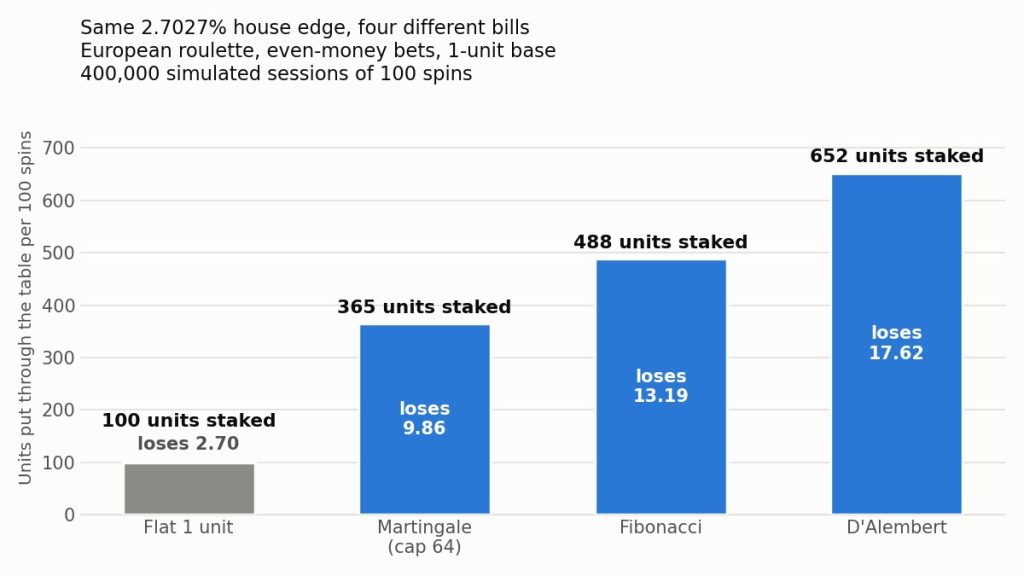
| Approach | Staked per 100 spins | Expected loss | Loss rate |
|---|---|---|---|
| Flat, 1 unit every spin | 100 units | 2.70 | 2.70% |
| Martingale (table max 64) | 365 units | 9.86 | 2.70% |
| Fibonacci | 488 units | 13.19 | 2.70% |
| D’Alembert | 652 units | 17.62 | 2.70% |
The last column is the point. Every system loses at the same rate, because the rate is a property of the wheel. The middle column is what you actually pay, and it is a property of the system.
The Martingale, priced
The Martingale is the one everybody knows: bet one unit on an even-money chance, double after every loss, go back to one unit after every win. Each completed sequence nets exactly one unit, however long it took.
It works until it doesn’t, and the table limit decides when. Suppose your base bet is 1 unit and the table lets you go to 64 — that is a seven-step ladder, 1-2-4-8-16-32-64, and losing all seven costs 127 units.
| Steps allowed | Largest bet | Cost of a full bust | Chance per sequence | Roughly |
|---|---|---|---|---|
| 5 | 16 | 31 units | 3.5707% | 1 in 28 |
| 6 | 32 | 63 units | 1.8336% | 1 in 55 |
| 7 | 64 | 127 units | 0.9416% | 1 in 106 |
| 8 | 128 | 255 units | 0.4835% | 1 in 207 |
| 9 | 256 | 511 units | 0.2483% | 1 in 403 |
| 10 | 512 | 1,023 units | 0.1275% | 1 in 784 |
Read the seven-step row carefully, because it explains why the system feels like it works. 99.06% of sequences end in a win of one unit. You will sit there and grind out unit after unit and it will look like a machine.
Then do the division. A bust arrives on average once every 105 sequences — and it costs 127. You win 105 units, then hand back 127. That is where the missing 2.7% has been going the whole time, and it arrives all at once.
Put the other way round: starting with a 127-unit bankroll, the chance of doubling it to 254 before the first bust is about 30%. Seven in ten Martingale bankrolls do not get there.
The D’Alembert is the expensive one
The D’Alembert raises the bet by one unit after a loss and lowers it by one after a win, never going below one. It is usually sold as the calm alternative to the Martingale, and in one specific sense that is fair: no single sequence can take your whole bankroll, because the bet climbs in steps rather than doubling.
Measured by what it costs, though, it is the most expensive of the three — and unlike the Martingale, it gets worse the longer you play.
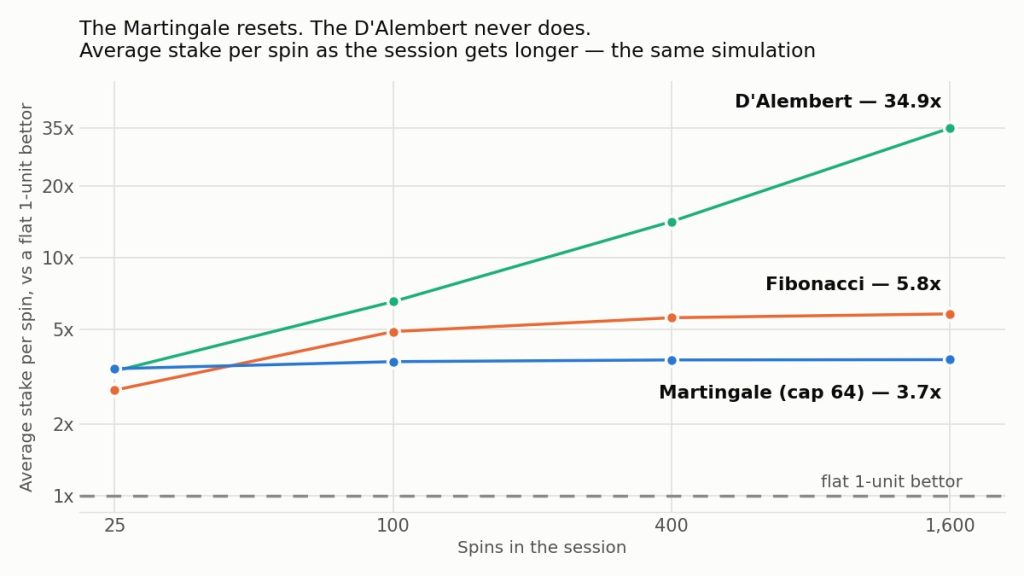
| Spins in the session | Flat | Martingale (cap 64) | Fibonacci | D’Alembert |
|---|---|---|---|---|
| 25 | 1.00× | 3.41× | 2.77× | 3.33× |
| 100 | 1.00× | 3.65× | 4.88× | 6.52× |
| 400 | 1.00× | 3.71× | 5.58× | 14.14× |
| 1,600 | 1.00× | 3.72× | 5.79× | 34.89× |
The table reads average stake per spin, as a multiple of what a flat 1-unit bettor stakes. The Martingale column barely moves: it resets to one unit after every win, so no matter how long you sit there, the average bet stays around 3.7 units. The D’Alembert has no reset. Its bet level is a random walk that only comes down one unit at a time, and it drifts upward roughly with the square root of the number of spins — double the session length and the typical bet grows by about 40%.
At 1,600 spins — a long evening, or a few short ones — the D’Alembert player has pushed nearly ten times as much money across the table as the Martingale player, and has lost close to ten times as much: about 1,500 units of turnover cost versus 160.
To be fair to it: “low risk” and “low cost” are two different things, and the D’Alembert genuinely has the gentler ruin profile of the two. It just is not cheap, and almost every guide that calls it low-risk leaves the reader thinking it is.
The Fibonacci, and the rule most guides get wrong
The Fibonacci sequence is 1, 1, 2, 3, 5, 8, 13, 21, 34, 55 — each number the sum of the two before it. As a betting system you move one step forward along the ladder after a loss.
On a win you step back two places, not back to the start. That detail gets stated wrongly all over the internet, and it matters: stepping back two is what makes the system a slow recovery ladder rather than a Martingale in disguise. You only return to a 1-unit bet when a run of wins walks you off the front of the sequence.
| Step | 1 | 2 | 3 | 4 | 5 | 6 | 7 | 8 | 9 | 10 |
|---|---|---|---|---|---|---|---|---|---|---|
| Bet | 1 | 1 | 2 | 3 | 5 | 8 | 13 | 21 | 34 | 55 |
| Down by here | 1 | 2 | 4 | 7 | 12 | 20 | 33 | 54 | 88 | 143 |
Ten straight losses on the Fibonacci puts you 143 units down, against 1,023 for a ten-step Martingale. The trade is that recovery is partial and slow: a win at step 10 returns 55 units against 143 lost, and moves you back only to step 8.
In turnover terms it lands between the other two and, like the Martingale, it plateaus — around 5.8 times a flat bettor’s stake, whatever the session length.
The one change that actually halves the edge
Everything above says systems cannot move the 2.7027%. One thing can, and it has nothing to do with betting patterns.
French tables — and many European ones — run a rule called la partage or en prison. When the ball lands in the zero, an even-money bet does not simply lose. Under la partage you get half your stake back immediately; under en prison the bet is held for the next spin and returned in full if it wins. Either way, half the damage the zero does to even-money bets is undone, and:
| Wheel and rule | House edge on even-money bets | Cost of 1,000 units staked |
|---|---|---|
| European, la partage or en prison | 1.3514% | 13.51 units |
| European, no such rule | 2.7027% | 27.03 units |
| American (double zero) | 5.2632% | 52.63 units |
That is a genuine four-to-one spread in what the same play costs, decided entirely by which table you sit at before you place a single bet. The rule applies only to the even-money bets, so it does not help a straight-up player. Note that the wheel a game calls “European” is not always the one it deals — check the layout for a 00 pocket and check the table rules for la partage rather than trusting the name of the game.
Streaks, and the belief that costs the most
The single most expensive idea in roulette is that a colour is “due”. The wheel has no memory. After eight blacks the chance of black on the ninth spin is 18/37, exactly what it was on the first.
Long streaks feel impossible because they are rare, not because anything prevents them:
| Same even-money result in a row | Chance |
|---|---|
| 5 | 1 in 37 |
| 6 | 1 in 75 |
| 7 | 1 in 155 |
| 8 | 1 in 319 |
| 10 | 1 in 1,347 |
| 15 | 1 in 49,424 |
| 20 | 1 in 1,813,779 |
| 26 | 1 in 136,823,184 |
The bottom row is not hypothetical. The best-known run in the game’s history, reported at Monte Carlo in 1913, was 26 blacks in a row — a roughly one-in-137-million sequence that happened anyway, and cost a room full of people who kept doubling on red a great deal of money. A one-in-37 event, five in a row, happens several times in an ordinary evening; a seven-step Martingale ladder dies to exactly that.
What all this means at the table
Four things follow from the arithmetic above, and none of them is a way to win:
- Table choice is the only decision that changes the edge. Single zero over double zero halves your cost; la partage on top halves it again.
- Turnover is the only thing a system changes. Less money across the table means a smaller expected loss, which is why flat betting is the cheapest way to play and every progression is more expensive than it looks.
- A high win rate is not an edge. The Martingale wins 99% of its sequences and still loses, because the 1% is 127 times the size of the 99%.
- Decide the stop before you sit down, in money and in time, because no progression contains one. Every system above has a built-in reason to keep going after a loss, which is the opposite of what a limit does.
Roulette is entertainment you pay for, and the arithmetic on this page is what it costs. Play only with money you can afford to lose, set deposit and time limits before you start, and use self-exclusion if it stops being fun. If gambling is causing harm, free confidential help is available at BeGambleAware. 18+ only.

In short
The Martingale, the D’Alembert and the Fibonacci are three ways of deciding how much to bet next. None of them touches the house edge, because the edge is a property of the wheel and applies to every unit staked no matter what order the units go in. What they do change is how many units you stake — and on that measure the D’Alembert, the one usually described as the safe choice, is the most expensive of the three over any session longer than a few dozen spins.
If you want a smaller bill, the levers are the wheel (single zero, not double), the table rule (la partage or en prison on even-money bets), and your own turnover. Everything else is a way of rearranging the same expected loss into a different shape.
For how the games themselves work, see our guides to online roulette and the rest of our casino games. For where online gambling stands legally for players in Vietnam, see gambling in Vietnam.
1

22bet
Casino package up to 39,800,000 VND + 150 free spins
18+ Gamble responsibly GambleAware.org T&C’s apply
2

20Bet
100% up to 3,000,000 VND + 120 free spins
Wagering: 40x the bonus amount
18+ Gamble responsibly GambleAware.org T&C’s apply
3

BC.GAME
Up to 220% deposit rebate across your first 4 deposits
Wagering: Locked bonus - unlocks gradually as you wager
18+ Gamble responsibly GambleAware.org T&C’s apply
FAQ
What is the house edge in roulette?
On a single-zero (European) wheel it is 1/37 = 2.7027% of everything staked, and it is the same on every bet type — straight up, split, corner, dozen or red/black. On a double-zero (American) wheel it is 2/38 = 5.2632%, with one worse bet: the five-number bet on 0-00-1-2-3 carries a 7.8947% edge.
Which roulette bet has the best odds?
For value, none of them: every bet on a European wheel returns the same 2.7027% edge, so a straight-up number and red/black cost exactly the same per unit staked. What differs is volatility — red/black wins 18 times in 37 and pays 1 to 1, a straight-up number wins 1 time in 37 and pays 35 to 1. The one real improvement is a table with la partage or en prison, which halves the edge on even-money bets to 1.3514%.
Does the Martingale strategy work?
It produces a very high win rate and a negative expectation at the same time, which is what makes it convincing. On a seven-step ladder (1 up to 64), 99.06% of sequences end in a one-unit win, but the remaining 0.94% costs 127 units. That works out to roughly one bust every 105 sequences, so you win about 105 units and then give back 127. The table limit is what stops it, and there is no ladder long enough to remove that.
Is the D’Alembert safer than the Martingale?
It is gentler in one sense and more expensive in another. No single sequence can wipe out a bankroll, because the bet moves up one unit at a time instead of doubling. But it never resets, so its stake drifts upward through the session: over 1,600 spins it averages about 34.9 times a flat bettor’s stake against the Martingale’s 3.7, and expected loss follows turnover. Over a long session it costs considerably more.
How does the Fibonacci betting system actually work?
You bet along the sequence 1, 1, 2, 3, 5, 8, 13, 21, 34, 55, moving one step forward after a loss and back two steps after a win. The back-two rule is the part most guides state incorrectly as “start again” — you only return to a 1-unit bet when wins walk you off the front of the ladder. Ten straight losses leaves you 143 units down, compared with 1,023 for a ten-step Martingale.
Can any betting system beat the house edge?
No, and the reason is arithmetic rather than opinion. Expected loss equals the house edge multiplied by the total amount staked, and that holds however you choose your bets — including when each bet depends on the last result. A system can only change how much you stake, not the rate at which it is taxed. Staking more after losses means losing more money, at the same 2.7027%.
What are la partage and en prison?
They are table rules for even-money bets when the ball lands in the zero. Under la partage you immediately get half your stake back; under en prison the bet is held for one more spin and returned in full if it wins. Either rule cuts the even-money house edge from 2.7027% to 1.3514% — the only change discussed on this page that actually moves the number. It does not apply to straight-up or other inside bets.
If red has come up eight times in a row, is black due?
No. The wheel has no memory, so the chance of black on the next spin is 18/37 regardless of what came before. Long streaks are rare but not prevented: five in a row happens about 1 spin sequence in 37, ten in a row 1 in 1,347, and the 26 blacks reported at Monte Carlo in 1913 sit at about 1 in 137 million — and still occurred.
Is European or American roulette better to play?
European, by a factor of two. The extra 00 pocket on an American wheel raises the edge from 2.7027% to 5.2632%, so identical play costs about twice as much: 1,000 units of turnover loses roughly 27 units on a single-zero wheel and roughly 53 on a double-zero one. Check the layout for a 00 pocket rather than relying on what the game is called.