


What Are Poker Ranges, and How Do They Work?
July 26, 2026
Every poker player must know about the poker ranges by position before they start playing. These ranges are sets of hands that either you or another player hold in a specific situation. This guide shows how ranges are written (66+, AJs+), how big common preflop ranges are in combos, how to read a range chart, and what a 3-bet is and which hands it usually represents.
Table of Content
Inside the Mind of a Pro: Understanding Ranges in Poker

In a game of poker, there is a preflop range as well as a postflop range. They can vary widely depending on the cards that are in play at the moment. Knowing your opponent’s range as well as your own can inform your decisions during a round, though it does not guarantee the result.
You always start a round of poker by building up from the opponent’s range preflop. The ranges are very wide before the community cards appear. Five reference ranges, from tightest to widest, with their exact size (a hand with no s or o, such as AK, means both the suited and offsuit versions):
- 2.6% (34 combos): QQ+, AK
- 4.7% (62 combos): TT+, AQ+
- 10.1% (134 combos): 44+, AJ+, KQ, KJs
- 19.8% (262 combos): 22+, A2s+, K9s+, Q9s+, J9s+, T9s, A9o+, KJo+, QJo
- 32.7% (434 combos): 22+, A2s+, K5s+, Q7s+, J7s+, T7s+, 97s+, 86s+, 76s, 65s, A7o+, K9o+, Q9o+, J9o+, T9o
Players can raise from the start, which indicates that they have a good hand. In this situation, you continue to clarify that range according to their actions. When the flop, turn, and river appear on the table, more information becomes available.
Before the discovery of the poker range charts, players were guessing the opponent’s range of hands. A range chart can be kept as a study reference while you review poker hands. The guessing part is still there, but it is way better when you use a poker range chart.
Decoding the Matrix: Unraveling the Enigma of Poker Ranges
You will determine the poker hand ranges using a 13×13 matrix chart that has 169 starting-hand types. A 52-card deck makes 1,326 possible two-card holdings; those collapse into 169 types once you group them as pairs, suited and off-suited. Remembering them is hard, but not impossible. You can even review hand ranges and use a chart on the side.
There are four formats that represent the poker range. On the chart, all possible pocket pairs appear diagonally across the matrix. The suited hands are above that diagonal, which appears with the letter “s”. Below the diagonal hands, you will find the off-suited hand combinations with the letter “o”. When you use software to determine the player’s range, it provides you with certain percentages. You can see them in the percentage form, which shows all possible poker opening ranges.
Then there are the combo range counts. They show how many options a player has to create a combination. Keep in mind that your hole cards impact these combos. A pocket pair can feature only six combos. For instance, below, you can see the combos of pocket 7s:
- 7d 7h
- 7s 7c
- 7d 7s
- 7h 7s
- 7d 7c
- 7h 7c
And finally, we have the range strands. They are a string of text that shows all the hands that you choose on the chart.
 How To Win Blackjack
 Popular Casino Games
 Roulette Strategies
Why Should You Learn Poker Ranges?
Understanding the range of hands in poker is crucial, and every player should be aware of it. Every professional player sharpens up their skills in determining the range in poker. There are many variables in a game of poker. So, guessing a poker range hand is a higher level of thinking. It requires a lot of game and memory practice to increase your poker knowledge. There are several reasons why you should study the poker ranges chart. Below, we will reveal some of them so you know about their major benefits.
1
Hand Reading
You can start playing with more confidence when you have a solid idea of the opponent's range. Knowing that will give you a clear idea of the cards that they hold. From there on, you can use that range in your favor and make the best move.
2
Bluff Detection
If you are good at reading your opponent's calling ranges, then you can easily spot a bluff. But this requires knowing the other player's characteristics and style of play. Also, you must have a lot of poker practice in order to master this "sixth sense".
3
Post-Flop Play
The preflop range can change drastically when the community cards appear on the table. Connecting the dots on how they affect each of the players' ranges will get you some useful information. As the turn and river appear, you will have a much clearer idea about the situation.
4
Better Tournament Result
At poker tournaments, you will come across all kinds of bad and good players. Constantly waiting for a big hand isn't an option at these events. Understanding the poker range of each of the players is a crucial strategy that you must follow.

20Bet
100% up to 3,000,000 VND + 120 free spins
Wagering: 40x the bonus amount
How to Apply Poker Ranges in Your Decision Making
The poker ranges apply everywhere, regardless of whether you are playing poker at land-based or live casinos. To increase your decision-making skills with them, you will first need some practice. That way, you will memorize the poker range chart more effectively. However, playing poker online gives you a chance to use the software. Or, you can even determine a range manually with a printed chart. It all starts by setting a preflop range strand on your opponent’s hand. Here, you look at the player’s actions and style of play, as there is very little information that you can use.
Ranges are measured as a share of the 1,326 possible two-card starting hands. A tight range, of the kind usually opened from early position, is roughly 9 to 15% of hands; a wide range, of the kind opened from the button or defended from the big blind, can be half of all hands. The two tables below show one of each.
A Tight Preflop Raising Range (about 9%)
In the following table, you’ll find the range of hands that players commonly choose to raise before the flop, accounting for approximately 9% of all possible combinations:
| 9% | ||
|---|---|---|
66+ |
AJs+ |
KQs |
AJo+ |
KQo |
Here, the range of hands with a higher percentage of preflop raises, around 50% of all possible combinations are presented:
| 50% | ||
|---|---|---|
22+ |
A2s+ |
K2s+ |
Q7s+ |
J7s+ |
T7s+ |
96s+ |
86s+ |
75s+ |
64s+ |
53s+ |
43s |
A2o+ |
K5o+ |
Q8o+ |
J8o+ |
T8o+ |
98o |
87o |
76o |
65o |
Reading a Range Chart
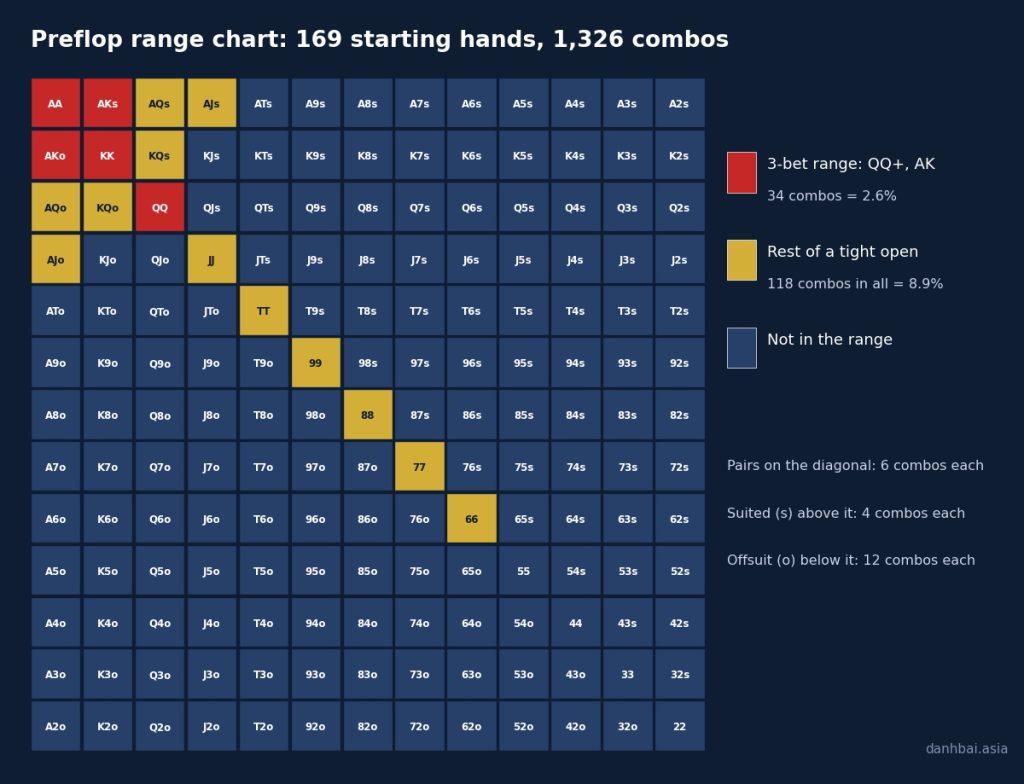
A range chart lays out all 169 types of starting hand on a 13×13 grid: pairs on the diagonal, suited hands above it and offsuit hands below it. Each type stands for a different number of actual card combinations — 6 for a pair, 4 for a suited hand, 12 for an offsuit hand — which is why ranges are measured in combos out of 1,326, not in cells. The shorthand is simple: 66+ means every pair from sixes up to aces, AJs+ means AJ, AQ and AK suited, and AJo+ the same hands offsuit. The red and gold cells in the chart are the tight raising range from the first table above: 118 combos, 8.9% of all starting hands.
What Is a 3-Bet in Poker?
A 3-bet is the third bet in a betting sequence — in practice, a re-raise of a raise. Before the flop the big blind counts as the first bet, so the first player to raise makes the 2-bet (the open raise) and the next player to re-raise makes the 3-bet. A re-raise of a 3-bet is a 4-bet, and so on. After the flop there are no blinds in the count: the first bet is the 1-bet, a raise is the 2-bet and a re-raise is the 3-bet.
| Action (blinds 1,000/2,000 VND) | Amount | Name |
|---|---|---|
| Big blind posted | 2,000 VND | 1st bet |
| Player A raises | 6,000 VND | 2-bet (open raise) |
| Player B re-raises | 18,000 VND | 3-bet |
| Player A re-raises again | 45,000 VND | 4-bet |
| Player B moves all in | whole stack | 5-bet |
A common sizing is around three times the open raise when you will act after the raiser on later streets, and nearer four times when you will act first. Players 3-bet for two reasons: for value, with hands that are ahead of the opener’s range, and as a bluff, often with hands such as A5 suited that hold an Ace and so make AA and AK less likely for the opponent.
3-bet ranges are small. QQ+ and AK — the red cells in the chart — are 34 combos, 2.6% of all starting hands; widening to JJ+, AQ suited and AK is 44 combos, 3.3%. Against a raise from late position, which comes from a wider range, players 3-bet wider too. Facing a 3-bet, the opener has three options: fold, call, or 4-bet.
Advanced Strategies for Poker Ranges

Playing online casino games such as poker can involve using an advanced strategy. Below, we will reveal some poker range strategies that you can employ.
Think and Play Faster
This strategy requires a lot of practice in determining a hand range. When you achieve that, you can start playing faster, especially with your strong hands. This can build a larger pot in the hands you do win, though no poker outcome is ever guaranteed.
Attack the Weaker Players
Combining the player’s hand range with their characteristics and style of play is crucial. Following this strategy means dealing with these players early in the game. Figure out their ranges to make more informed decisions against them.
The Bluffing Strategy
The name speaks for itself. Following this strategy combines discovering the opponent’s ranges with bluffing. But it requires very good bluffing skills that you can use to your advantage. You will need to get inside the opponent’s head to make this strategy work.

Conclusion: Understanding Poker Ranges
Understanding a hand range is an important poker skill, but it does not guarantee winning — results still depend on the cards and variance. It helps you determine the player’s hands as well as upcoming moves in the game. There is a wider range of possible combinations at the beginning.
But, when the community cards land on the table, everything clears out. If you want to become a better poker player, then learning the hand ranges is necessary. You can do that either with the use of software or by studying a chart manually. Although this is an option at online casinos, in real-life play it is much more demanding. It requires a lot of practice and determination to play poker like a pro.
Studying ranges alongside the terms of any bonuses or promotions can help you understand these games better. Remember that poker carries real risk, the house always takes its cut (the rake), and there is no guaranteed profit. You can even use the offers to test your poker skills before deciding whether to play with real money. If you do, play responsibly (18+) — gambling involves risk and the house holds a long-term edge.
FAQ
What Are Poker Hand Ranges?
The hand ranges in poker refer to the set of hands that a player might feature in a specific situation. They are based on the player’s action, gameplay, and the cards in play.
What Is a Poker Chart of Ranges?
A poker chart of ranges is a 13×13 matrix that features 169 starting-hand types (the deck’s 1,326 two-card combinations grouped as pairs, suited and off-suited). On the chart, all possible pocket pairs appear diagonally across the matrix. The suited hands are above that diagonal, while the off-suited ones appear below the diagonal hands.
During a Preflop, What Ranges Should I Play?
You should base your preflop ranges according to your position, opponents, and style of play. Always adjust your ranges based on the game that you play.
How Can I Calculate a Player’s Hand Range?
You will need to know the player’s characteristics, style of play, skills, and position on the table. Additionally, the stakes and game dynamics are also important factors.
What Is a 3-Bet in Poker?
A 3-bet is a re-raise of a raise. Before the flop the big blind counts as the first bet and the open raise as the second, so the first re-raise is the third bet. Example: blinds 1,000/2,000 VND, a player raises to 6,000 (2-bet) and another re-raises to 18,000 — that is the 3-bet. A re-raise of it is a 4-bet.
What Does 66+ or AJs+ Mean in a Poker Range?
The plus sign means “and every better hand of the same kind”. 66+ is every pair from sixes to aces (9 pairs, 54 combos); AJs+ is AJ, AQ and AK of the same suit (12 combos); AJo+ is the same three hands offsuit (36 combos). There are 1,326 starting-hand combos in total, so a range’s size is usually given as a percentage of that.