


How to Win at Baccarat: Every Bet on the Table, Priced
August 29, 2026
Baccarat has three bets. One of them costs you 1.0579% of your stake, one costs 1.2351%, and the third costs 14.36% — more than thirteen times the first. Everything else written about winning at baccarat is a distraction from that.
The interesting part is the 5% commission on the banker bet, which most guides describe as a fee that eats into your winnings. It is the opposite. Without it the banker bet would pay +1.24% to the player, and the casino would be running a game it loses. The commission exists to take that away — and it is priced with real precision: at 5.3863% the banker bet becomes exactly as bad as the player bet. The house charges 5%, which leaves the banker fractionally the better of the two and not by accident.
This page prices every bet on the table, the two commission variants, and what each betting system actually costs, all computed by enumerating the 8-deck shoe rather than quoted. 18+.
Table of Content
The three bets, priced
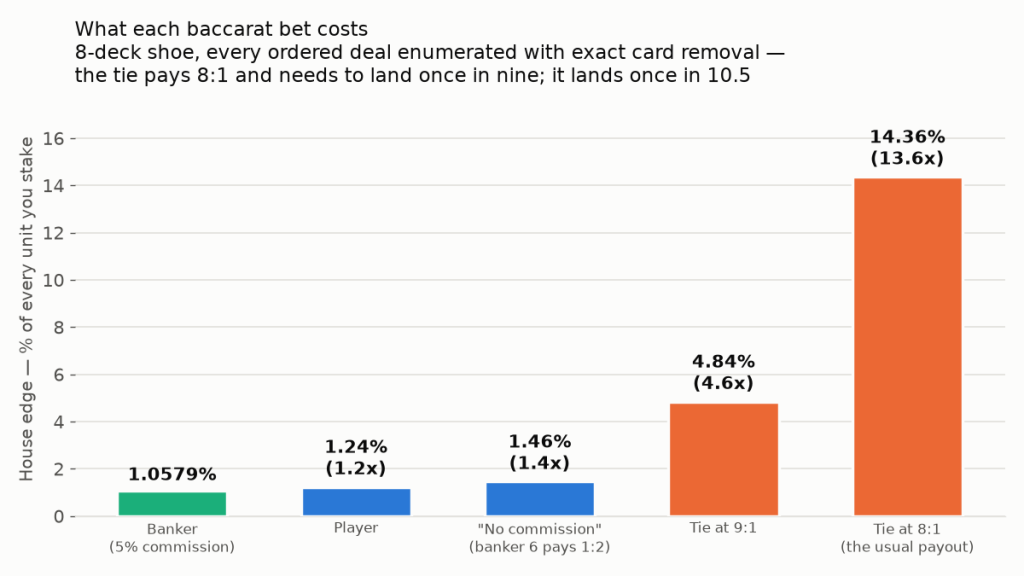
Baccarat is a game you do not play. Both hands are dealt by a fixed rule with no decisions in it; your only choice is which of three bets to make before the cards come out. Here is what each one is worth, computed by enumerating every ordered deal from an 8-deck shoe with exact card removal:
| Bet | Pays | How often it wins | House edge | Against the banker bet |
|---|---|---|---|---|
| Banker | 1:1 less 5% commission | 45.8597% | 1.0579% | — |
| Player | 1:1 | 44.6247% | 1.2351% | 1.17x as expensive |
| Tie | 9:1 | 9.5156% | 4.8440% | 4.6x as expensive |
| Tie | 8:1 (the usual payout) | 9.5156% | 14.3596% | 13.6x as expensive |
The whole of “how to win at baccarat” is in the last column. Bet banker, and never bet the tie. A tie pays 8:1 and comes up 9.52% of the time — it needs to come up once in nine hands to break even, and it comes up once in 10.5. That gap is the 14.36%.
The player bet is not a disaster, just worse: 1.17 times the cost of the banker bet, which over two hundred hands at one unit a hand is the difference between staking 200 units to lose 2.12 of them and staking the same 200 to lose 2.47.
The commission is the game
Strip the commission out and the banker bet wins 45.8597% of hands against the player’s 44.6247%. Paid at even money with no deduction it would return +1.24% to you, every hand, forever. No casino offers that, and the 5% is how they do not.
Two numbers say how carefully it is set:
| Commission on a winning banker bet | What the banker bet is worth |
|---|---|
| 0% — no commission at all | +1.24% to the player |
| 2.6932% | exactly break-even |
| 5% — what tables charge | 1.0579% to the house |
| 5.3863% | exactly as bad as the player bet |
| above that | the banker bet becomes the worse of the two |
So the useful window is narrow. The banker bet stops being free at 2.69% and stops being the better bet at 5.39%, and the industry sits at 5% — inside that window, close to the top of it, and stable across every casino you will meet. If you are ever offered banker at a commission above 5.39%, the correct response is to bet player instead.
“No commission” baccarat costs more, not less
Some tables advertise commission-free baccarat. The catch is a single clause: a winning banker bet that totals 6 pays half instead of even money. That looks like a small carve-out. It is not.
| Table | What changes | House edge |
|---|---|---|
| Standard | 5% commission on every banker win | 1.0579% |
| “No commission” | banker wins with a 6 pay 1:2 | 1.4581% |
The banker wins with exactly six 5.3864% of the time, and giving up half the payout on those hands costs more than the 5% taken from all of them. The commission-free table is 38% more expensive than the one that charges you a commission. It is the clearest example in the casino of a rule that sounds like a concession and is a price rise.
 How To Win Blackjack
 Popular Casino Games
 Roulette Strategies
What every betting system costs
Every system sold for baccarat — Martingale, Paroli, D’Alembert, Fibonacci, and every scorecard pattern — changes one thing and one thing only: how much money you put on the table. None of them changes the odds of the next hand, because the next hand does not know what the last one did.
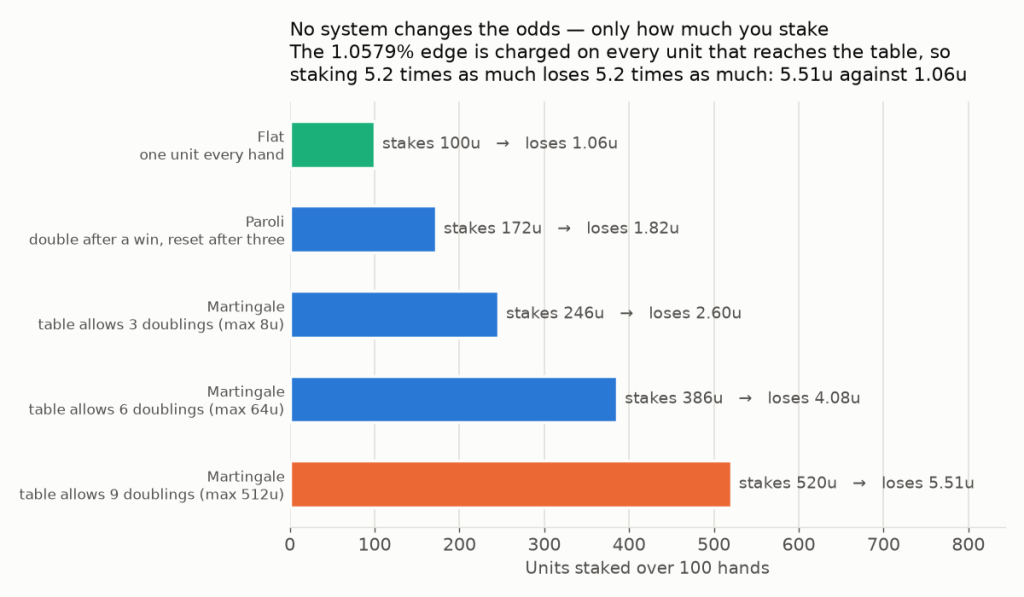
That makes them all easy to price. The house edge is charged on every unit you stake, so a system that stakes twice as much loses twice as much. Here is what each one actually stakes per hand, computed exactly:
| System | Staked per hand | Lost per hand | Against flat betting |
|---|---|---|---|
| Flat — one unit every hand | 1.000 units | 1.058% | 1.00x |
| Paroli — double after a win, reset after three | 1.724 units | 1.824% | 1.72x |
| Martingale, table allows 3 doublings (8 units max) | 2.459 units | 2.602% | 2.46x |
| Martingale, table allows 6 doublings (64 units max) | 3.860 units | 4.083% | 3.86x |
| Martingale, table allows 9 doublings (512 units max) | 5.204 units | 5.505% | 5.20x |
Read the last column as the whole answer to “does this system work”. A Martingale at a table that allows nine doublings stakes 5.20 units a hand and therefore loses 5.20 times what flat betting loses. It does not lose more because it is a bad system in some subtle way; it loses more because it is a machine for increasing your turnover, and turnover is exactly what the edge is charged on.
The Martingale’s appeal is that it wins small amounts very often. It does. It also loses your whole session in the one sequence where the doubling runs into the table maximum, which is why the number in the table rises with how many doublings the table allows. A table that lets you double nine times is not being generous.
The patterns on the scorecard are not there
Baccarat tables hand out scorecards, and players fill them in looking for runs, alternations and “the shoe turning”. What the card records is real; what it predicts is nothing. Every hand is dealt from a shoe deep enough that the previous result moves the next one by a rounding error, and the drawing rules are fixed — there is no decision anywhere for a pattern to influence.
Runs happen because runs are what a near-even coin does. Of the hands that resolve one way or the other, the banker takes 50.68%:
| Run of bankers | How often | Roughly |
|---|---|---|
| 2 in a row | 25.69% | 1 in 3.9 sequences |
| 3 in a row | 13.02% | 1 in 7.7 sequences |
| 4 in a row | 6.60% | 1 in 15.2 sequences |
| 5 in a row | 3.34% | 1 in 29.9 sequences |
| 6 in a row | 1.69% | 1 in 59.0 sequences |
| 7 in a row | 0.86% | 1 in 116.4 sequences |
Six bankers in a row turns up about once every 59 sequences. In a four-hour session you will see several, and each one will look like a pattern. It is what 50.68% does when you watch it long enough.

20Bet
100% up to 3,000,000 VND + 120 free spins
Wagering: 40x the bonus amount
How to Manage Your Money While Playing Baccarat
Getting immersed in the fast-paced gameplay of baccarat can be very easy, especially if you're a newbie to gambling. Hence, it's important to get familiar with money-management techniques to avoid spending more money than you can afford. Keep reading.
Estimated Time Needed:
05:00
Tools Needed:
PC, Smartphone, Tablet
Supplies Needed:
Time, Money
 Step 1
Set a Budget and Stick to It
Before you start a gambling session, it's important to set a gambling budget. This way, you can control how much you spend on gambling and prevent losing any money you can't afford.
 Step 2
Set Win and Loss Limits
Setting win and loss limits is an effective way to control how much money you spend. Once you reach your limit, it's important to take a break and end the session to avoid overspending.
 Step 3
Don't Bet More than You Can Afford to Lose
Setting budgets and limits is an effective technique to control how much you spend on gambling. However, you should know that you will not win every time. This is why it's important to plan ahead and gamble only the amount that you can afford to lose.
 Step 4
Take Breaks
It’s a fact that gambling problems exist, and one of the ways to keep you from losing more than you can afford is to know when to end your gambling session. Having control over your entertainment time is equally important as setting limits and budgets. Not only will it prevent you from crossing them, but it’s also crucial for gamblers who have experienced a series of losing bets.

What actually happens at the table
Neither hand has a decision in it. The player hand draws a third card on a total of 0 to 5 and stands on 6 or 7; the banker hand follows a longer fixed rule that depends on the player’s third card. A natural — an 8 or a 9 in the first two cards — ends the hand immediately. That is the entire game.
| Cards dealt | How often | Why |
|---|---|---|
| 4 cards | 37.89% | a natural, or both hands stand |
| 5 cards | 30.34% | exactly one of the two draws a third card |
| 6 cards | 31.77% | both hands draw a third card |
Ties resolve as pushes on the banker and player bets: the stake comes back and the hand costs nothing. That is why the banker bet’s 1.0579% is smaller than the raw win-rate gap suggests — nearly one hand in ten is refunded.
The three habits that cost the most
Three habits account for most of what a baccarat player loses beyond the 1.0579% the game charges. Each one is priced below.
Betting on the tie
It is the one bet on the table that is genuinely expensive. At the usual 8:1 it costs 14.3596% of your stake against the banker bet’s 1.0579% — 13.6 times as much. The tie lands 9.5156% of the time, about once in 10.5 hands, and 8:1 needs it once in nine. One unit on the tie every hand costs you what 14 units on the banker would.
Chasing the pattern on the scorecard
The card records what happened; it predicts nothing. The banker takes 50.68% of the hands that resolve, so a run of six turns up roughly once in 59 sequences — often enough that you will see several in an evening and read each as a trend. Switching bets to follow a run does not change the odds of the next hand, which is the same 1.0579% it was before the run started.
Taking the “no commission” table
Dropping the 5% sounds like a saving and is a price rise. Those tables pay only half on a winning banker hand totalling 6, which happens 5.3864% of the time, and that costs more than the commission did: 1.4581% against 1.0579%, about 38% more expensive.
So what does “winning” look like
Baccarat is one of the cheapest games in the casino if you make the cheap bet and one of the most expensive if you make the other one. The whole of the advantage available to a player is this:
- Bet banker. 1.0579% against the player bet’s 1.2351%. That is the only decision in the game and it is the same every hand.
- Never bet the tie. At the usual 8:1 it costs 14.36%, 13.6 times the banker bet. Even the generous 9:1 version costs 4.6 times as much.
- Avoid the commission-free table. 1.4581% against 1.0579%.
- Flat-bet. Not because systems are unlucky, but because they raise your turnover and the edge is charged on turnover.
Do all four and the game costs you 1.0579% of everything you stake. Do none of them and it costs several times that. Neither number is positive, and no sequence of bets makes it positive — correct play in baccarat means losing more slowly, not winning.
Set a budget before you sit down, treat it as the price of the evening, and stop when it is gone.
FAQ
Is banker or player the better bet in baccarat?
Banker, and it is not close. The banker bet costs 1.0579% of your stake even after the 5% commission; the player bet costs 1.2351%, about 1.17 times as much. The banker hand wins 45.8597% of hands against the player hand’s 44.6247%, because it acts last and can react to the player’s third card.
Why is there a 5% commission on the banker bet?
Because without it the banker bet would pay +1.24% to the player and the casino would lose money on the game. The commission takes that away and a little more. It would break even at 2.6932%, and at 5.3863% the banker bet becomes exactly as bad as the player bet — so 5% sits just inside the window where banker is still the better of the two.
How much does the tie bet cost?
At the usual 8:1 payout, 14.3596% of your stake — 13.6 times the banker bet. A tie happens 9.5156% of the time, or about once in 10.5 hands, and 8:1 needs it once in nine. Some tables pay 9:1, which brings it down to 4.8440% — still 4.6 times the banker bet.
Is commission-free baccarat a better deal?
No, it is worse. Those tables drop the 5% but pay only half on a winning banker hand totalling 6, which happens 5.3864% of the time. That costs more than the commission did: the house edge goes from 1.0579% to 1.4581%, about 38% more expensive.
Does the Martingale work in baccarat?
No, and it is precisely quantifiable why. The house edge is charged on every unit you stake, and a Martingale exists to increase how much you stake. At a table allowing nine doublings it puts 5.20 units on the table per hand instead of one, so it loses 5.20 times as much: 5.505% of a unit per hand against 1.058%.
Can you count cards in baccarat?
Not usefully. The drawing rules are fixed and neither hand has a decision, so knowing the composition of the remaining shoe changes almost nothing you could act on. The theoretical advantage from a perfect count is far smaller than the edge you would need to overcome, and it appears only at the very end of a shoe that is about to be reshuffled.
Do the patterns on the baccarat scorecard mean anything?
No. Each hand is dealt from a fresh, deep shoe and the drawing rules are fixed, so the previous result cannot influence the next. Runs appear because that is what a near-even proposition does: the banker takes 50.68% of the hands that resolve, so six bankers in a row happens about once in 59 sequences — often enough to see several in an evening.
How many cards are dealt in a hand of baccarat?
Four, five or six. 37.89% of hands end on four — either someone had a natural 8 or 9, or both hands stood. 30.34% use five, when exactly one hand draws a third card, and 31.77% use all six.
What happens to my bet if the hand is a tie?
Banker and player bets push: your stake is returned and the hand costs you nothing. Ties happen 9.5156% of the time, so nearly one hand in ten is refunded — which is a large part of why the banker bet’s house edge is as small as 1.0579%.