


How to Win at Blackjack: What Every Decision Actually Costs
August 29, 2026
The hand every blackjack player agonises over is a hard 16 against the dealer’s 10. Hit it and you probably bust; stand and you probably lose anyway. It comes up in 1.82% of hands, more often than almost any other decision worth arguing about, and players will hold up a table debating it.
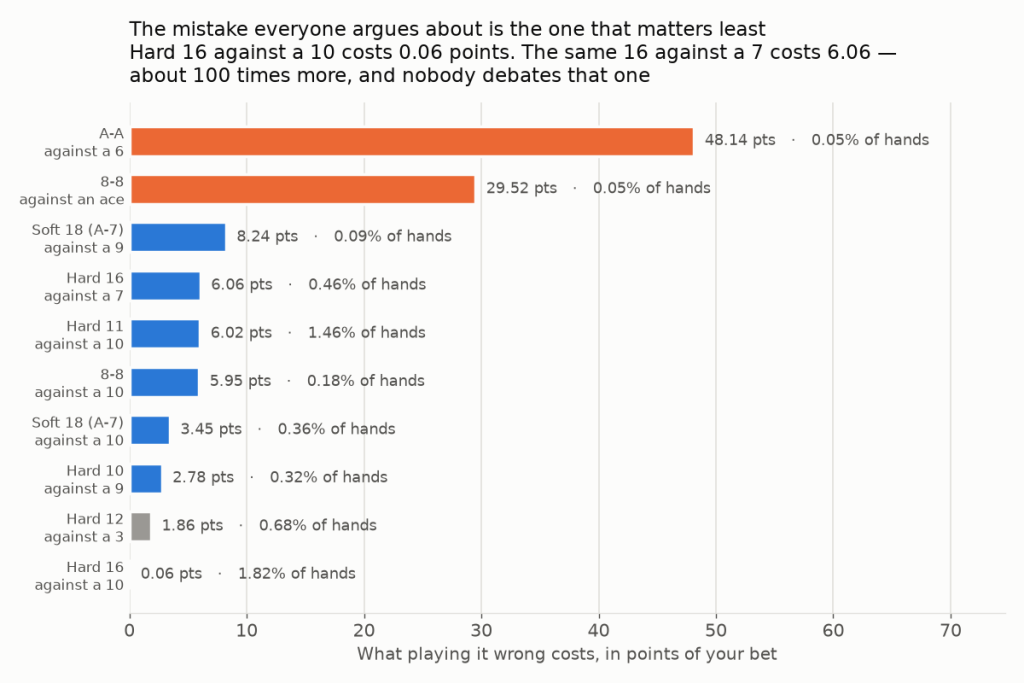
It is worth 0.06 of a point. Getting it wrong costs you about six hundredths of one percent of your bet. The same 16 against a dealer’s 7 — a card nobody worries about — costs 6.06 points if you play it wrong, roughly 100 times more.
That gap is what this page is about. Below is the full basic-strategy chart, the price of each common mistake in the order that actually matters, and what the three usual ways of playing are really worth. Every number was solved from the rules rather than copied, and each one was checked a second way before it went on the page.
Table of Content
 Popular Casino Games
How to Avoid Scams
The Online Casino Secrets
Popular Casino Games
How to Avoid Scams
The Online Casino Secrets
What actually separates a good player from a bad one
Blackjack has a house edge you cannot remove. Played perfectly under common rules — the dealer stands on soft 17, you may double on any two cards, you may double after splitting, blackjack pays 3:2 — the house keeps 0.5096% of every bet in the long run. That is the floor. No system gets under it, and anyone selling you one is selling you something else.
What varies enormously is how far above that floor you play. Here are the three styles you see at every table, priced:
| How you play | House edge | Cost against correct play |
|---|---|---|
| Basic strategy, played correctly | 0.51% | — |
| Correct hitting and standing, but never doubling or splitting | 2.42% | 1.91 points |
| Copy the dealer: draw to 17, stand on 17 or better | 5.67% | 5.17 points |
| Never bust: stand on every hard 12 or higher | 6.08% | 5.57 points |
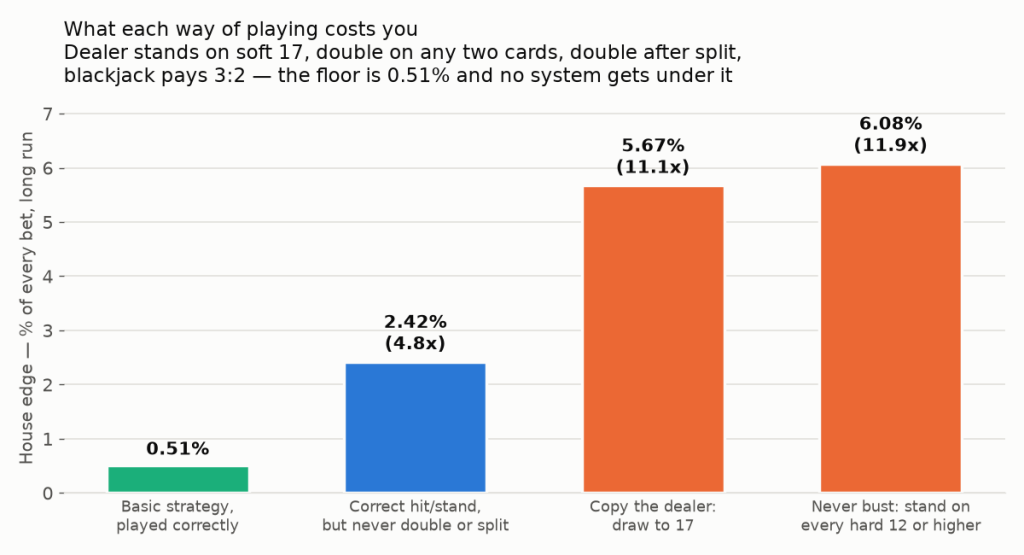
Two things stand out. The first is that giving up doubling and splitting is the single most expensive habit a careful player can have. A player who hits and stands correctly but never doubles and never splits is playing at 2.42% — nearly five times the house edge of correct play — while feeling like they are playing well. Every decision they make is right except the two that put more money on the table when the odds are good.
The second is that refusing to bust is worse than simply copying the dealer. Standing on every hard 12 or more feels safe, and it is the most expensive of the three at 6.08%. Playing by the dealer’s own rules — draw to 17, stand on 17 — is 5.67%. The dealer’s rulebook beats the instinct to protect your hand, because the hands you save from busting are mostly hands that were going to lose anyway.
So the order of priority is settled before you learn a single chart cell: double and split when you should, then worry about the close decisions.

The basic strategy chart
This is solved output, not a chart copied from somewhere. Every cell is the play with the highest expected value given your hand and the dealer’s upcard. It was checked cell by cell against the published multi-deck chart for these rules, and all 260 cells agree.
Read down the left for your hand and across the top for the dealer’s upcard. H = hit, S = stand, D = double if you can (otherwise hit), P = split.
Hard totals — no ace, or an ace that has to count as 1
| Your hand | 2 | 3 | 4 | 5 | 6 | 7 | 8 | 9 | 10 | A |
|---|---|---|---|---|---|---|---|---|---|---|
| 8 | H | H | H | H | H | H | H | H | H | H |
| 9 | H | D | D | D | D | H | H | H | H | H |
| 10 | D | D | D | D | D | D | D | D | H | H |
| 11 | D | D | D | D | D | D | D | D | D | H |
| 12 | H | H | S | S | S | H | H | H | H | H |
| 13 | S | S | S | S | S | H | H | H | H | H |
| 14 | S | S | S | S | S | H | H | H | H | H |
| 15 | S | S | S | S | S | H | H | H | H | H |
| 16 | S | S | S | S | S | H | H | H | H | H |
| 17+ | S | S | S | S | S | S | S | S | S | S |
Anything below 8 is always a hit, and 17 or more is always a stand. The interesting band is 12 to 16, where you stand against a dealer 2 to 6 and hit against 7 or higher. The reason is not your hand — it is that a dealer showing 2 to 6 is the one likely to bust, so you stop drawing and let them.
Soft totals — an ace still counting as 11
| Your hand | 2 | 3 | 4 | 5 | 6 | 7 | 8 | 9 | 10 | A |
|---|---|---|---|---|---|---|---|---|---|---|
| A-2 | H | H | H | H | D | H | H | H | H | H |
| A-3 | H | H | H | D | D | H | H | H | H | H |
| A-4 | H | H | H | D | D | H | H | H | H | H |
| A-5 | H | H | D | D | D | H | H | H | H | H |
| A-6 | H | D | D | D | D | H | H | H | H | H |
| A-7 | S | D | D | D | D | S | S | H | H | H |
| A-8 | S | S | S | S | S | S | S | S | S | S |
| A-9 | S | S | S | S | S | S | S | S | S | S |
A soft hand cannot bust on the next card, which is why the chart is so much more aggressive here. Note A-7, the row that costs players the most money: an 18 that looks perfectly respectable. You stand on it against a 2, 7 or 8, double it against 3 through 6, and hit it against a 9, 10 or ace. Standing on soft 18 against a 9 is the fourth most expensive mistake in the game.
Pairs
| Your pair | 2 | 3 | 4 | 5 | 6 | 7 | 8 | 9 | 10 | A |
|---|---|---|---|---|---|---|---|---|---|---|
| A-A | P | P | P | P | P | P | P | P | P | P |
| 2-2 | P | P | P | P | P | P | H | H | H | H |
| 3-3 | P | P | P | P | P | P | H | H | H | H |
| 4-4 | H | H | H | P | P | H | H | H | H | H |
| 5-5 | D | D | D | D | D | D | D | D | H | H |
| 6-6 | P | P | P | P | P | H | H | H | H | H |
| 7-7 | P | P | P | P | P | P | H | H | H | H |
| 8-8 | P | P | P | P | P | P | P | P | P | P |
| 9-9 | P | P | P | P | P | S | P | P | S | S |
| 10-10 | S | S | S | S | S | S | S | S | S | S |
Two rules here never change and are worth memorising on their own: always split aces and eights, never split tens or fives. Splitting aces turns one poor hand into two hands starting on the best card in the deck. Splitting eights breaks up 16, the worst total you can hold. Splitting tens breaks up 20, which is already close to the best hand at the table, and splitting fives breaks up a 10 that you should be doubling.
These charts assume the common rule set named above. If your table pays 6:5 on blackjack instead of 3:2, no chart will save you — that single rule costs more than twice the entire house edge of the 3:2 game, and the right response is to find another table.
1

HappyLuke
See HappyLuke's current offer
18+ Gamble responsibly GambleAware.org T&C’s apply
2

20Bet
100% up to 3,000,000 VND + 120 free spins
Wagering: 40x the bonus amount
18+ Gamble responsibly GambleAware.org T&C’s apply
3

BC.GAME
Up to 220% deposit rebate across your first 4 deposits
Wagering: Locked bonus - unlocks gradually as you wager
18+ Gamble responsibly GambleAware.org T&C’s apply
Which mistakes actually cost you
Not all errors are equal, and the ones players argue about are mostly not the ones that matter. Each cost below is the expected value you give up, in points of your bet, every time you play that hand wrongly. Beside it is how often that exact hand appears, so you can see which are worth learning first.
| The hand | The mistake | What it costs | How often the hand comes up |
|---|---|---|---|
| A-A against a 6 | hitting instead of splitting | 48.14 points | 0.05% of hands |
| 8-8 against an ace | standing instead of splitting | 29.52 points | 0.05% of hands |
| Soft 18 (A-7) against a 9 | standing instead of hitting | 8.24 points | 0.09% of hands |
| Hard 16 against a 7 | standing instead of hitting | 6.06 points | 0.46% of hands |
| Hard 11 against a 10 | hitting instead of doubling | 6.02 points | 1.46% of hands |
| 8-8 against a 10 | hitting instead of splitting | 5.95 points | 0.18% of hands |
| Soft 18 (A-7) against a 10 | standing instead of hitting | 3.45 points | 0.36% of hands |
| Hard 10 against a 9 | hitting instead of doubling | 2.78 points | 0.32% of hands |
| Hard 12 against a 3 | standing instead of hitting | 1.86 points | 0.68% of hands |
| Hard 16 against a 10 | standing instead of hitting | 0.06 points | 1.82% of hands |
The table rewards reading in both directions. A-A against a 6 tops it at 48.14 points — hitting a pair of aces instead of splitting them is the most expensive single decision on the list, because you are turning the strongest start in the game into a soft 12. It is also rare, at 0.05% of hands, so it costs you seldom but hurts every time.
At the other end, hard 16 against a 10 costs 0.06 points and is the hand everyone deliberates over. Hitting and standing are almost exactly as bad as each other, because the hand is already close to lost whichever way you go. Do whichever you like and spend the attention somewhere it earns something.
Where it earns something is the middle of the table: hard 11 against a 10 turns up in 1.46% of hands and doubling rather than hitting is worth 6.02 points every time, and hard 16 against a 7, where standing feels natural and costs 6.06 points. Those two are common and cheap to learn.
The advice that does not work
Card counting is the strategy most often recommended and the least useful online. In software blackjack the deck is shuffled before every hand, so there is nothing to count — the running count is reset before you can act on it. Live-dealer tables use real cards, but shoes are shuffled frequently and bet-sizing patterns are easy to spot, so it is not a plan for an online bankroll either.
Betting systems have the same problem in a different shape. Doubling your stake after a loss does not change the odds of the next hand; it changes how quickly you reach the table limit or the end of your money. The house edge applies to every bet regardless of what the previous bet did.
What does work is unglamorous: learn the chart, always double and split when it says so, pick a table paying 3:2, and choose stakes small enough that a normal losing run does not end your session. That is the whole edge available to a player, and it takes the house edge from 6.08% at its worst down to 0.5096%.
None of it makes blackjack a way to earn money. Correct play means losing more slowly, not winning. Set a budget before you sit down, treat it as the price of the entertainment, and stop when it is gone.
FAQ
Short answers to the questions this page gets asked, each one priced from the same solver the tables above are built on.
What is the house edge in blackjack?
With the common rule set — dealer stands on soft 17, doubling allowed on any two cards, doubling after a split allowed, blackjack paying 3:2 — perfect basic strategy leaves the house with 0.5096% of every bet in the long run. Rule changes move it: a table paying 6:5 on blackjack instead of 3:2 is far more expensive than any playing mistake on this page.
Should I hit or stand on 16 against a dealer 10?
Hitting is very slightly better, but the difference is only 0.06 of a point — the smallest of any decision on this page. Both plays lose money; the hand is close to lost either way. It is the most argued-over hand in blackjack and very nearly the least important.
What is the most expensive mistake in blackjack?
Of the common ones, failing to split a pair of aces. Hitting A-A against a dealer 6 instead of splitting costs 48.14 points. Standing on 8-8 against an ace instead of splitting costs 29.52. Both come from refusing to put a second bet out when the odds most favour it.
Do I really need to double and split?
Yes, more than you need to get the close decisions right. A player who hits and stands correctly but never doubles or splits faces a house edge of 2.42% against 0.5096% for full basic strategy — nearly five times as much, from just those two decisions.
Is it safer to never bust?
No, it is the most expensive of the common styles. Standing on every hard 12 or higher gives the house 6.08%, worse even than copying the dealer’s own draw-to-17 rule at 5.67%. The hands you save from busting are mostly hands that would have lost anyway.
When should I split and when should I not?
Always split aces and eights, whatever the dealer shows. Never split tens or fives — a 20 is already close to the best hand at the table, and a pair of fives is a 10 you should be doubling. Everything else depends on the dealer’s upcard; the pairs chart above gives each case.
Does card counting work in online blackjack?
Not in software blackjack: the deck is reshuffled before every hand, so there is no running count to keep. Live-dealer tables deal real cards, but shoes are shuffled frequently and the bet-sizing pattern counting requires is easy to spot. It is not a realistic plan for online play.
Do betting systems like the Martingale improve my chances?
No. Raising your stake after a loss does not change the odds of the next hand — each hand is priced the same regardless of what came before. What the system changes is how fast you reach the table limit or the end of your bankroll.
What is a soft hand, and why does the chart play them differently?
A soft hand contains an ace still counting as 11, such as A-6 for a soft 17. It cannot bust on the next card, because the ace drops to 1 if the total would go over 21. That free draw is why the chart hits and doubles soft hands far more readily than hard ones of the same total.