

How to Find Reputable Online Poker Casinos in Vietnam
Playing casino games like poker should be fun. Instead of only listing poker casinos, this section explains the factors that matter most when you choose a poker site.


Poker is a family of card games in which players bet on who holds the best five-card hand. The modern game took shape in the United States in the 19th century, and today's most-played versions are Texas Hold'em and Omaha. The best poker hands, from the top: royal flush, straight flush, four of a kind, full house, flush, straight, three of a kind, two pair, one pair and high card. This comprehensive guide will explain everything you need to know about poker and how the game works. You will learn about the common poker variations and basic poker rules. Besides, we will explain how you can find reputable online poker sites and the different bonuses available to claim for the game. So for all that and more, keep reading.
If you are keen on playing online poker for real money, then you should play at reputable poker sites. This way, you will enjoy a great gambling experience playing the game, and you may even be able to claim fantastic bonuses that will boost your bankroll. We've listed some of reputable online poker casinos that our editors have compared against the same criteria.


Poker is widely played in Vietnam, alongside local card games such as xì tố and liêng.
Online, it comes in two forms: games against other players, and casino versions played against the house, such as Casino Hold’em, Caribbean Stud, Ultimate Texas Hold’em, Pai Gow Poker and video poker. All of them use the hand rankings and rules explained below.
Playing casino games like poker should be fun. Instead of only listing poker casinos, this section explains the factors that matter most when you choose a poker site.
 Step 1
When choosing a poker site, check the casino's license to know if it operates legally. Also, consider how safe the casino site is, as top online gambling platforms use Secure Sockets Layer (SSL) to ensure players' details do not fall into the wrong hands. Similarly, take into account the poker site's reputation and only play at a trustworthy online casino.
 Step 2
There are many different kinds of poker, like Texas Hold'em, Stud Poker, and Omaha Poker. Before registering an account with a poker casino online, ensure that it has a decent selection of poker variants. Also, make sure that the games are from fair and trusted software developers in the iGaming industry, so you can enjoy a good experience.
 Step 3
Reputable online poker casinos offer various bonuses and promotions that can boost players' bankrolls and allow them to place more bets. So before signing up with a poker site, take your time to check its promotions page to see all the current offers for poker. Besides that, consider the terms and conditions of these bonuses to know how feasible it is to win from them.
 Step 4
Before you can play at any poker site, you need to deposit money into your betting account. When you choose reputable poker online casinos, the deposit and withdrawal processes will be easy, as these gambling platforms accept numerous payment methods. In addition, they have reasonable minimum and maximum transaction limits, and most do not charge players fees for processing payments.
Playing online poker is one of the easiest things to do once you know the rules. If you are new, you can practice by playing free poker games. Then you can visit the poker casinos listed here and create an account to play for real money after depositing. Once you log in, you need to find a poker room and buy chips or make a buy-in. Here are the general steps involved in a game of poker when playing the most common variants with community cards.
Choosing between online poker and land-based poker is a matter of personal preference. Both options have benefits that appeal to different types of players. Playing online poker allows you to choose from a wide range of poker games that are not available in traditional casinos. Not only that, you don’t need to spend money on transportation, drinks, and food. All you need is an internet-enabled device to play poker online in Vietnam. Above all, you can play online poker with bonuses.
Conversely, you will incur additional costs if you choose to play traditional poker in a physical casino. It also takes time to travel from your home to a land-based casino. Moreover, there are limited versions of poker and fewer offers in physical casinos. However, you can easily read the faces of your opponents if you wish to bluff. And traditional poker provides a great atmosphere to interact with casino staff and other players in person.

Just like other casino games, online poker comes with basic rules that you will find in different variants of the game. These rules dictate who places the first bet and the number of people at a poker table. Other important things you should know include poker rakes, fees, buy-ins, chips, blinds, and the number of decks. We’ll explain everything in detail to help you understand.
Depending on the casino and poker room selected, there can be 2 to 14 people. Even though some community poker games can be played by up to 22 people, many casinos do not have rooms to accommodate such numbers. When it comes to cards, traditional poker is played with a single deck of 52 cards. However, two decks may be involved to speed up the process of shuffling and dealing the cards.
Most poker games are hosted by a selected dealer. The dealer’s button shows the person who is the current dealer, moving one position after each hand in a clockwise direction. Just before a poker game begins, players have to convert their money into chips that represent the actual amount of money. The main goal of the game is to create the most valuable poker hand, collect chips from your opponents, or win the pot.
The player to the left of the dealer button pays the small blind before the cards are dealt. Then the player to the left of that player is required to pay the big blind. Just so you know, blinds refer to mandatory bets that players are forced to place to get the game started.
When you visit a poker table, you need to pay a fee known as the buy-in for the selected poker game. This amount contributes to the prize pool every player wants to win in poker tournaments. Also, players have to pay a small amount of money known as the rake to the cardroom. This can range from 2.5% to 10% of the size of the pot, up to a specified limit.
 Online Roulette
 Casino Games
 Online Blackjack
There are many betting options in poker. However, these options may vary from one variation to another. If you are considering playing this popular table game, you must understand how these betting options work and when to use them. The availability of these options may sometimes depend on the current situation at a poker table, but we will explain how they work below.
This is one of the betting options available to players in a poker game. If the betting round is not yet open, you will have the option to check. This is equivalent to betting zero, meaning you decline to place a bet but want to keep your cards and be at the table. However, you cannot check if a current bet is on the table.
Betting in poker is just as it sounds—you stake money in the game. This action involves moving poker chips on the table to get the game running, and each poker variation has its own specified minimum and maximum table stakes. The ante bet in some poker variants that gets the game round started is an example of a betting action.
This kind of poker bet can be made if there is already an initial bet on the table. It lets you increase the current table limit by betting above it. For instance, if the current betting amount on a Texas Hold’em game is $5, you can raise the amount to $10. If a player wishes to raise a bet, they usually need to bet twice the table’s current bet.
The call betting option is used in poker to match a bet or a raise. It simply means you are willing to bet the current amount on the table and keep the game going. For example, if a previous player raises the current table stakes in a poker game to $20, you can call to bet the same $20 and continue playing.
Folding is a poker betting option that you can use to discard your hand and forfeit a poker game round. It is used to signify that you are no longer interested in the pot, especially when you think you do not have a good hand compared to your opponents. You lose all the bets you’ve placed so far when you fold.


Pot odds compare what a call costs you against what the pot pays if you win it. Say the pot holds $200 and your opponent bets $100. The pot is now $300 and it costs you $100 to call, so your pot odds are 300:100, or 3:1. Turn that ratio into a percentage — 1 ÷ (1 + 3) — and you get 25%. That 25% is your break-even equity: the share of the time you need to win this hand for calling to be worth exactly as much as folding.
On its own that number decides nothing. Pot odds only become a decision when you put them next to the chance your hand actually improves. The rule is one line: call when your chance of winning is higher than the break-even equity, fold when it is lower. Both halves are below.
An out is a card still in the deck that makes your hand. Hold two hearts on a board with two more hearts and there are 13 − 4 = 9 hearts left, so a flush draw has 9 outs. An open-ended straight draw has 8. After the flop you have seen 5 cards, which leaves 47 unknown; after the turn, 46. That is all the arithmetic the table needs.
| Outs | Typical draw | Hits on the turn | Hits on the river | Hits by the river (both cards) | “Rule of 4” says | Error |
|---|---|---|---|---|---|---|
| 2 | Pocket pair to a set | 4.26% | 4.35% | 8.42% | 8% | −0.42 |
| 4 | Inside (gutshot) straight draw | 8.51% | 8.70% | 16.47% | 16% | −0.47 |
| 5 | One pair to two pair or trips | 10.64% | 10.87% | 20.35% | 20% | −0.35 |
| 6 | Two overcards | 12.77% | 13.04% | 24.14% | 24% | −0.14 |
| 8 | Open-ended straight draw | 17.02% | 17.39% | 31.45% | 32% | +0.55 |
| 9 | Flush draw | 19.15% | 19.57% | 34.97% | 36% | +1.03 |
| 12 | Flush draw + gutshot | 25.53% | 26.09% | 44.96% | 48% | +3.04 |
| 15 | Flush draw + open-ended straight | 31.91% | 32.61% | 54.12% | 60% | +5.88 |
The last two columns are the shortcut most players are taught — the rule of 4 and 2: multiply your outs by 4 with two cards to come, by 2 with one card to come. It is close enough up to about 8 outs and then drifts. On a monster 15-out draw it overstates your chances by almost six percentage points, which is the difference between a call that makes money and one that does not. Note also that the “hits by the river” column only applies if you are certain to see both cards — if there is another bet coming on the turn, the one-card column is the honest number.
Bet sizes come in a handful of standard shapes, and each one carries a fixed break-even number. This table converts them once so you do not have to do it at the table. “Pot” means the pot before your opponent’s bet.
| Opponent bets | Your pot odds | Break-even equity | Outs needed, two cards to come | Outs needed, one card to come |
|---|---|---|---|---|
| 1/4 pot | 5.0 : 1 | 16.67% | 5 | 8 |
| 1/3 pot | 4.0 : 1 | 20.00% | 5 | 10 |
| 1/2 pot | 3.0 : 1 | 25.00% | 7 | 12 |
| 2/3 pot | 2.5 : 1 | 28.57% | 8 | 14 |
| 3/4 pot | 2.33 : 1 | 30.00% | 8 | 14 |
| Pot-sized | 2.0 : 1 | 33.33% | 9 | 16 |
| 1.5x pot | 1.67 : 1 | 37.50% | 10 | 18 |
| 2x pot | 1.5 : 1 | 40.00% | 11 | 19 |
Read the two tables together and the arithmetic of a draw stops being a mystery. A flush draw is 34.97% to get there by the river, so it beats a pot-sized bet’s 33.33% break-even — but only when you are sure to see both cards. Facing that same pot-sized bet on the turn, the flush draw is worth 19.57% against a 33.33% requirement, and calling burns money. The identical hand facing the identical bet is a call one street and a fold the next, which is why the number of cards still to come matters as much as the number of outs.
One caveat on the whole method: these figures assume your draw wins if it lands. A flush draw against a board that could already be paired, or a straight draw where the card that completes you also completes a bigger hand, is worth fewer outs than you counted — experienced players discount them for exactly that reason.
The tables below are exact probabilities for one 52-card deck, not simulations. They answer the three questions that come up most often at a Hold’em table: how often a hand is dealt, what the flop is likely to do for it, and how two hands compare when the money goes in before the flop.
There are 1,326 possible two-card starting hands.
| Starting hand | Chance | About 1 hand in |
|---|---|---|
| Any pocket pair | 5.88% | 17 |
| One particular pair, e.g. pocket aces | 0.45% | 221 |
| Aces or kings | 0.90% | 110.5 |
| Ace-king, any suits | 1.21% | 82.9 |
| Ace-king suited | 0.30% | 331.5 |
| Two cards of the same suit | 23.53% | 4.25 |
| Two cards ten or higher | 14.33% | 7 |
| At least one ace | 14.93% | 6.7 |
After you see your two cards, 50 remain and there are 19,600 possible flops.
| You hold | On the flop | Chance | About 1 in |
|---|---|---|---|
| A pocket pair | Three of a kind (a set) or better | 11.76% | 8.5 |
| A pocket pair | Exactly a set | 10.78% | 9.3 |
| A pocket pair | Full house | 0.73% | 136 |
| A pocket pair | Four of a kind | 0.24% | 408 |
| Two unpaired cards | A pair or better with at least one of them | 32.43% | 3.1 |
| Two unpaired cards | Both of them pair (two pair or better) | 2.11% | 47 |
| Two suited cards | A flush | 0.84% | 119 |
| Two suited cards | A flush draw (two more of your suit) | 10.94% | 9.1 |
| Connectors from 5-4 to J-T | A straight | 1.31% | 76.6 |
If you see all five board cards, a pocket pair becomes a set or better 19.18% of the time (about 1 in 5), and two suited cards finish with a flush in that suit 6.40% of the time (about 1 in 16). That second number is why suited cards are worth less than they look: the suit adds a flush roughly once in every 16 hands that go to the river.
When two players are all-in before the flop, all five board cards are dealt with no more betting, so each hand’s share below is final. Suits matter a little — hands that share a suit with the opponent’s cards lose some flush chances — so the exact cards are given.
| Hand | Against | Wins | Ties | Loses |
|---|---|---|---|---|
| A♠ A♥ | K♠ K♥ | 82.36% | 0.54% | 17.09% |
| A♠ A♥ | K♦ K♣ | 81.06% | 0.38% | 18.55% |
| J♠ J♥ | 9♦ 8♣ | 83.45% | 0.30% | 16.26% |
| J♠ J♥ | 9♦ 8♦ | 79.58% | 0.36% | 20.07% |
| Q♠ Q♥ | A♦ K♣ | 56.99% | 0.34% | 42.66% |
| 7♠ 7♥ | A♦ K♣ | 55.25% | 0.28% | 44.47% |
| 2♠ 2♥ | A♦ K♣ | 52.75% | 0.58% | 46.67% |
| A♦ K♦ | 7♠ 7♥ | 47.71% | 0.34% | 51.95% |
| A♠ K♥ | Q♦ J♣ | 64.10% | 0.39% | 35.51% |
| A♠ K♥ | 9♦ 8♣ | 63.37% | 0.33% | 36.30% |
| A♠ K♥ | A♦ Q♣ | 71.72% | 4.59% | 23.69% |
| K♠ 7♥ | K♦ 2♣ | 49.61% | 28.09% | 22.30% |
Four patterns cover most all-in spots:
To turn a matchup into a decision, use it like the outs table above. A tie splits the pot, so 2-2 against A-K holds 52.75% plus half of 0.58% — 53.04% of the pot on average. Compare that with the break-even equity your pot odds ask for: below 53.04% the call is worth more than the fold, above it less.
Hand rankings matter a lot in poker, and some other games, like video poker, also adopt the same rankings. There are 10 of them. From best to worst: royal flush, straight flush, four of a kind, full house, flush, straight, three of a kind, two pair, one pair and high card. The order is not arbitrary: it is a frequency count, running from the hand that occurs 4 times in 2,598,960 to the one that occurs 1,302,540 times. The ten are explained below, and the table at the end of the section gives the exact odds on each.
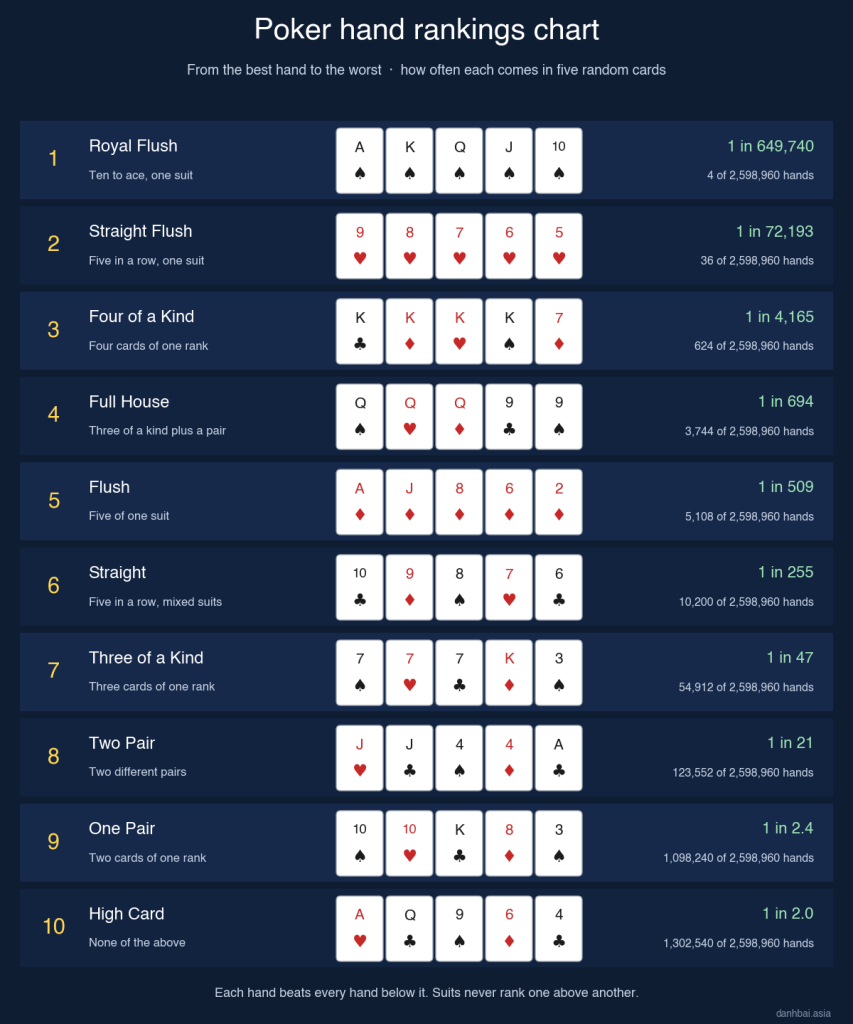
The chart puts the whole order on one page, with an example of each hand and how often it comes in five random cards. A higher hand always beats a lower one, whatever cards are in it: the lowest flush beats the highest straight, and the lowest full house beats the highest flush.
This is the lowest hand ranking in poker: five cards that make none of the hands above. If two players both have high card, their highest cards are compared — an Ace beats a King — and then the next highest, card by card.
| # | Hand | What it is | Distinct five-card hands | Chance in five random cards | Odds against |
|---|---|---|---|---|---|
| 1 | Royal Flush | 10-J-Q-K-A of one suit | 4 | 0.000154% | 649,739 : 1 |
| 2 | Straight Flush | Five in sequence, one suit, not a royal | 36 | 0.00139% | 72,192 : 1 |
| 3 | Four of a Kind | All four cards of one rank | 624 | 0.0240% | 4,164 : 1 |
| 4 | Full House | Three of one rank plus a pair | 3,744 | 0.1441% | 693 : 1 |
| 5 | Flush | Five of one suit, not in sequence | 5,108 | 0.1965% | 508 : 1 |
| 6 | Straight | Five in sequence, mixed suits | 10,200 | 0.3925% | 254 : 1 |
| 7 | Three of a Kind | Three of one rank, two odd cards | 54,912 | 2.1128% | 46 : 1 |
| 8 | Two Pairs | Two pairs plus one odd card | 123,552 | 4.7539% | 20 : 1 |
| 9 | Pair | Two of one rank, three odd cards | 1,098,240 | 42.2569% | 1.37 : 1 |
| 10 | High Card | Anything else | 1,302,540 | 50.1177% | 1.00 : 1 |
| All possible five-card hands | 2,598,960 | 100% | |||
Two things in that table are worth carrying to the table with you. First, the ranking order is not a convention — it is the frequency count read backwards: a flush outranks a straight because there are 5,108 flushes against 10,200 straights, and every position in the list works the same way. Second, 92% of all five-card hands are a single pair or worse. Big hands are rare, which is why most pots are decided by betting rather than by showdown.
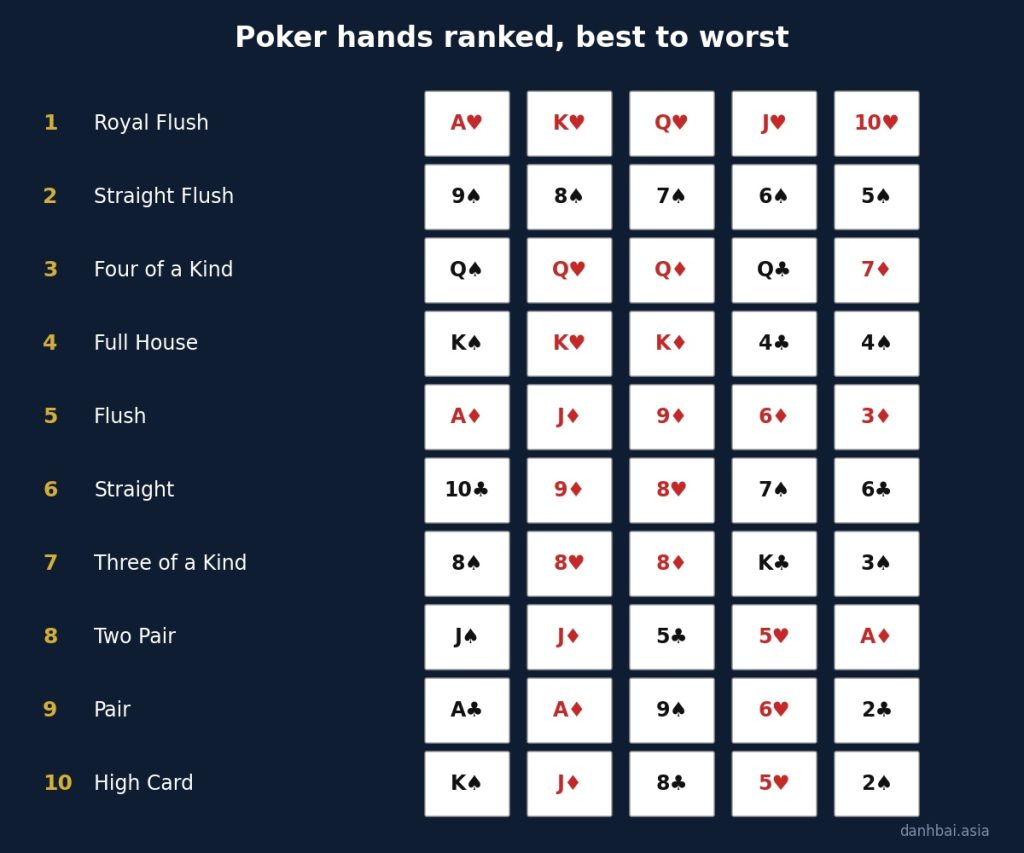
| Hand | Beats | Is beaten by |
|---|---|---|
| Royal Flush | Every other hand | Nothing (two royals split the pot) |
| Straight Flush | Four of a kind and everything below | Royal flush, or a higher straight flush |
| Four of a Kind | Full house and everything below | Straight flush, royal flush |
| Full House | Flush and everything below | Four of a kind and above |
| Flush | Straight and everything below | Full house and above |
| Straight | Three of a kind, two pair, pair, high card | Flush, full house, four of a kind, straight flush, royal flush |
| Three of a Kind | Two pair, pair, high card | Straight and above |
| Two Pair | Pair, high card | Three of a kind and above |
| Pair | High card | Two pair and above |
| High Card | Nothing | Every made hand |
The worst five-card hand is 7-5-4-3-2 in at least two suits: no pair, no straight, no flush, and the lowest high card a hand can have. 6-5-4-3-2 would be lower, but it is a straight; every other hand made of cards below 7 contains a pair. Of the 2,598,960 possible five-card hands, 1,020 are 7-5-4-3-2 without a flush. Any pair beats it, and two players holding it split the pot.
In Texas Hold’em, the worst starting hand is usually said to be 7-2 offsuit: both cards are low, they are not suited, and they are too far apart to make a straight together. Measured against one random hand, all-in before the flop, 3-2 offsuit does even worse, because a 7 beats more of the cards an opponent can hold:
| Starting hand | Wins | Ties | Equity against one random hand |
|---|---|---|---|
| A-A (for comparison) | 84.93% | 0.54% | 85.20% |
| 7-2 offsuit | 31.71% | 5.75% | 34.58% |
| 3-2 offsuit | 29.24% | 6.13% | 32.30% |
Equity counts a tie as half a win. The figures come from every possible board against every possible opponent hand, 2,097,572,400 combinations for each starting hand. You are dealt one particular offsuit hand, such as 7-2 offsuit, 12 times in 1,326, or 0.90% of the time.
When two players hold the same type of hand, the higher-ranked cards win: three Aces beat three Kings, a King-high flush beats a Queen-high flush. If the main cards are equal, the remaining cards — the kickers — are compared one by one, and if all five cards match the pot is split. Suits never break a tie in standard poker.

Contrary to what some people think, playing poker games online is pretty safe. To offer online casino games, reputable poker sites team up with top-tier and well-known software providers. These providers have a team of experts who design their games after carefully considering the industry’s guidelines.
Before an online trustworthy poker game is released, it passes through a series of tests. It is only when the game checks all the required boxes (including safety) that it is made available to play at online casinos. Top developers also work with independent audit laboratories like iTech Labs and eCOGRA to vet their games regularly and ensure there are no loopholes.
So, how do you know if an online poker casino in Vietnam can be trusted? First of all, you must make sure that the operator is licensed to offer real-money poker and other casino games. Trustworthy casinos usually display their regulator and license information in the footer section of the website. The most common regulators you can trust include the UK Gambling Commission (UKGC), the Government of Curacao, and the Malta Gaming Authority (MGA).
Reputable poker casinos also use Hypertext Transfer Protocol Secure (HTTPS) and SSL encryption. These technologies secure connections between your browser and the server on which the casino site is hosted. They also scramble your information to make it impossible for unwanted parties to access it. You can tell if a poker site is safe if the URL begins with “HTTPS” and a padlock.
Safe poker sites offer top-quality poker casino games created by reputable game providers. If the operator partners with renowned game developers like Evolution, NetEnt, and Playtech, the games are usually tested for fairness by an independent lab. These and other established software providers use random number generators (RNGs) in their poker games.
A casino’s choice of payment methods also matters when it comes to safety. The leading poker casinos use payment methods that are accepted in Vietnam and worldwide. You should check the Cashier section for popular electronic wallets (e-wallets), bank cards, cryptos, online banking options, and bank transfers. Also, a safe casino has a clear privacy policy and provides the necessary tools to help you gamble responsibly.
Before you start playing poker online, you should be aware of the benefits and drawbacks of the game. This way, you will know what to expect and can decide if it is the right game for you to play.
There are numerous types of poker to choose from in the lobby of top online poker sites. While these poker games may share the same basic rules, they also have other betting rules you must understand to play them. Over the next few subsections, we will explain how some of the popular online poker types work.
If you want to play online poker successfully, you must avoid certain mistakes. You don’t want to lose a game just because of a petty mistake that can be avoided in the first place. The best poker players know what to do and what not to do.
You should also follow suit to avoid costly mistakes when playing poker online or in land-based casinos. There’s always something you can do before and during an online poker game to play a hand better and avoid bad losses. With that said, the following tips will help you avoid mistakes that some poker players make.
The term bankroll simply refers to the amount of money you have in your gambling account. If you want to play poker without taking unwanted risks, you must have a budget for that. This means setting aside a specific amount of money that you are willing to spend on gambling.
Managing your bankroll entails deciding the size of your bets so that you don’t spend too much money at once. Even if you lose, you will not fall into the temptation of spending more than your budget permits. Moreover, you will be able to monitor your losses and know when to stop.
Failure to keep table and position dynamics in mind can be a problem when playing poker. To have the edge over your opponents, you should keep your eyes on blinds, the early position (under the gun), the middle position, and the late position.
You may not know what your opponents have, but you can guess the strength of their hand depending on the position. When it comes to table dynamics, you should pay close attention to stack sizes and the way other players play. In cash games, for instance, the best players are most likely to go for the maximum buy-in. Those are the ones you should be targeting.
Not knowing how to bluff correctly is a potentially harmful mistake every poker player should avoid. That’s why it’s important to learn how bluffing works in poker. Making a bluff simply means betting or raising when you have a weak hand. The objective is to trick at least one of the other players into folding a better hand.
Bluffing is a skill that requires you to have the right timing skills. You are unlikely to succeed if you bluff frequently. Likewise, bluffing too rarely makes your betting pattern easy to read. The idea here is to balance the frequency of your bluffs and avoid detection by other players.
There are some distinct differences between playing poker for real money and for free. When you choose a reputable poker site, you will be able to play poker for free and for real money. So it is essential that you understand the difference between both to know how they work.


Poker is a game of skill and luck, so players use strategies to decide how to play each hand. But keep in mind that no strategy can guarantee you’ll win every time, so only bet with money you can afford to lose. Nevertheless, here are the best winning strategies in online poker.
It’s easy to get tempted to play every hand in an online poker game. However, you must avoid this temptation and know when to fold. When you get your starting hand, check if it is good enough to continue playing. If not, fold and wait another turn.
There are 1,326 possible two-card starting hands in Texas Hold’em, and the table below shows how often each type of hand actually arrives. The numbers explain why folding is the normal action rather than the disappointing one.
| Starting hand | Combinations out of 1,326 | Chance | Roughly |
|---|---|---|---|
| Any suited hand | 312 | 23.53% | 1 in 4.2 |
| Two Broadway cards (10 to Ace) | 190 | 14.33% | 1 in 7 |
| Any pocket pair | 78 | 5.88% | 1 in 17 |
| AA, KK, QQ or AK — the premium range | 34 | 2.56% | 1 in 39 |
| AK, suited or not | 16 | 1.21% | 1 in 83 |
| One specific pair, such as pocket Aces | 6 | 0.4525% | 1 in 221 |
| AK suited | 4 | 0.3017% | 1 in 332 |
If you only play the premium range you are folding 38 hands out of every 39. And what arrives on the flop is worth knowing too: a pocket pair improves to a set or better 11.76% of the time (about 1 flop in 8.5), a suited hand flops a four-card flush draw 10.94% of the time but a made flush only 0.84% (1 in 119), and two unpaired hole cards pair the board 32.43% of the time. Miss is the normal outcome of a flop.
The maths that pays for itself is small and fixed. Three pieces cover almost every decision: how often each hand ranking occurs, which is why the rankings are ordered the way they are; how many outs your draw has and what that converts to as a percentage; and what break-even equity the bet in front of you demands. The tables in the hand rankings and pot odds sections above give you all three, and none of them changes from hand to hand — learn them once and the arithmetic at the table becomes a lookup rather than a calculation.
The one number that does move is your read on whether the card you need actually wins the pot when it arrives. That part is judgement, not arithmetic, and it is where the difference between players sits.
Always try to mix things up when playing poker online, as this will make you less predictable. Learn how to play aggressively when there is a need for it, as well as how to play tight, loose, passive, and slow. The idea should be to not make it easy for your opponent to read your tells and win.
Reputable online casinos that feature poker games offer incredible bonuses and promotions. These bonuses can boost your bankroll and let you play more real-money poker games. In the next few sections, we’ll talk about the most common bonuses you can get at reputable poker sites.
Also called sign-up bonuses, welcome bonuses are casino offers that are exclusive to new players when they sign up with a poker site. The bonus is a way for poker online casinos to welcome new players and help them get started with their gambling experience. A poker welcome bonus can be offered as free betting chips or a first deposit bonus as a percentage of the deposit.
A reload bonus is a promotional offer available at many top poker sites. Here, a poker casino site will match the amount you deposit by a percentage and offer it as a bonus. For example, you can get a 100% reload bonus of up to $50 at some poker sites to use on your favorite poker games.
These are poker bonuses that you can claim without any deposit requirements. The bonus is offered for free, and it often comes as free betting chips that you can wager on poker games. However, it is worth pointing out that no-deposit poker bonuses are not as common as deposit bonuses.
Some top poker sites have loyalty or VIP programs where players can enjoy special and exclusive perks for their loyalty. For instance, you may earn comp points for every real-money poker game played. These points can be accumulated and exchanged for bonus money. Some poker sites may offer players dedicated account managers, free entries into poker tournaments, invitations to live poker events, and so on.


When playing poker in real-money casinos, you should be able to deposit and withdraw money safely. The leading casinos make this possible by offering secure and fast online casino payment methods. These include e-wallets, credit cards, debit cards, cryptocurrencies, and bank transfers, among others. For instance, you can use PayPal, NETELLER, Bitcoin, Skrill, Visa, or Mastercard for casino payments. Here are the steps you need to follow.

Advancements in mobile technology have made it possible for players to play poker on their smartphones and tablets. Playing poker at mobile casinos offers more comfort. You can play on the go, whether on a bus or moving train, and you will not be restricted to a desktop computer screen. Some mobile poker casinos even have native apps for Android and iOS that poker players can download to get the full mobile gambling experience.
Reputable online casinos in Vietnam will allow you to play live poker games for real money. If this is what you are looking for, you only need to visit the live casino section once you sign up and deposit funds. Playing live poker means being able to interact with dealers and other players in real-time. High-definition cameras capture the action, so you can see everything as it happens without leaving your home.
Depending on the casino, you can choose from a wide selection of live poker games. The top live casinos are powered by well-known providers of live dealer games. Thanks to Evolution and other well-known live casino game developers, you can play live versions of Caribbean Stud Poker, Casino Hold’em Poker, Texas Hold’em Poker, Ultimate Texas Hold’em and Three Card Poker, among others. These games offer an immersive gaming experience and bring you closer to a real-life casino, even when playing on mobile devices.
There are several terminologies you may come across in poker games. And if you want to play poker, you need to be familiar with a few terms. We’ve highlighted some common poker terms and their meanings below.
We’ve discussed everything you should know about online poker in this guide. It is a fun table game to play online, for free or for real money. Remember, online poker has many variants like Texas Hold’em, Omaha Hi/Lo, Five-Card Stud, HORSE, and so on. While these variants have specific rules, the main objective is similar, to form the best poker hand rankings to win.
If you want to have the best time playing poker online, you should choose a top site that has been licensed by a reputable organisation. If you play at our recommended poker sites, you can enjoy better bonuses, and faster withdrawals.
Yes. Reputable poker sites can be trusted because they have a valid license from a well-known governing body. They also partner with reputable software providers to feature poker games.
It depends on the type of bonus. But regardless, you must create an account with a poker site that offers bonuses. If it’s a deposit bonus, you have to make the qualifying deposit to claim it.
A reputable poker site holds a licence from a recognised regulator such as the UKGC, the MGA or the Curaçao Gaming Authority, runs its games from established providers whose RNGs are tested by an independent lab like eCOGRA or iTech Labs, uses HTTPS with SSL encryption, and publishes clear bonus terms and a working payout route. The operators listed at the top of this page all meet those conditions.
Yes. You can play poker for free online at some casino sites. However, note that you can’t win any money playing free poker.
If you play at a legitimate poker site, you won’t fall victim to rigged poker games. This is because top online casinos work with independent audit firms to audit their poker games regularly.
There are 1,326 possible two-card starting hands in Texas Hold’em and 6 of them are pocket Aces, so the chance is 0.4525%, or 1 in 221. Any pocket pair arrives far more often: 78 combinations, 5.88%, or roughly 1 hand in 17.
A flush draw has 9 outs. With both the turn and the river still to come it completes 34.97% of the time; with only the river to come, 19.57%. That second figure is the one that matters when you are facing a bet on the turn, and it is well below the 33.33% a pot-sized bet requires.
From best to worst: royal flush (10-J-Q-K-A of one suit), straight flush, four of a kind, full house, flush, straight, three of a kind, two pair, one pair and high card. The order follows how rare each hand is: there are only 4 royal flushes among the 2,598,960 possible five-card hands, against 1,302,540 high-card hands.
A flush, a full house, four of a kind, a straight flush and a royal flush all beat a straight. A straight beats three of a kind, two pair, one pair and high card. Between two straights, the higher top card wins; 10-J-Q-K-A is the highest straight and A-2-3-4-5 the lowest.
Omaha is a community-card game like Texas Hold’em, but each player is dealt four hole cards instead of two and must use exactly two of them with exactly three of the five board cards to make a hand. It is usually played pot-limit (PLO). In Omaha High/Low the pot is split between the best high hand and the best qualifying low hand of five different cards eight or lower.
With a pocket pair you flop three of a kind or better 11.76% of the time, about 1 in 8.5 (exactly a set: 10.78%). By the river, if you see all five board cards, it is 19.18%, about 1 in 5.
All-in before the flop, aces win 82.36% when the two pairs share suits (A♠A♥ against K♠K♥) and 81.06% when they do not (A♠A♥ against K♦K♣); about 0.4–0.5% of boards are split.
The worst five-card hand is 7-5-4-3-2 in at least two suits, the lowest no-pair hand that is not a straight. In Texas Hold’em the worst starting hand is usually said to be 7-2 offsuit, with 34.58% equity against one random hand; 3-2 offsuit is lower still at 32.30%.