


Pai Gow Poker: Rules, How to Set Your Hand, Odds and House Edge
October 24, 2026
Pai Gow Poker is a casino card game played against the dealer with a 53-card deck: the usual 52 cards plus one joker. You get seven cards and split them into two poker hands — a five-card hand and a two-card hand — and you win only if both of your hands beat the dealer’s. Win one and lose one and the bet is a push, which happens in about 40% of hands. That makes Pai Gow one of the slowest-moving games in the casino: the house edge against a dealer who sets the house way is 2.72%, but your stake changes hands far less often than at blackjack or baccarat.
The game was invented in 1985 at a California card club, adapting the Chinese domino game pai gow to playing cards. Below: the rules, the hand rankings and their two oddities, how to set your hand, the odds of every seven-card hand, and what changes when you play it online.
How Pai Gow Poker works
- Bet. You place one wager before the deal.
- Seven cards each. You and the dealer receive seven cards from a single 53-card deck.
- Set your two hands. Split your cards into a five-card high hand (also called the back or bottom hand) and a two-card low hand (the front, top or “second highest” hand). The five-card hand must rank higher than the two-card hand.
- The dealer sets the house way. The dealer reveals seven cards and splits them by a fixed set of rules, so the dealer makes no choices of their own.
- Compare. Your high hand plays against the dealer’s high hand and your low hand against the dealer’s low hand.
| Your two hands | Result |
|---|---|
| Both beat the dealer’s | You win even money, minus a 5% commission: a 100 bet pays 95 |
| One wins, one loses | Push — your bet is returned |
| Both lose | You lose the bet |
A tie on a hand — the same high hand or the same low hand on both sides — is called a copy, and copies go to the dealer. So a hand where you tie the low hand and win the high hand is a push, and a hand where you tie one and lose the other is a loss. The copy rule, together with the 5% commission, is where the house edge comes from.
In a land casino a player may also take a turn as the banker, playing against the dealer and the other players; online versions leave the bank with the house.
Hand rankings in Pai Gow Poker
The five-card hand uses the normal poker hand rankings, with two differences:
- The joker is semi-wild. It counts as an ace, or as any card that completes a straight, flush, straight flush or royal flush. It cannot make any other pair or set: a joker with two kings and no aces is a pair of kings and an ace, not three kings.
- Five aces is the top hand. Four aces plus the joker beat a royal flush.
- A-2-3-4-5 is the second-highest straight in most casinos and in Betsoft’s online version: it ranks below A-K-Q-J-10 and above K-Q-J-10-9.
The two-card hand can only be a pair or two single cards. The best low hand is a pair of aces (an ace and the joker count); after that pairs rank down to 2-2, then unpaired hands rank by their higher card, then the lower one, so A-K beats A-Q.
The high hand must outrank the low hand. With A-A-9-7-5-4-3 you cannot put the aces in front, because A-A in the two-card hand would beat the A-high hand behind it. A hand set the wrong way is a foul: in a land casino it is a “dead hand” and loses; online, the game will not let you confirm it.
How to set your hand: the house way
Most hands are obvious: put the strongest five-card hand you can behind and the two highest remaining cards in front. The hands that need thought are the ones with two pair, three of a kind, or a straight or flush you could break up. Every casino prints a house way — the rules its dealers follow — and copying it is a sound way to play your own hand, because it is close to optimal: the difference between the house way and a perfect strategy is about 0.2% of your bet. This is a typical Las Vegas house way:
| You hold | The house way |
|---|---|
| No pair | Highest card behind; second and third highest in front |
| One pair | Pair behind; the two highest other cards in front |
| Two pair, both 6s or lower | Keep both pairs behind |
| Two pair: a low pair (2s–6s) with a 7s–Ks pair, or two pairs of 7s–10s | Split them — higher pair behind, lower pair in front — unless you also hold an ace: then keep both pairs behind and put the ace in front |
| Two pair: a 7s–10s pair with a J–K pair, two J–K pairs, or aces with any pair | Always split, higher pair behind |
| Three pair | Highest pair in front |
| Three of a kind | Keep it behind; three aces: one ace in front, the pair of aces behind |
| Straight or flush | Keep it behind, choosing the version that leaves the highest two cards for the front. With one pair as well, play the pair in front if the straight or flush stays behind |
| Full house | Almost always split it: three of a kind behind, the pair in front |
| Four of a kind | 2s–6s: keep together. 7s–10s: split into two pairs unless an ace can go in front. Jacks–aces: always split |
| Five aces | Split: a pair of aces in front, three aces behind (unless you also hold a pair of kings to put in front) |
Three worked hands:
- K♠ 10♦ 8♣ 6♥ 4♠ 3♦ 2♣ (no pair). Behind: K-6-4-3-2. In front: 10-8. Keeping the king behind protects the high hand; 10-8 is the best front the rest allows.
- 9♠ 9♦ 4♣ 4♥ K♠ 7♦ 2♣ (a medium and a low pair, no ace). Split: 9-9-K-7-2 behind, 4-4 in front. A pair in front beats any unpaired dealer front.
- The same pairs with A♠ instead of K♠. Keep the two pair behind (9-9-4-4-2) and put A-7 in front: with an ace available for the front, the house way keeps the pairs together.
Pai Gow Poker odds
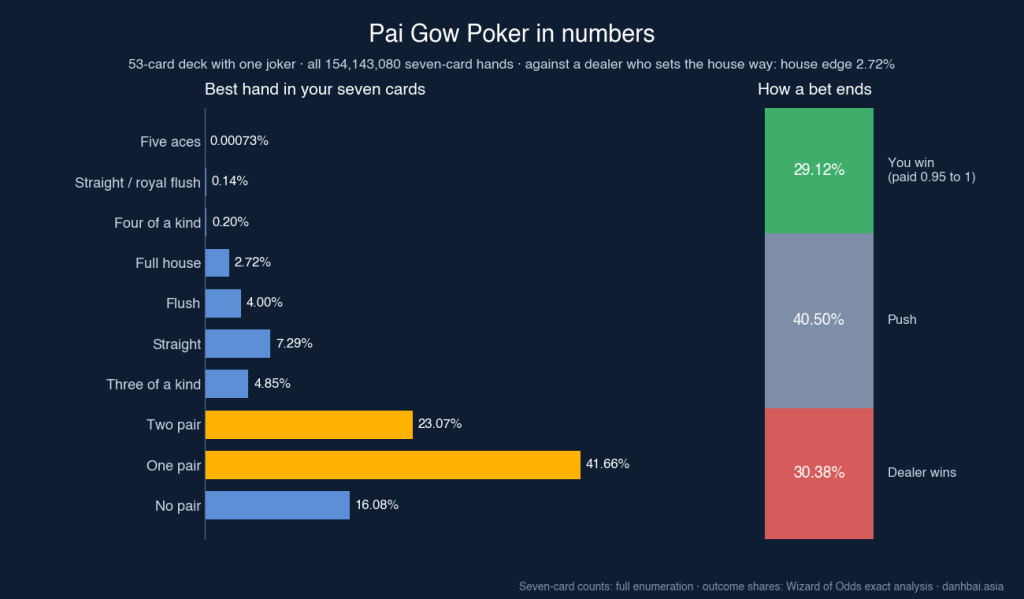
With seven cards from a 53-card deck there are 154,143,080 possible hands. How often each one is the best poker hand you can make, before you split it:
| Best hand in seven cards | Hands | Chance |
|---|---|---|
| Five aces | 1,128 | 0.0007% |
| Straight flush or royal flush | 210,964 | 0.14% |
| Four of a kind | 307,472 | 0.20% |
| Full house | 4,188,528 | 2.72% |
| Flush | 6,172,088 | 4.00% |
| Straight | 11,236,028 | 7.29% |
| Three of a kind | 7,470,676 | 4.85% |
| Two pair | 35,553,816 | 23.07% |
| One pair | 64,221,960 | 41.66% |
| No pair | 24,780,420 | 16.08% |
Two things stand out. A straight is more common than three of a kind here, because seven cards and a joker give many ways to fill one. And almost two hands in three are one pair or two pair — exactly the hands where the choice of what goes in front decides the result.
House edge and pushes
Against a dealer who banks and sets the house way, with you also setting the house way, a bet ends like this:
| Outcome | Pays | Chance |
|---|---|---|
| You win both hands | 0.95 to 1 | 29.12% |
| Push | — | 40.50% |
| The dealer wins | Lose 1 | 30.38% |
That is a house edge of 2.72% of the amount bet. Setting every hand perfectly brings it to 2.51%, so the house way gives up about 0.2%. Because four bets in ten are pushes, the edge per decided hand is higher than the headline number, but the swings are small — Betsoft rates its version low volatility, with an RTP of 97.27%. Our house edge guide compares the edge on other casino games.
In a land casino, banking changes the maths: a player who banks against the table, using the house way, gives up only about 0.25%, because the copies now go to them; the 5% commission is still charged on what the bank wins. Online versions do not offer the bank.
Playing Pai Gow Poker online
Online Pai Gow Poker is an RNG card game rather than a live dealer table. 22bet lists two versions in its casino lobby: Betsoft’s Pai Gow Poker and Rival’s Pai Gow. The Betsoft game follows the rules above:
- 53-card deck with a semi-wild joker; five aces is the top hand and A-2-3-4-5 the second-highest straight.
- 5% commission on winning bets; copies go to the dealer.
- No dead hands: if your split is not allowed, the game asks you to rearrange it.
- No banking and no “dragon” hand, which some land tables offer as an extra seat.
- One bet per round; the demo table runs from 1 to 100 per hand.
Check the game’s rules panel before your first hand: online versions can differ on the wheel straight, the commission and side bets. Play only with money you can afford to lose; the 40% push rate stretches a session, but it does not change the 2.72% edge.

22bet
Pai Gow Poker FAQ
How do you play Pai Gow Poker?
You and the dealer get seven cards from a 53-card deck with one joker. You split yours into a five-card hand and a two-card hand, and the five-card hand must rank higher. Each of your hands is compared with the dealer’s: win both and you are paid even money minus 5%, win one and it is a push, lose both and you lose.
What happens on a tie in Pai Gow Poker?
A tied hand is a “copy” and goes to the dealer. Win one hand and tie the other and the bet pushes; lose one and tie the other and you lose.
What is the joker in Pai Gow Poker?
The joker is semi-wild: it counts as an ace, or as any card that completes a straight, flush, straight flush or royal flush. It cannot make any other pair, so a joker with a pair of eights and no ace is a pair of eights plus an ace.
What is the best hand in Pai Gow Poker?
Five aces — four aces and the joker — which happens 1,128 times in 154,143,080 seven-card hands. In the two-card hand the best possible is a pair of aces.
What is the house edge in Pai Gow Poker?
2.72% against a dealer who banks and sets the house way, when you set your hands the house way too; 2.51% with perfect hand-setting. Betsoft lists the RTP of its online version as 97.27%.
How often do you push in Pai Gow Poker?
About 40.5% of hands. You win 29.12% and the dealer wins 30.38%.
What is the house way in Pai Gow Poker?
The fixed rules the dealer follows to split their seven cards, such as “with one pair, put the pair behind and the two highest other cards in front”. Each casino prints its own; they differ only on a few two-pair and four-of-a-kind hands.
Can you play Pai Gow Poker online?
Yes, as an RNG card game. 22bet carries Betsoft’s Pai Gow Poker and Rival’s Pai Gow; the Betsoft version charges the standard 5% commission and gives copies to the dealer.