


Caribbean Stud Poker: Rules, Payouts, Odds and Strategy
October 19, 2026
Caribbean Stud Poker is five-card stud played against the dealer instead of other players. You and the dealer each get five cards, and one of the dealer’s cards is turned face up. After looking at your hand you make one decision: fold and give up your ante, or raise by putting in twice the ante. There is no drawing and no bluffing, and the dealer only “plays” with a hand of ace-king or better. This guide explains the rules, the pay table, the odds and the house edge, and the simple strategy for when to raise.
How to play Caribbean Stud Poker
- Place the ante. Many tables also offer an optional progressive or bonus side bet at this point.
- The deal. You and the dealer each receive five cards from a single 52-card deck. One of the dealer’s cards is dealt face up; the other four stay hidden.
- Fold or raise. Fold, and you lose the ante. Raise, and you add a bet of exactly twice the ante.
- The dealer reveals. The dealer turns over the other four cards and checks whether the hand qualifies.
- Settlement. The three possible outcomes are below.
| Result | Ante | Raise |
|---|---|---|
| Dealer does not qualify (less than ace-king) | Wins 1 to 1 | Returned (push) |
| Dealer qualifies, your hand is better | Wins 1 to 1 | Wins according to the pay table |
| Dealer qualifies, hands are equal | Returned | Returned |
| Dealer qualifies, the dealer’s hand is better | Loses | Loses |
The dealer qualifies with an ace and a king or any better hand. The lowest qualifying hand is A-K-4-3-2; the highest non-qualifying hand is A-Q-J-10-9. Hands are ranked as in ordinary poker; see our poker hand rankings. The dealer fails to qualify on about 43.7% of deals.
Caribbean Stud payouts
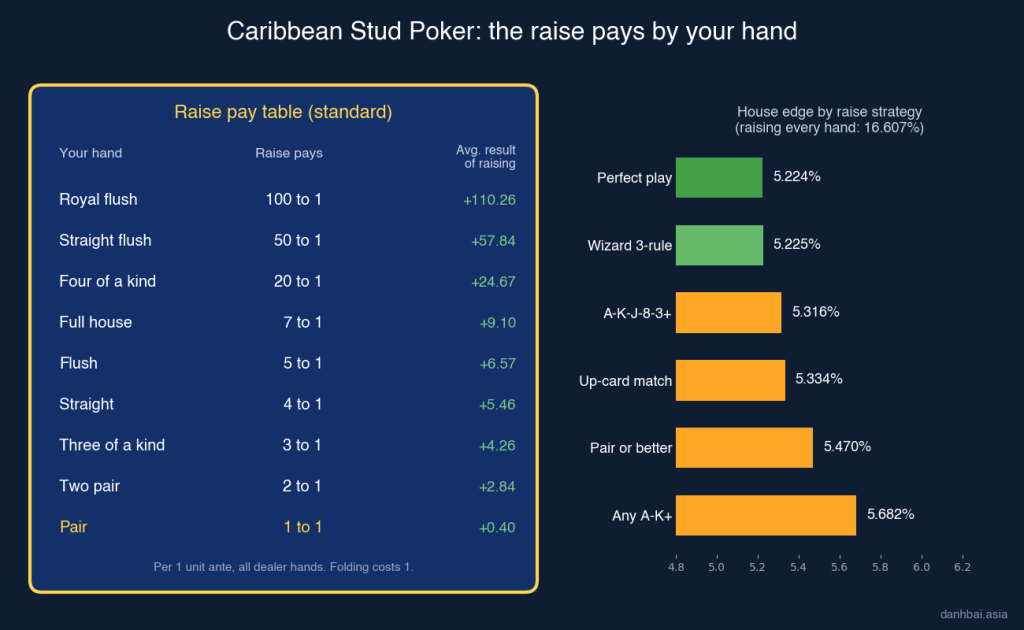
The raise is paid by the strength of your hand, as long as the dealer qualifies and you win. This is the standard pay table used in US casinos; online and live versions can use their own, so check the table on the screen.
| Your hand | Raise pays | Chance of being dealt it |
|---|---|---|
| Royal flush | 100 to 1 | 1 in 649,740 |
| Straight flush | 50 to 1 | 1 in 72,193 |
| Four of a kind | 20 to 1 | 1 in 4,165 |
| Full house | 7 to 1 | 1 in 694 |
| Flush | 5 to 1 | 1 in 509 |
| Straight | 4 to 1 | 1 in 255 |
| Three of a kind | 3 to 1 | 1 in 47 |
| Two pair | 2 to 1 | 1 in 21 |
| One pair, or ace-king | 1 to 1 | 42.3% (pair) |
Because the dealer has to qualify before the raise is paid, a big hand often collects only the ante: on 43.7% of deals the dealer does not qualify, and your raise is simply returned however strong your hand is. That is why the average result of raising a full house is about 9.1 units, not 7 plus the ante every time.
House edge and odds
With perfect strategy the house edge is 5.224% of the ante. Because you raise on just over half of all hands (52.23%), your average total bet is about 2.05 antes, so the expected loss is about 2.56% of the money you actually bet (the “element of risk”). How close you get to the best figure depends on the raise rule you follow:
| Raise strategy | House edge (per ante) |
|---|---|
| Perfect play (depends on the dealer’s up-card) | 5.224% |
| The three-rule strategy below | 5.225% |
| Raise with A-K-J-8-3 or better | 5.316% |
| Raise when the dealer’s card matches one of yours | 5.334% |
| Raise with a pair or better only | 5.470% |
| Raise with any ace-king or better | 5.682% |
| Raise every hand | 16.607% |
The first four figures are from the Wizard of Odds (Michael Shackleford); we reproduced the pair-or-better, ace-king-or-better and raise-everything rows exactly by working through every possible player and dealer hand. Raising every hand more than triples the cost, because 43.7% of hands are below ace-king and can win only when the dealer fails to qualify.
For comparison, Ultimate Texas Hold’em, another poker game played against the dealer, has a house edge of 2.185% of the ante with perfect play.
Caribbean Stud strategy
Almost every decision follows two rules:
- Always raise with a pair or better. Even the lowest pair, 2-2, returns more on average by raising than the certain loss of folding.
- Always fold with less than ace-king. A hand like A-Q-J-10-9 cannot beat any qualifying dealer hand, so the raise can never win; it only risks two more units.
The hard decisions are the ace-king hands with no pair, about 6.4% of all deals. The Wizard of Odds’ three-rule strategy, which comes within 0.001% of perfect play, says: with ace-king, raise if any one of these applies, otherwise fold.
- The dealer’s up-card is a 2 through queen and matches the rank of one of your cards (fewer cards of that rank are left to pair it).
- The dealer’s up-card is an ace or king, and you hold a queen or jack.
- The dealer’s card does not match any of yours, you hold a queen, and the dealer’s card is lower than your fourth-highest card.
Examples
Folding always costs exactly 1 ante. The figures below are the average result of raising, per ante, worked out over every possible dealer hand; a figure above −1 means raising loses less than folding.
| Your hand | Dealer’s card | Average result of raising | Play |
|---|---|---|---|
| A♠ K♦ 9♣ 6♥ 3♠ | 9♦ | −0.971 | Raise (rule 1: the 9 matches) |
| A♠ K♦ 9♣ 6♥ 3♠ | 10♥ | −1.180 | Fold |
| A♠ K♦ Q♣ 6♥ 3♠ | A♥ | −0.709 | Raise (rule 2: you hold a queen) |
| A♠ K♦ J♣ 6♥ 3♠ | K♥ | −0.934 | Raise (rule 2: you hold a jack) |
| A♠ K♦ 8♣ 6♥ 3♠ | A♥ | −1.322 | Fold |
| A♠ K♦ Q♣ 6♥ 3♠ | 4♥ | −0.999 | Raise (rule 3: 4 is lower than your 6) |
| A♠ K♦ Q♣ 6♥ 3♠ | 9♥ | −1.018 | Fold (9 is higher than your 6) |
| 2♠ 2♦ 7♣ 9♥ J♦ | A♥ | −0.698 | Raise (any pair) |
Many of these decisions are close: the difference between raising and folding on an ace-king hand is often a few hundredths of an ante. Getting the two main rules right matters far more than the fine print.
Side bets
Caribbean Stud tables usually offer a side bet that pays on the strength of your own hand, whatever the dealer holds. In Evolution‘s live Caribbean Stud Poker there are two: a 5+1 Bonus bet, which pays on the best five-card hand made from your five cards plus the dealer’s face-up card, up to 1,000 to 1; and a progressive jackpot side bet, which pays a growing jackpot for a royal flush and fixed amounts for three of a kind up to a straight flush, even if you fold or the dealer beats you. Side-bet pay tables, and their costs, differ between games; read the table before you add one.
Caribbean Stud online
22bet runs Evolution’s live Caribbean Stud Poker, dealt by a real dealer on a video stream, and Habanero’s Caribbean Stud as a random-number-generator game. Its lobby also lists the related Caribbean Poker games from Betsoft and 7777 Gaming and Oasis Poker games from Platipus, Betsoft and Evoplay, which are variations on the same idea with their own rules. Check the raise pay table and the side-bet table of whichever version you open. If you prefer a game where you choose how much to bet on each street, see our guide to Ultimate Texas Hold’em; for other poker games against the house, see our live poker guide.
Play responsibly
Caribbean Stud is for players aged 18 and over. The house edge applies to every hand, and the raise triples what is at stake on half of them. Set a budget before you play and stop when it is spent.

22bet
Caribbean Stud FAQ
How do you play Caribbean Stud Poker?
Place an ante, receive five cards, and look at the dealer’s one face-up card. Fold and lose the ante, or raise twice the ante. The dealer needs ace-king or better to qualify: if not, the ante pays 1 to 1 and the raise is returned; if so, the better hand wins and a winning raise is paid from the pay table.
What does the dealer need to qualify in Caribbean Stud?
An ace and a king, or any pair or better. The lowest qualifying hand is A-K-4-3-2. The dealer fails to qualify on about 43.7% of deals.
What is the house edge in Caribbean Stud Poker?
5.224% of the ante with perfect strategy. Because you raise about half of all hands, that equals about 2.56% of the total amount you bet.
When should you raise in Caribbean Stud?
Always raise with a pair or better and always fold with less than ace-king. With ace-king, raise if the dealer’s card matches one of yours (2 through queen), if the dealer shows an ace or king and you hold a queen or jack, or if you hold a queen and the dealer’s unmatched card is lower than your fourth-highest card.
What happens if the dealer does not qualify?
Your ante wins even money and your raise is returned, whatever hand you hold.
What does a royal flush pay in Caribbean Stud?
100 to 1 on the raise in the standard pay table, as long as the dealer qualifies. If the dealer does not qualify, the raise is returned and only the ante wins. Progressive side bets pay a royal flush separately.
Is Caribbean Stud the same as Ultimate Texas Hold'em?
No. Caribbean Stud deals five cards and has one raise-or-fold decision; Ultimate Texas Hold’em uses two hole cards and five community cards with several betting rounds. Ultimate Texas Hold’em has a lower house edge, 2.185% of the ante with perfect play.
Can you play Caribbean Stud online?
Yes. 22bet runs Evolution’s live Caribbean Stud Poker and Habanero’s Caribbean Stud, plus related Caribbean Poker and Oasis Poker games.