


Bai Cao Rules: How to Play Bài Cào (Ba Cây), the Vietnamese Three-Card Game
October 8, 2026
Bài Cào — also called ba cây, “three cards” — is the simplest of the traditional Vietnamese card games. Everyone gets three cards from a standard 52-card deck, you add them up, keep the last digit, and the higher total wins. There is no drawing, no discarding and no decision to make once the cards are dealt. This guide covers how a round works, how to count a hand, the special hands some tables use, the exact odds of every total, and where Bài Cào is found online.
How a round of Bài Cào is played
- Stakes: players agree the stake before the deal. At many tables one player acts as banker (nhà cái) and everyone else bets against the banker’s hand; at others all hands are compared with each other.
- Deal: the dealer shuffles and gives each player three cards face down.
- Count: each player works out the points of their three cards (below).
- Showdown: hands are turned over and the higher total wins. How a tie is settled depends on the table — agree it before the first deal.
In northern Vietnam the same game is often called ba cây, and some tables play it with a reduced 36-card deck (ace to 9 only).
Card values and how to count a hand
- Ace counts 1.
- 2 to 9 count their face value.
- 10, J, Q and K count 10 — which, after you drop the tens digit, is the same as 0.
Add the three cards and keep only the last digit. The result, from 0 to 9, is your score — players call it the nút. A 9 is the best score and is called cào; a 0 is the worst and is called bù.
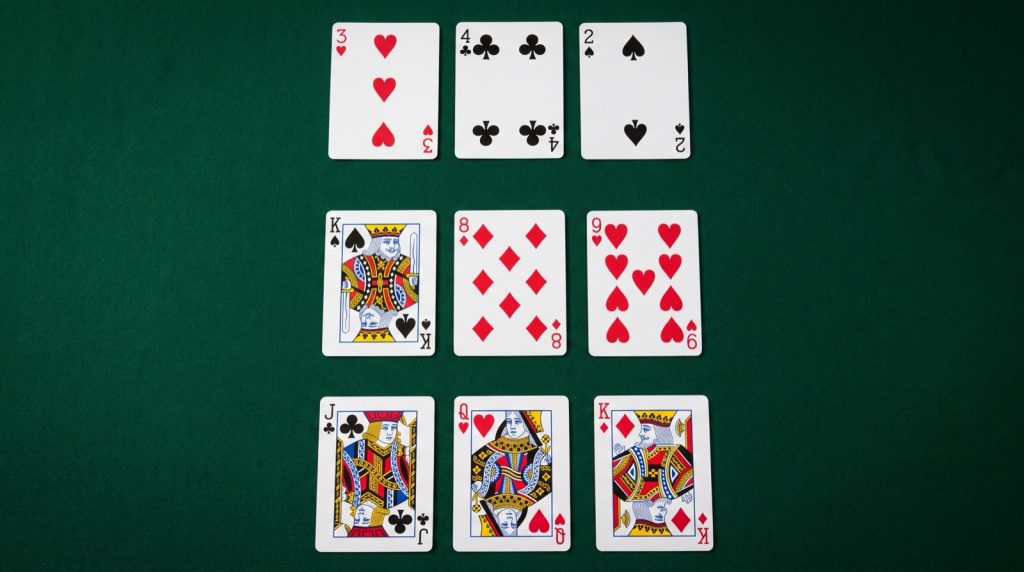
- 3 + 4 + 2 = 9 → 9 points (cào).
- K + 8 + 9 = 10 + 8 + 9 = 27 → 7 points.
- 10 + J + 8 = 28 → 8 points.
- 5 + 5 + 10 = 20 → 0 points (bù).
If that counting looks familiar, it is the same as in baccarat: tens and picture cards are worth nothing and only the last digit counts.
Special hands: Ba Tây, Sáp and Liêng
Plenty of tables play on points alone. Others add special hands that beat any points total — rules vary by region, so agree them before you start:
- Ba tây (also ba tiên): three picture cards — any mix of J, Q and K. Where it is used, it wins outright without counting.
- Sáp: three cards of the same rank, for example three 8s. Common in the ba cây variant.
- Liêng: three consecutive ranks in any suits, for example 5-6-7. Also common in ba cây, and the hand that gives Liêng, the betting game, its name.
Bài Cào odds: how often each score comes up
A 52-card deck gives exactly 22,100 different three-card hands. Counting the score of every one of them:
| Score | Number of hands | Chance |
|---|---|---|
| 0 (bù) | 2,384 | 10.79% |
| 1, 3, 5, 7 or 9 (each) | 2,212 | 10.01% |
| 2, 4, 6 or 8 (each) | 2,164 | 9.79% |
| Total | 22,100 | 100% |
If the ten scores were equally likely, each would have 2,210 hands. Instead the worst score, 0, is the most common one: you are dealt bù about 7.8% more often than cào. The reason is the sixteen cards worth 10 (every 10, J, Q and K). All 560 hands made only of those cards total 30, which is 0 — while each rank from ace to 9 has just four cards.
How rare are the special hands?
| Special hand | Number of hands | Chance | On average |
|---|---|---|---|
| Ba tây (three of J, Q, K) | 220 | 0.996% | 1 deal in 100 |
| Liêng (three in a row) | 704 | 3.19% | 1 deal in 31 |
| Sáp (three of a kind) | 52 | 0.24% | 1 deal in 425 |
The liêng count covers the eleven runs from A-2-3 to J-Q-K. Tables that also allow Q-K-A have twelve runs: 768 hands, 3.48%.
What your score is worth against one opponent
Playing on points alone, this is how often each score beats, ties or loses to one other hand dealt from the same deck — counted over all 407,170,400 possible pairs of hands, not simulated:
| Your score | Beats | Ties | Loses |
|---|---|---|---|
| 0 (bù) | 0.00% | 10.75% | 89.25% |
| 1 | 10.79% | 10.01% | 79.21% |
| 2 | 20.81% | 9.78% | 69.41% |
| 3 | 30.59% | 10.01% | 59.41% |
| 4 | 40.60% | 9.78% | 49.61% |
| 5 | 50.39% | 10.00% | 39.60% |
| 6 | 60.41% | 9.78% | 29.81% |
| 7 | 70.19% | 10.01% | 19.80% |
| 8 | 80.21% | 9.78% | 10.01% |
| 9 (cào) | 89.99% | 10.01% | 0.00% |
A cào can never lose and a bù can never win: the best a bù can do is tie, and the worst a cào can do is tie. In between, each extra point is worth about ten percentage points, while the tie rate barely moves from 10%.
The tie rule is where the banker’s edge comes from
Across all those pairs, the two hands tie 9.999% of the time, and because the game is symmetrical each side wins exactly 45.0005%. So the tie rule decides who has the edge:
- Banker takes ties: the banker wins 55.0% of hands and the player 45.0% — a banker’s edge of 9.999%, exactly the tie rate.
- Ties broken by the highest card, then suit: the game is back to an even 50-50, and whoever runs the table usually takes a fee per hand instead.
| Game | House edge | Where it comes from |
|---|---|---|
| Sic bo / tài xỉu (big/small) | 2.78% | the 6 triples out of 216 outcomes |
| Bầu cua | 7.87% | short pay when a symbol shows twice |
| Bài Cào, banker takes ties | 9.999% | the tie rule |
The useful question before sitting down at a Bài Cào table is not which score is “due” — every deal is independent — but how ties are settled.
Bài Cào is pure chance
Once the cards are dealt there is nothing left to decide, so no skill or system changes your score. Every shuffle is independent of the last. Anything sold as a Bài Cào winning formula or card-reading software has no basis. Treat it as a game of luck played for fun.
Bài Cào vs Liêng vs Baccarat
| Bài Cào | Liêng | Baccarat | |
|---|---|---|---|
| Cards | 3 each | 3 each | 2 or 3 per hand |
| Counting | Last digit; 10/J/Q/K = 0 | Last digit; 10/J/Q/K = 0 | Last digit; 10/J/Q/K = 0 |
| Decisions | None after the deal | Raise, call or fold | None — a fixed drawing rule |
| Special hands | Ba tây, sáp, liêng at some tables | Sáp, liêng, ảnh beat any points | None; a natural 8 or 9 ends the hand |
| Opponent | Other players or a banker | Other players | You bet on Player, Banker or Tie |
See all the Vietnamese card games, including Tiến Lên, Sâm Lốc, Phỏm and Xì Dách.
Playing Bài Cào online
Bài Cào has its own online versions. 22bet’s casino lobby has three of them from King Midas Games — Bai Cao, Bai Cao Black and Red and Bai Cao Mystic Four — along with the same studio’s Teen Patti Blitz and Teen Patti Versus, India’s three-card game. In its live casino, 22bet runs Teen Patti tables from Evolution and Ezugi with real dealers. 20Bet’s live casino lists Three Card Poker and Teen Patti in its Poker section. If you play for real money, set a budget before you start.

Play responsibly
Played for money, Bài Cào is gambling, and a fast one — a round takes seconds. Set limits on time and money before you start and stop when you reach them. For adults 18 and over only.

22bet

20Bet
Bai Cao FAQ
Is Bài Cào the same as Ba Cây?
Essentially yes. Both deal three cards each and compare points. Ba cây is the usual name in northern Vietnam, where tables more often add special hands such as sáp and liêng, and sometimes use a 36-card deck.
How do you count points in Bài Cào?
Ace counts 1, 2 to 9 count face value, and 10/J/Q/K count 10. Add the three cards and keep the last digit: 9 (cào) is the best score, 0 (bù) the worst.
What is the most common score in Bài Cào?
0. Of the 22,100 possible hands, 2,384 score 0 (10.79%), against 2,212 for each odd score and 2,164 for each even score. The sixteen cards worth 10 are the reason.
What is ba tây?
Three picture cards — any mix of J, Q and K. Tables that use it treat it as an outright win. It comes up in about 1 deal in 100 (220 of 22,100 hands).
Is there a strategy for Bài Cào?
No. There are no decisions after the deal, so the outcome is pure chance. The one thing worth checking is how the table settles ties: if the banker takes ties, the banker has a 9.999% edge.
Can you play Bài Cào online?
Yes. 22bet’s casino lobby has three versions from King Midas Games: Bai Cao, Bai Cao Black and Red and Bai Cao Mystic Four. For adults 18 and over.