


Tien Len Rules: How to Play the Vietnamese 13-Card Game
August 20, 2026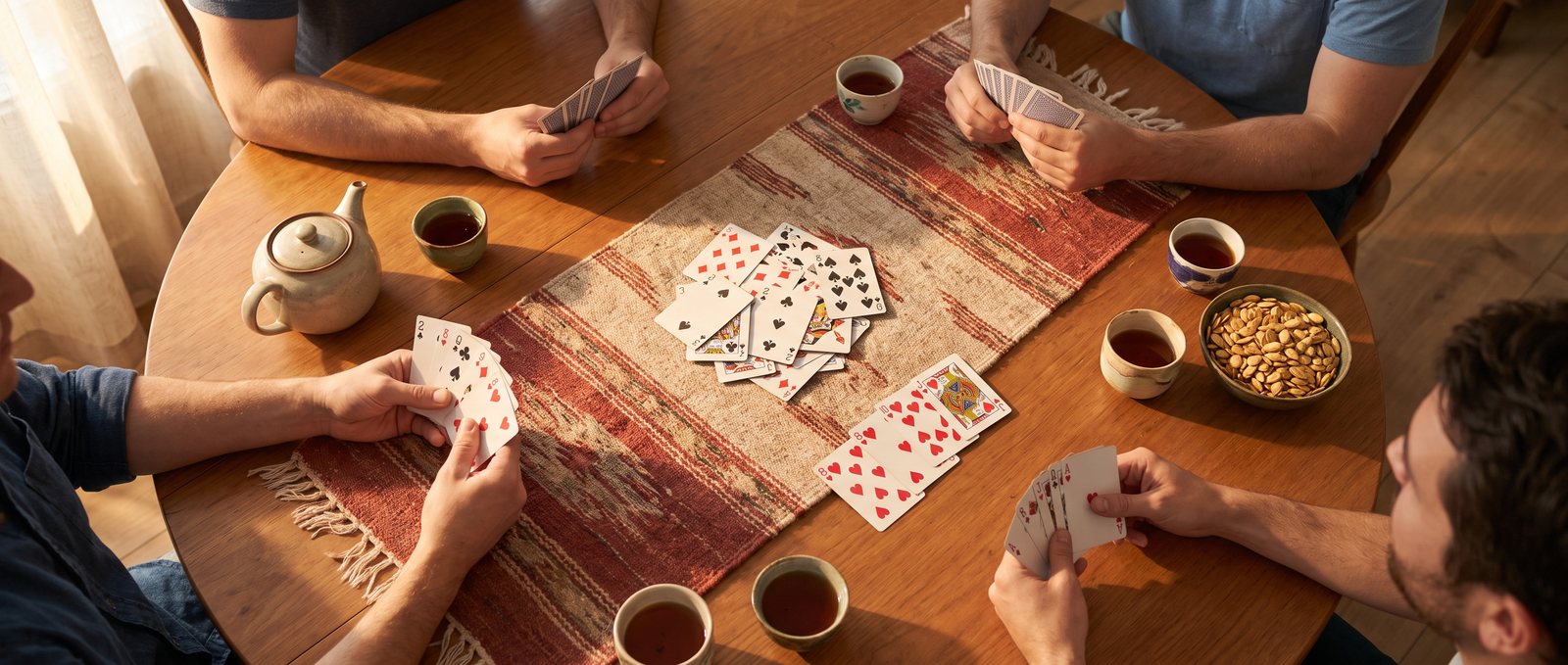
Tiến Lên is Vietnam’s best-known card game, and the one most likely to be on the table when a Vietnamese family sits down to play. In English it usually goes by Thirteen, 13, or Viet Cong (VC). It is a shedding game: everyone starts with thirteen cards, and the goal is simply to be the first to get rid of all of them.
The basic play is easy to pick up in one round. What trips people up — and what most guides skate over — is the bomb rules, the exact order of the suits, and the fact that the American VC version and the Vietnamese original genuinely differ. This guide covers all three.
What you need
A standard 52-card deck with the jokers removed, and ideally four players. The game works with two or three as well; with four players the whole deck is dealt out, 13 cards each, which is where the English name Thirteen comes from.
How many players — and what changes when it isn’t four
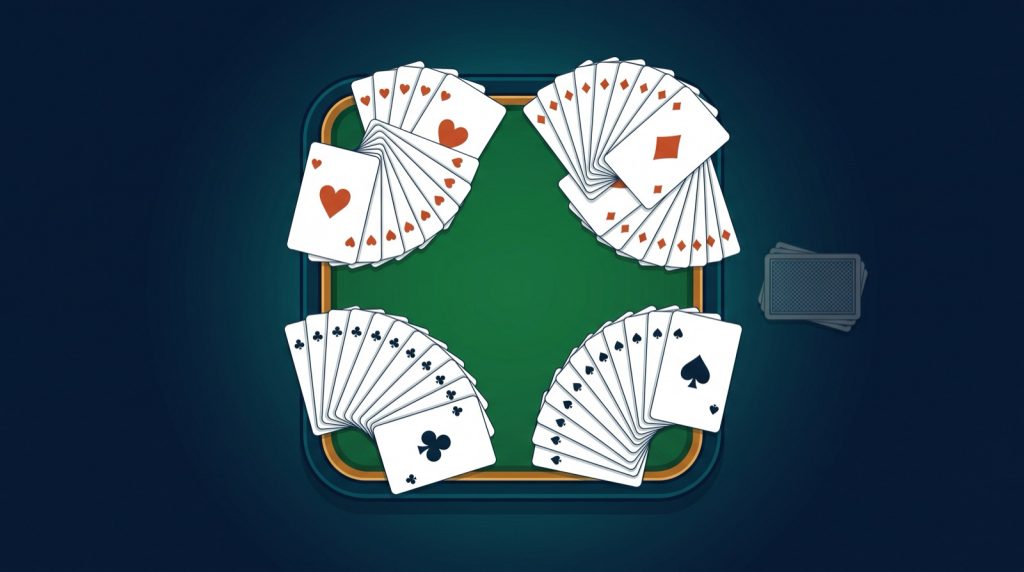
Four is the standard game, and the arithmetic is the whole reason: 4 × 13 = 52. The deck is dealt out exactly, nothing is held back, and every card in the game is in somebody’s hand.
With fewer players, each still receives 13 cards. The remainder is simply set aside and takes no part in the hand.
| Players | Cards dealt | Left out of play | What it changes |
|---|---|---|---|
| 2 | 26 | 26 — half the deck | Half the pack never appears. Almost nothing can be deduced from what has been played. |
| 3 | 39 | 13 — a quarter | Playable and common, but a card you never see may simply not be in the game. |
| 4 | 52 | 0 | Complete information: any card you neither hold nor have seen is in another hand. |
| 5 or more | — | — | Not possible with one deck (5 × 13 = 65). Pagat’s answer is to shuffle two 52-card packs together. |
That last column is the part most guides skip, and it changes how the game actually plays. At four players, elimination works: if you do not hold the 2♥ and it has not been played, somebody at the table is holding it, and holding back a bomb for it is a real plan. At three, thirteen cards are out of the game, so the same reasoning collapses — the 2♥ you are waiting to chop may not be in play at all. Short-handed Tien Len is a looser, more speculative game for that reason, not because any rule changed.
Above four players you need a second pack. That introduces a question the standard rules do not answer: with two decks shuffled together every card exists twice, so an exact duplicate of the combination on the pile can be played. Whether a duplicate beats it, ties it, or is simply not allowed is not standardised — settle it before the first deal, along with the bomb rules below.
Card ranking
The ranking has one twist worth memorising immediately: the 2 is the highest card, not the lowest, and the 3 is the lowest.
| Rank | Cards (low to high) |
|---|---|
| Highest | 2 (often called the “pig” or heo) |
| A, K, Q, J, 10, 9, 8, 7, 6, 5, 4 | |
| Lowest | 3 |
So the weakest card in the deck is the 3 of spades and the strongest single card is the 2 of hearts.
Suit ranking — and why it matters less than you think
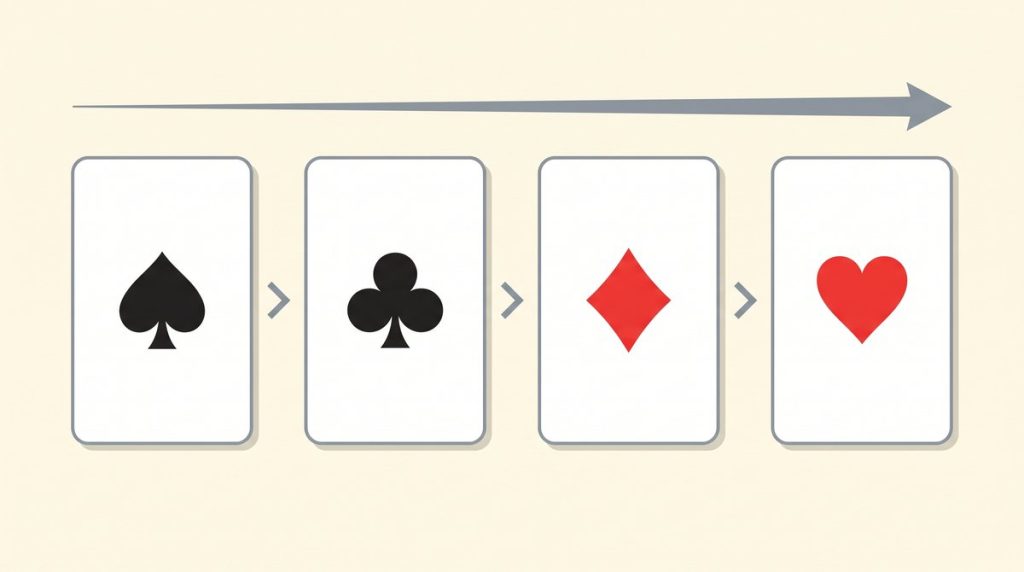
When two cards share a rank, the suit decides which is higher:
| Suit | Order |
|---|---|
| ♥ Hearts | Highest |
| ♦ Diamonds | 2nd |
| ♣ Clubs | 3rd |
| ♠ Spades | Lowest |
The rule people get backwards: rank always beats suit. A 10♠ beats a 9♥ because ten beats nine — the suits are irrelevant. Suit only settles a tie between two cards of the same rank, or between two sequences whose top cards are the same rank.
The valid combinations
| Combination | What it is | Example |
|---|---|---|
| Single | One card | K♦ |
| Pair | Two cards of the same rank | 7♠ 7♥ |
| Triplet | Three cards of the same rank | 9♣ 9♦ 9♥ |
| Quartet | Four cards of the same rank | 5♠ 5♣ 5♦ 5♥ |
| Sequence | Three or more consecutive ranks, suits may be mixed | 9♣ 10♦ J♣ |
| Double sequence | Three or more consecutive pairs, suits may be mixed | 5♣ 5♠ 6♥ 6♦ 7♣ 7♦ |
The governing principle is strict: you can only beat a combination with the same type of combination, containing the same number of cards, and of higher rank. A pair is beaten only by a higher pair; a five-card sequence only by a higher five-card sequence. Comparison is made on the highest card of the combination. There is exactly one exception, covered under bombs below.
Sequences: the “around the corner” rule
Sequences may not wrap around from the top of the ranking back to the bottom. Because the order runs 3 → 2, a sequence can climb to the 2 and stop there, but it cannot continue past the 2 into a 3 — that would jump from the highest rank to the lowest.
This is one of the points where versions genuinely diverge, so it is worth settling before you deal:
- In the standard game, a 2 may appear in a sequence (K-A-2 is legal).
- In Viet Cong (VC) and in common Southern Vietnamese house rules, 2s may not be used in a plain sequence at all, though they may still appear in double sequences. Under that rule the longest possible run ends at the ace.
How a hand is played
- The first lead. In the first hand of a session, the player holding the 3♠ leads. In the standard game they play it as a single card; in VC and many Vietnamese games they must simply include it in whatever they lead, so it can go out inside a pair, triplet or sequence.
- Following. Play passes around the table. On your turn you either beat what is on the pile — same combination type, same card count, higher rank — or you pass.
- Passing is binding. Once you pass, you are out for the rest of that pile and cannot rejoin it, even if you could have beaten a later play.
- Winning the pile. When nobody can or will beat the last play, that player takes the pile, sets it aside, and leads a fresh one with any combination they like.
- Later hands. The winner of the previous hand leads first and may open with anything.
Bombs (chopping a 2)
This is the part that causes most arguments, so here it is precisely. Bombs are the only exception to matching combination types, and they may be played only against 2s that are currently winning the pile — never against any other card.
| What is on the pile | What can beat it |
|---|---|
| A single 2 | A quartet, or a double sequence of 3+ pairs |
| A pair of 2s | A quartet, or a double sequence of 4+ pairs |
| A triplet of 2s | A double sequence of 5+ pairs |
Two details that most explanations leave out, and that settle most table disputes:
- A bomb is not unbeatable. It can be beaten in turn.
- Playing a bomb changes what everyone else has to match. Once the bomb lands, the pile’s type becomes the bomb’s type — so the next player must beat that quartet or double sequence, not the 2 that was originally led.
Vietnamese house rules often go further than this and let bombs beat each other according to a local pecking order — commonly three consecutive pairs as the weakest bomb, then the quartet, then four consecutive pairs. Sources disagree about that hierarchy, and about whether a quartet may chop a pair of 2s or only a single one. There is no universal answer, so agree the bomb order before the first deal rather than mid-hand.
Viet Cong (VC): the American version
VC is the form most commonly played in the United States, and its differences are substantive rather than cosmetic:
- A player dealt all four 2s wins immediately, without playing a card.
- The holder of the 3♠ must include it in the opening combination.
- 2s may not appear in a plain sequence, though they may appear in double sequences.
- The bomb equivalents are called slams, and they are harder to make:
| What is on the pile | What beats it in VC |
|---|---|
| A single 2 | A quartet, or a double sequence of 3+ pairs (same as standard) |
| A pair of 2s | Two consecutive quartets, or a double sequence of 5+ pairs |
| A triplet of 2s | Three consecutive quartets, or a double sequence of 7+ pairs |
VC is also sometimes played with trading: after the deal and before the opening lead, any two players may swap an equal number of cards by mutual agreement. When trading is in use, four 2s no longer win automatically.
Southern and northern Tien Len are not the same game
English-language sources describe one Tien Len. Vietnamese sources describe at least two. Everything above — and the version on Pagat, and the rules in effectively every app that calls itself Thirteen — is Tiến Lên Miền Nam, southern Tien Len. Tiến Lên Miền Bắc, the northern game, uses the same deck, the same rank and suit order and the same objective, but is stricter about what counts as a valid combination:
- Pairs must match in colour. 7♥+7♦ (both red) and 7♠+7♣ (both black) are pairs. 7♥+7♠ is not.
- Sequences must be a single suit. 5♣-6♣-7♣ is a run; 5♣-6♦-7♣, perfectly ordinary in the south, is not.
That single constraint changes how a hand is built. In the south a pair is any two cards of a rank, so most hands hold several; in the north roughly half of those pairings stop being legal, which makes pairs scarcer, double sequences much harder to assemble, and the bombs that depend on them rarer.
One correction worth making, because a number of guides state it the wrong way round: some say a northern pair must be the same suit. That is impossible. Each rank holds exactly one card in each suit, so two cards of the same rank are always of different suits. Colour is the only constraint here that means anything. Triples are unaffected for the same reason — three cards of a rank necessarily span three suits, so no colour rule can apply to them.
How firmly is this established? Vietnamese rule sources describe the colour and suit constraints consistently for the northern game. Pagat, the standard English-language card-rules reference, does not record a northern variant at all and defines both pairs and runs with suits mixed. In practice the rule varies by table and by app. Treat it the way you treat bombs: agree the variant before the first card is dealt.
Our guide to Vietnamese card games indexes the rest of the family, several of which do not use a 52-card pack at all.
Ending the game and keeping score
Players drop out as they finish their cards. The game runs until only one player is left holding cards, and that player is the loser. Depending on the group, play may stop as soon as the first person goes out, or continue to settle second, third and fourth place.
When Tiến Lên is played for stakes, the usual arrangement is that the loser pays a fixed amount to each of the other players, sometimes scaled by how many cards they were caught holding. Scoring is entirely a house convention — there is no standard table.
House rules to settle before you deal
Tiến Lên has no governing body, and nearly every family plays a slightly different game. These are the points most likely to cause a mid-hand argument:
- May a 2 appear in a sequence?
- Must the opening 3♠ be played alone, or may it go out inside a combination?
- Can bombs beat other bombs, and in what order?
- Can a quartet chop a pair of 2s, or only a single 2?
- Are there instant-win hands beyond four 2s?
- Does the hand stop at the first player out, or continue for placings?
Other Vietnamese games worth knowing
Tiến Lên is the most widely played Vietnamese card game, but far from the only one. Bầu Cua is the dice game that appears at Lunar New Year, and our guide to Vietnamese card games covers the wider set — Tam Cúc, Tứ Sắc, Tổ Tôm, Phỏm and the rest — including which deck each one uses. There is also a detailed Vietnamese-language guide to the Southern rules of Tiến Lên.
If you are more interested in the casino side, see our overviews of poker and the full range of casino games, or the background piece on the most popular casino games.
Play responsibly
Tiến Lên is first and foremost a social game — most of the hands played each year are played for nothing at all. If you do play for money, treat it as entertainment rather than income, set a limit before you start, and never chase losses. Gambling is for adults aged 18 and over. If gambling is causing problems for you or someone close to you, free and confidential help is available at GamblingTherapy.org.
Rules and legality vary a great deal by country; for the situation in Vietnam specifically, see our overview of gambling in Vietnam.
Tien Len is rarely found in international online casinos; the card games there are mainly baccarat, blackjack and poker. If you want to play cards for real money, read about the casinos that accept Vietnamese players first, then try 20Bet’s live casino. 18+ only — set a time limit and a budget before you start.
Tien Len — frequently asked questions
How many cards do you get in Tien Len?
Thirteen each. With four players a standard 52-card deck is dealt out completely, 13 cards per player — which is why the game is called Thirteen in English.
What is the highest card in Tien Len?
The 2 of hearts. The 2 is the highest rank (above the ace), and hearts is the highest suit. The lowest card is the 3 of spades.
What is the suit order in Tien Len?
From highest to lowest: hearts, diamonds, clubs, spades. Suit only matters when two cards have the same rank — rank always beats suit, so a 10♠ still beats a 9♥.
What is a bomb in Tien Len and what can it beat?
A bomb is the one exception to matching combination types, and it may only be played against a 2 that is currently winning the pile. A single 2 is beaten by a quartet or a double sequence of three or more pairs; a pair of 2s by a quartet or a double sequence of four or more pairs; a triplet of 2s by a double sequence of five or more pairs. A bomb can never be used against any card other than a 2.
Once someone plays a bomb, what do the other players have to beat?
The bomb, not the 2. Playing a bomb changes the type of the pile — everyone after it must beat that quartet or double sequence. A bomb is not unbeatable.
Can a 2 be part of a sequence?
It depends on the version. In the standard game a 2 may appear in a sequence, so K-A-2 is legal, but a sequence can never wrap around from the 2 back to a 3. In Viet Cong and in common Southern Vietnamese house rules, 2s cannot be used in a plain sequence at all, though they may appear in double sequences.
Who goes first in Tien Len?
In the first hand of a session, whoever holds the 3♠ leads. In the standard game they play it as a single card; in Viet Cong and many Vietnamese games they only have to include it in whatever combination they lead. In later hands the previous winner leads and may open with anything.
What is the difference between Tien Len and Viet Cong (VC)?
VC is the American form. Four 2s in the deal win outright, the 3♠ must be included in the opening combination, 2s cannot go in plain sequences, and the bomb equivalents — called slams — are harder: a pair of 2s needs two consecutive quartets or a double sequence of five or more pairs, and a triplet of 2s needs three consecutive quartets or a double sequence of seven or more pairs. VC is also sometimes played with card trading before the opening lead.
Is Tien Len a game of luck or skill?
Both. The deal is random, but choosing when to break up a combination, when to spend a 2, when to hold a bomb and when to pass all make a large difference over a session.
Can you play Tien Len with 3 players?
Yes. Each of the three players is still dealt 13 cards, and the remaining 13 are set aside and take no part in the hand. The rules are unchanged, but the game plays differently: with a quarter of the deck out of play you cannot deduce where a missing card is, so holding a bomb back for a 2 that may not be in the game at all is a much weaker plan than it is at four players.
How many players do you need for Tien Len?
Four is the standard game, because 4 × 13 = 52 deals the deck out exactly with nothing left over. Two and three players work, with the undealt cards set aside. Five or more is not possible with a single pack — 5 × 13 = 65 — so Pagat’s rules call for two 52-card packs shuffled together.
What is the difference between southern and northern Tien Len?
Northern Tien Len (Tiến Lên Miền Bắc) adds two constraints to the southern game: a pair must be two cards of the same rank and the same colour, and a sequence must be all one suit. Everything else — the deck, the rank order, the suit order, the objective — is the same. Note that Pagat, the standard English reference, does not record a separate northern variant, and practice varies by table and by app, so agree the version before you deal.