What Is Bầu Cua Cá Cọp?
Bầu cua is a Vietnamese dice game played with three six-sided dice and a board of six picture squares. Players put money on the squares they think will come up; the dealer shakes the three dice under a bowl, lifts it, and pays out every square whose picture is showing.
The game goes by two names in English, which is why searches for it split in two. Bầu cua tôm cá means “gourd–crab–shrimp–fish”, and bầu cua cá cọp means “gourd–crab–fish–tiger”. Both refer to the same game. It is also called lắc bầu cua (“shaking bầu cua”) after the bowl-shaking that starts each round, and it is most strongly associated with Tết, the Lunar New Year, when it comes out at family gatherings across Vietnam and in Vietnamese communities abroad.
It is a pure game of chance. The dice decide everything; no amount of skill, experience or bet arrangement changes what they show.
The Six Symbols on the Bầu Cua Board
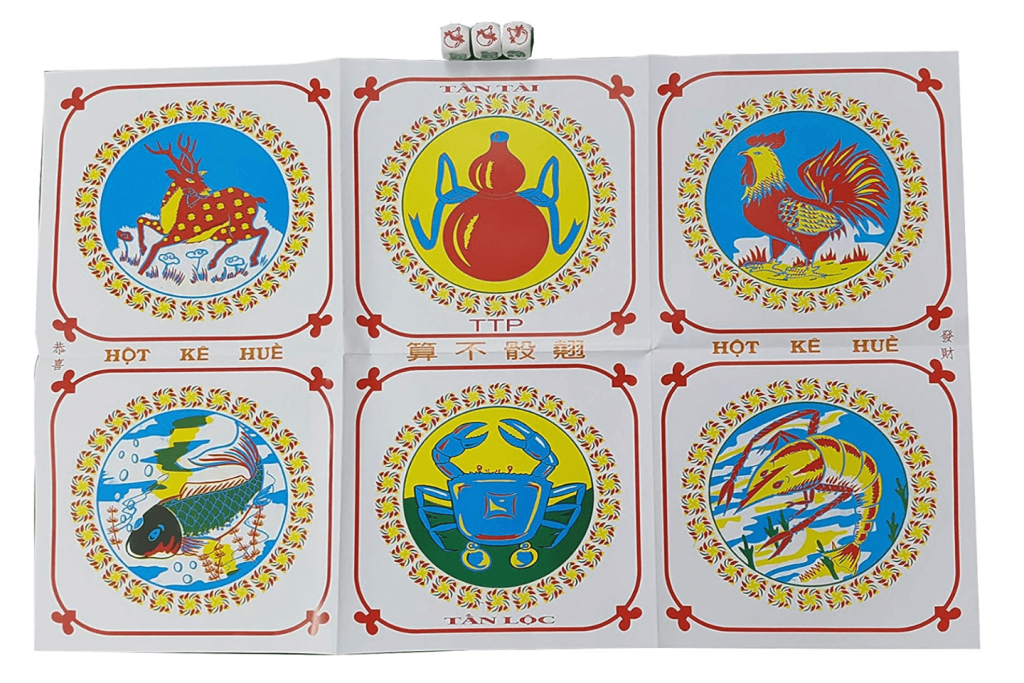
A Vietnamese bầu cua board carries six symbols, normally laid out in two rows of three. Each of the three dice carries all six, one per face.
Because every symbol appears exactly once on every die, no square is more likely to come up than any other. That single fact is worth holding on to before reading any advice about “picking the right square”.
The set changes from country to country. The Chinese version, Hoo Hey How (魚蝦蟹, “fish–prawn–crab”), replaces the deer with a coin. Thai boards carry a tiger. The Cambodian game Klah Klok uses a deer, as Vietnam does. Gourd, crab, shrimp and fish turn up in nearly every version.
Why Is It Called “Bầu Cua Cá Cọp” When There Is No Tiger?
This is the question the game’s English name raises most often, and it deserves an honest answer: it is still argued over, and there is no settled explanation. A Vietnamese board has a deer (nai) in the sixth square, not a tiger (cọp), yet “bầu cua cá cọp” remains a common name for it.
Vietnamese sources generally offer three suggestions:
- “Bầu cua cá cọp” simply rhymes better and is easier to say.
- It is a slurring of cọc, one word for a stag, into cọp.
- It is confusion with the Thai version of the game, which really does have a tiger on the board.
All three are widely repeated hypotheses rather than established fact. We set them out so you can weigh them; we are not claiming any one of them is correct.
How a Round of Bầu Cua Is Played
A round is short and the sequence never varies:
- The dealer puts the three dice in a bowl or covered plate, shakes them, and sets it face down on the table.
- Players place money on any of the six squares they choose.
- When betting closes, the dealer lifts the bowl to show the three dice.
- Winning squares are paid; losing squares are collected.
There is no limit on how many people can play, and one player may cover several squares in the same round.
How Bầu Cua Payouts Work
Payouts depend on how many dice show your symbol — not merely on whether it appeared at all. This is the part casual players most often get wrong.
A winning square returns your stake plus the payout. Put 100 on the crab and two dice come up crab: you get your 100 back and 200 on top.
These are the usual odds, but they are a convention rather than a rule — some tables pay less. Ask how a table pays before you put money down.
The Real Odds of Bầu Cua: 216 Combinations
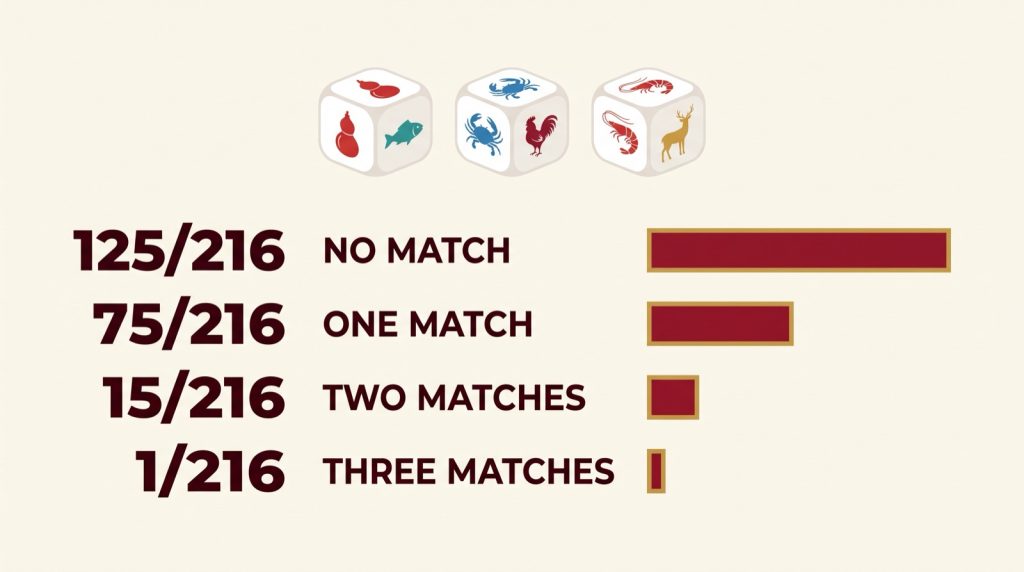
Three dice with six faces each give 6 × 6 × 6 = 216 possible outcomes. For any one symbol you pick, those 216 outcomes divide as follows.
The counts add to 216 exactly, which is the arithmetic check. The first thing they show is this: the chance that your symbol appears at all is 75 + 15 + 1 = 91 out of 216, about 42%. Bầu cua looks easy to win because six symbols and three dice feel generous, but you lose the majority of the rounds you bet on.
The House Edge Is 7.87%
Put the payouts and the probabilities together and the game’s cost falls out of the arithmetic. Staking 1 unit on one square across all 216 outcomes:
(+1 × 75) + (+2 × 15) + (+3 × 1) − (1 × 125) = 75 + 30 + 3 − 125 = −17
Divided across 216 rounds, that is −17/216 ≈ −7.87%. Over the long run a player loses roughly 7.87 units for every 100 staked. That is the house edge, and it is built into the payout table — it is not the dealer cheating. For comparison, it sits well above the edge on baccarat or blackjack and roughly in line with American roulette.
The 7.87% figure assumes the standard 1:1 / 2:1 / 3:1 payouts above. A table that pays less than that costs the player more.
What a Break-Even Bầu Cua Table Would Pay
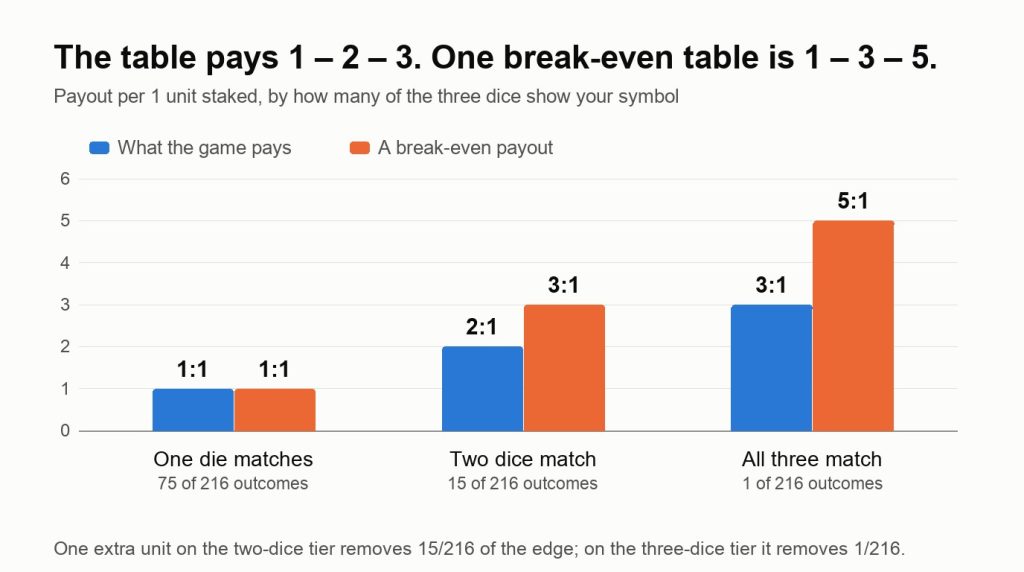
The 7.87% is the gap between what the game pays and what the outcomes are worth. That invites the obvious question, which almost nothing written about this game answers: what would the table have to pay for the bet to break even?
Keep the one-die payout at the game’s own 1:1 and solve for the other two, so that the winning outcomes exactly cover the 125 losing ones:
(75 × 1) + (15 × a) + (1 × b) = 125
In non-negative whole numbers that has four solutions — (a, b) = (0, 50), (1, 35), (2, 20) and (3, 5) — and only the last keeps both payouts anywhere near a real pay table. So 1:1 / 3:1 / 5:1 is a break-even table: 75 + 45 + 5 = 125, exactly. The game pays 1:1 / 2:1 / 3:1.
Which Part of the Pay Table Actually Matters
There is a cleaner way to see where the margin sits, and it does not depend on picking one break-even table over another. Adding one unit to a tier’s payout removes exactly that tier’s outcome count divided by 216 from the house edge:
A one-unit improvement on the two-dice result is worth exactly 15 times one on the three-dice result — and the three-dice result is the one every guide talks about, because it is the rare and dramatic one.
The practical version: a table paying 3:1 when two dice match runs at a house edge of 0.93% instead of 7.87%. A table that instead raises the three-dice payout from 3:1 all the way to 12:1 — which sounds far more generous — still leaves the edge at 3.70%. When comparing bầu cua tables, the two-dice cell is the one to read first.
Does Covering Every Symbol Help?
A common table tactic is to put the same stake on all six squares, on the theory that something must come up. It does — and it still loses.
Averaged out, six units staked return 5.53, which is the same −7.87%. Spreading your money across the board smooths the swings; it does not remove the edge. You break even only when all three dice show different symbols, and that happens in 120 of 216 rounds.
The same goes for the other approaches players talk about. Every square carries the identical 7.87% cost, so there is no cheaper one to find. Each round is independent, so a symbol that has not appeared for ten rolls is no more likely on the eleventh. And a staking system such as the Martingale only rearranges when you bet how much — it cannot change probabilities that are fixed by the dice. Anything sold as a guaranteed bầu cua formula or a prediction app is worth nothing.
Spreading Your Stake Changes Nothing — Here Is the Proof
Covering all six squares is the version players talk about, but the same holds for two squares, or three. Expected value adds up, so every unit you put down carries its own −17/216 no matter which square it sits on or how many other units are on the board:
The last column never moves. Spreading a stake changes how bumpy the ride is, and nothing else.
How Bầu Cua Compares With Other Dice Games
Bầu cua uses three dice, and so does Sic Bo; xóc đĩa uses four two-sided discs. Their main bets are not priced alike:
Two things follow. Bầu cua’s only bet costs roughly three times the cheapest bet on those tables — and on those same tables the side bets are far worse again, with Sic Bo’s specific-total bets and xóc đĩa’s all-one-colour bet running past 30%. Which bet you choose inside a game moves your cost more than which game you choose.
Where Bầu Cua Comes From
Bầu cua belongs to a family of picture-dice games played across Asia and, in different forms, well beyond it. The Chinese Hoo Hey How (fish–prawn–crab) is the closest relative, and the Cambodian Klah Klok is another. The British fairground game Crown and Anchor and the American chuck-a-luck run on the same three-dice, pick-a-symbol structure.
Exactly how and when the game reached Vietnam is not documented with any precision, and accounts that pin it to a particular place or group of people should be treated with caution. What is clear is that it settled into Vietnamese life as a Tết game — something brought out once a year, played for small stakes among family and neighbours, and valued more for the noise around the table than for the money. The other game that comes out at the same table is xóc đĩa, which uses four two-sided discs rather than dice — and whose best bet carries a far smaller house edge than anything on a bầu cua board.
Hoo Hey How, Crown and Anchor and Chuck-a-Luck: Bầu Cua Under Other Names
Three dice, six faces, and a bet on one face that pays 1:1, 2:1 or 3:1 depending on how many dice show it: the same game is played under several names, and with that standard pay table every one of them carries exactly the same 7.87% house edge as bầu cua.
The pictures change and the arithmetic does not. Of the 216 ways three dice can land, a bet on one face loses on 125 (57.9%), wins 1 unit on 75, 2 units on 15 and 3 units on 1, so it returns (75 + 30 + 3 − 125) ÷ 216 = −17/216, a loss of 7.87% of the stake on average, whichever face or symbol you choose. Only the pay table can move that figure: a chuck-a-luck table paying 10:1 on a triple instead of 3:1 adds 7 units to that one outcome, and the edge drops to 10/216, or 4.63%.
So if you know one of these games you know all four, and everything on this page about bầu cua odds, pay tables and spreading your stake applies to Hoo Hey How, Crown and Anchor and chuck-a-luck as well.
Jhandi Munda (Langur Burja): the six-dice version
Jhandi Munda, also called Langur Burja or Jhanda Burja, is the member of the family played in Nepal, northern India and Bangladesh, especially during Dashain, Tihar and Diwali. Its six symbols are the crown (munda), the flag (jhandi), heart, spade, diamond and club. The difference is the dice: Jhandi Munda is rolled with six dice instead of three, and in the most common rules a bet only pays when its symbol shows on two or more of them. The payout for each count is set by whoever runs the game, so there is no single house edge to quote, but the chances for any one symbol are fixed:
With six dice your symbol shows on at least one of them 66.51% of the time, so a single match is the most likely result of all; two or more come up on about one roll in four. As with the three-dice games, the six symbols are equally likely and earlier rolls tell you nothing about the next one.
Bầu Cua Online vs the Traditional Game
Online, there are no physical dice. Results come from a random number generator, or from a real dealer shaking a real bowl on camera in a live casino studio. The rules and the payout table are otherwise the same, so the probabilities and the 7.87% house edge carry over unchanged.
What does change is pace and company. A software version deals rounds far faster than a family table, and it deals them to you alone — which matters, because losses accumulate at the speed of play. Most casinos that carry the game also offer a demo mode, which is the sensible way to see how a particular version handles payouts before staking anything.
Three of the casinos listed on this page carry the game. 22bet has Bau Cua from KA Gaming and Funky Games, Bau Cua Fish Prawn Crab from King Midas Games, Fish Prawn Crab versions from JILI, CQ9 and PG Soft, and a live Fish Prawn Crab M table from SA Gaming. 20Bet lists Bau Cua, Fish Prawn Crab and Win Win Fish Prawn Crab among its games, plus live Fish Prawn Crab and Thai Fish Prawn Crab tables. BC.GAME has its own Cá-Tôm-Cua in BC Originals and a live Thai Fish Prawn Crab table from Sexy Gaming.
Bầu cua is not the only traditional game a Vietnamese family plays together — if you want the card game most likely to be on the table, see our guide to Tien Len rules, or the full overview of Vietnamese card games and the decks they use. Vietnamese readers can find our full analysis in bầu cua tôm cá là gì.