


Xóc Đĩa Rules: How Vietnam's Coin Game Works and What It Really Pays
August 22, 2026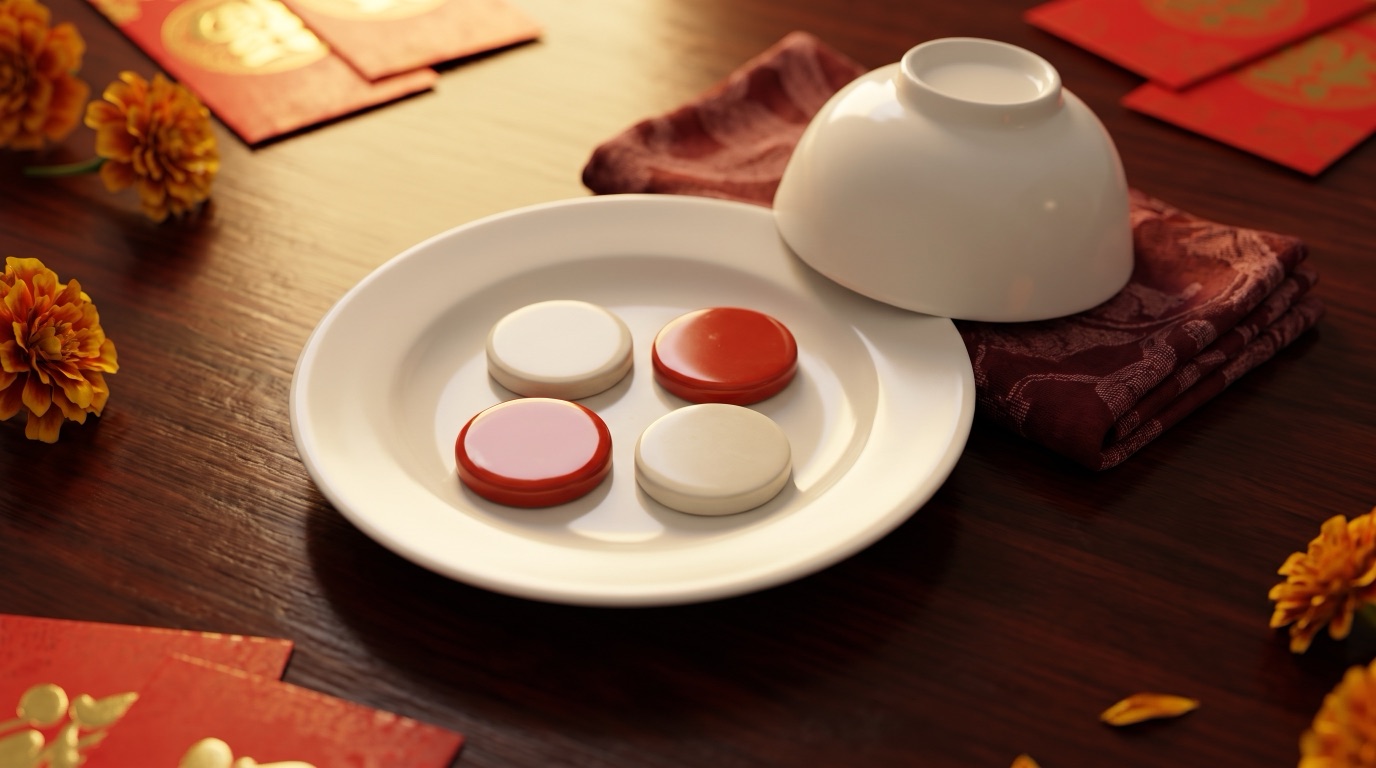
Xóc đĩa is the simplest gambling game Vietnam plays, and the one whose maths is easiest to get exactly right. Four discs, red on one side and white on the other, are shaken under a bowl. The bowl comes up, you count the red faces, and that count settles every bet on the table. There are no cards to rank, no dice pips to add, no dealer decisions. It is the closest thing in a casino to a coin toss — which is precisely why it is worth doing the arithmetic before you play it.
This guide covers the equipment, how a round runs, every bet, and the house edge on each one as published by the two studios whose paytables have been independently analysed. It also answers a question that trips up English-speaking players constantly: the game is often not called xóc đĩa in the lobby.
What is xóc đĩa?
Xóc đĩa (roughly “shake the plate”) is a Vietnamese game of pure chance played with four identical two-sided discs — one face red, one face white — a shallow plate, and a bowl to cover them. The banker sets the four discs on the plate, caps it with the bowl, shakes, and sets it down. Bets are placed while the result is already sealed underneath. The bowl is lifted, the red faces are counted, and the payouts follow from that single number.
Because each disc shows exactly one face, the number of red faces can only be 0, 1, 2, 3 or 4. Every bet on a xóc đĩa table is a bet on that number, or on a group of those numbers. In Vietnamese the two faces are conventionally read as dương (yang, red) and âm (yin, white).
The game belongs to Tết, the Lunar New Year, when it comes out at family gatherings alongside bầu cua cá cọp. The two are frequently confused by people who have seen both on the same table at the same party: bầu cua uses three dice with six animal faces, xóc đĩa uses four two-sided discs. They are different games with very different odds.
The kit: bát, đĩa and four quân vị
A traditional set is three items:
- Đĩa — the shallow plate the discs sit on.
- Bát (also chén) — the bowl that covers the plate and does the shaking.
- Four quân vị — the discs themselves, identical, red on one face and white on the other.
At home the discs are often replaced by four two-tone coins or buttons, and other colour pairs turn up, but red and white is the standard. Live-dealer studios use purpose-made chips: Ezugi describes “four chips, each having a red side and a white side”, and SA Gaming describes “four two-sided red and white tokens”. The kit has not changed in the move online.
How a round runs
- Betting opens. The table shows the available bets and a countdown.
- The shake. The banker places the four discs on the plate, covers them with the bowl and shakes.
- Betting closes. At zero, no bet can be added or moved.
- The reveal. The bowl is lifted and the red faces are counted.
- Settlement. Winning bets are paid at the table’s odds; losing stakes are collected.
A live round online typically runs on a fixed cycle of about a minute. Note the order: the result exists before the betting closes. Nothing you do after the shake can influence it, and nothing before it can either.
The five possible results
Every round ends in one of exactly five states, shown here from no red faces to four:
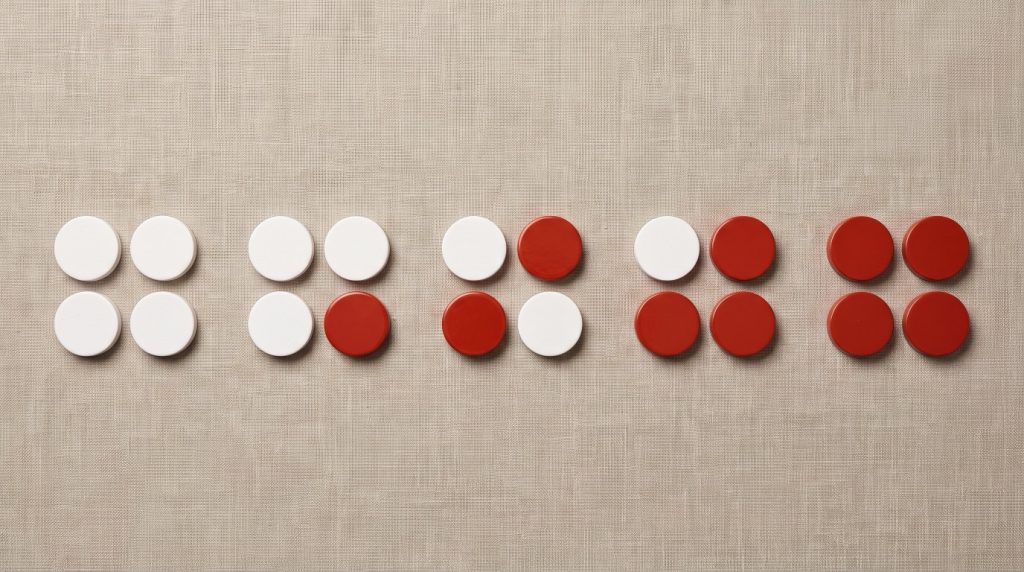
Left to right: 0 red, 1 red, 2 red, 3 red, 4 red — the only five results a round of xóc đĩa can produce.
Those five results are not equally likely, and that is the single most important thing to understand about the game. Each disc lands red or white independently with probability ½, so there are 2 × 2 × 2 × 2 = 16 equally likely arrangements of the four discs. Sorting those 16 arrangements by how many reds they contain gives:
| Red faces | Arrangements | Probability |
|---|---|---|
| 0 red (all white) | 1 of 16 | 6.25% |
| 1 red, 3 white | 4 of 16 | 25% |
| 2 red, 2 white | 6 of 16 | 37.5% |
| 3 red, 1 white | 4 of 16 | 25% |
| 4 red (all red) | 1 of 16 | 6.25% |
The 1–4–6–4–1 pattern is the fourth row of Pascal’s triangle, and it is the whole game. An even 2–2 split happens more than a third of the time; all four discs matching happens once in sixteen rounds for each colour. You can check the count yourself: write out the sixteen red/white strings of length four and sort them.
Even and odd — the main bet, and it is exactly 50/50
The bet most money goes on is chẵn / lẻ, even or odd, counted on the number of red faces:
- Even (chẵn) wins on 0, 2 or 4 red — that is, when the two colours split evenly or all four match.
- Odd (lẻ) wins on 1 or 3 red — when the split is 3–1 either way.
Adding the rows above: even = 1 + 6 + 1 = 8 of 16, odd = 4 + 4 = 8 of 16. Both are exactly 50%. No rounding, no zero pocket, no banker advantage built into the outcome. It is a true coin flip.
Which raises the obvious question: if the main bet is a genuine 50/50, how does the house make money?
Where the house edge actually comes from
Two mechanisms, and they are worth separating because one is mild and the other is severe.
1. Commission on the even/odd bet
The even and odd bets do not pay 1:1. They pay slightly less — typically 0.96:1 or 0.97:1 — so a winning 100 unit bet returns 96 or 97 units of profit rather than 100. That shortfall is the commission, and it works the same way as the banker commission in baccarat. On a 50/50 outcome, paying 0.96 gives the house 2%; paying 0.97 gives it 1.5%. Those are good numbers by casino standards — better than European roulette’s 2.7%.
2. Combination bets paid below true odds
This is where the money is made. The specific-outcome bets pay far less than the odds justify:
| Bet | True probability | Fair payout | Actual payout |
|---|---|---|---|
| All four red (or all four white) | 1 in 16 (6.25%) | 15:1 | 9:1 to 9.5:1 |
| Three red and one white (or the reverse) | 1 in 4 (25%) | 3:1 | 2.5:1 |
| Even / odd | 1 in 2 (50%) | 1:1 | 0.96:1 to 0.97:1 |
A bet that comes in once in sixteen rounds should return fifteen times your stake to break even. Paying nine instead is not a small trim. Worked out as a house edge, using the two paytables that have been independently analysed:
| Bet | Payout | House edge |
|---|---|---|
| All red / all white | 9:1 | 37.5% |
| All red / all white | 9.5:1 | 34.38% |
| Three red / three white | 2.5:1 | 12.5% |
| Even / odd | 0.96:1 | 2% |
| Even / odd | 0.97:1 | 1.5% |
The arithmetic is short enough to check. At 9:1, an all-red bet wins 9 units once in 16 rounds and loses 1 unit the other 15: (9 × 1 − 1 × 15) ÷ 16 = −6 ÷ 16 = −37.5%.
37.5% is a remarkable number, and not in a good way
Put the all-red bet next to bets English-speaking players already know:
- European roulette, any bet: 2.7%.
- American roulette, any bet: 5.26%. Its worst bet, the five-number, is 7.9%.
- Sic Bo specific triple at 180:1: 16.2%. At the stingier 150:1 some tables pay: 30.09%.
- Xóc đĩa all red at 9:1: 37.5%.
The all-red square is worse than every bet on a sic bo layout and roughly seven times worse than American roulette. It sits on the same table as one of the better bets in the building. That gap — 1.5% next to 37.5% on the same felt, decided by the same shake — is the practical takeaway of this page. Twenty-five times the disadvantage, for a prettier-looking payout.
Big/Small, and why the 2–2 result matters
Some studios add a Big/Small market. SA Gaming describes it as a bet on “whether the number of reds is greater than that of whites”. Structurally that is a bet on 3 or 4 red (5 of 16 = 31.25%) against 0 or 1 red (also 5 of 16), with the 2–2 result — 37.5% of all rounds — falling into neither camp. How a given table handles that middle case, and what it pays, varies, so read the specific table’s rules before backing it. The fact that will not vary is that more than a third of rounds land on 2–2.
What it is called in an online lobby
This is the practical problem with looking for xóc đĩa online: it is often listed under another name entirely, which is why players report that a casino “doesn’t have it” when it does.
- Ultimate Flip — Ezugi, an Evolution brand, describes it as “a game inspired by Vietnamese culture” and “a multiplier version of Xoc Dia”. If your casino runs Evolution or Ezugi tables, this is the game.
- Live Xoc Dia — SA Gaming lists it under its Vietnamese name.
- Shake the Plate — the literal English translation, and the heading it is analysed under by odds analysts.
- Sede — used by some online casinos.
All four are the same four-disc game. What differs between them is the paytable, and as the table above shows, the difference between 9:1 and 9.5:1 on the same bet is three percentage points of house edge — so it is worth checking which studio you are actually playing.
Live dealer versus RNG, and what “provably fair” means here
Online xóc đĩa comes in two forms. In a live-dealer version a real person shakes a real bowl on camera; the software only takes bets and settles them. In an RNG version, a random number generator decides the four faces.
Some RNG tables add an MD5 “provably fair” layer. Before betting opens, the server generates the result together with a secret string, hashes the pair with MD5, and publishes the hash. After the round it publishes the original string. Anyone can hash that string with any independent MD5 tool and compare it to the hash published beforehand. If they match, the result was fixed before bets were taken and was not altered mid-round.
It is worth being precise about what this proves. It proves the result was not changed after you bet. It does not change any of the probabilities on this page, and it does not reduce the house edge by a single basis point. A provably fair all-red bet is still a 37.5% disadvantage.
There is no system, and pattern-reading is the oldest trap in the game
Xóc đĩa produces long strings of results that look like patterns — five odds in a row, alternating runs, clusters of all-red. Vietnamese gambling sites sell “soi cầu” and “bắt cầu” methods for reading them. There is nothing to read. Each shake is independent of every shake before it; the discs have no memory, and neither does an RNG. A run of five evens does not make an odd more likely on the sixth, and a bet-progression system such as Martingale changes the shape of your losses without changing their expected size.
The only decisions that genuinely change your expected result are which bet you back and how much you stake. Backing even or odd instead of all-red moves you from a 37.5% disadvantage to about 2% — a bigger improvement than any strategy article can offer you.
Play responsibly
Xóc đĩa is a game of pure chance with a guaranteed long-run edge to the house on every bet available. Treat any stake as the cost of entertainment rather than an investment, set a limit before you sit down, and never chase a loss. Gambling is for adults aged 18 and over. If you want to understand where the game sits legally, our guide to gambling in Vietnam sets out the current position. For the wider family of games xóc đĩa is played alongside, see our guide to Vietnamese card games and our casino games section.
If you want to see Xoc Dia dealt live, read our dice game guide and the live casino lobby first, then play at 20Bet. 20Bet’s live casino runs two Xoc Dia tables with a real dealer; 22bet has Xoc Dia from Ezugi, Blockchain Xoc Dia and Lotto Xoc Dia from Via Casino, and an RNG Xoc Dia from CQ9 for quicker rounds at lower stakes. 18+ only — set a time limit and a budget before you start.

20Bet

22bet
Xóc đĩa — frequently asked questions
What is xóc đĩa?
A Vietnamese game of chance played with four discs that are red on one face and white on the other. The banker shakes them under a bowl on a plate; when the bowl is lifted, the number of red faces showing — 0, 1, 2, 3 or 4 — settles every bet. The name translates roughly as “shake the plate”.
How do you win at xóc đĩa?
By backing the correct outcome for the count of red faces. The main bet is even or odd: even wins on 0, 2 or 4 red, odd wins on 1 or 3 red. There are also bets on specific splits, such as all four the same colour or a 3–1 split. There is no skill element — the result is sealed under the bowl before betting closes.
Is xóc đĩa 50/50?
The even/odd bet is, exactly. Four discs give 16 equally likely arrangements; even (0, 2 or 4 red) accounts for 1 + 6 + 1 = 8 of them and odd (1 or 3 red) for 4 + 4 = 8. The payout is not 50/50 though: tables pay about 0.96:1 or 0.97:1 rather than 1:1, and that commission is the house edge — 2% and 1.5% respectively.
What is the house edge in xóc đĩa?
It depends enormously on the bet. Even/odd carries 1.5%–2%. A 3–1 split paying 2.5:1 carries 12.5%. All four discs the same colour carries 34.4% at 9.5:1 and 37.5% at 9:1 — worse than any bet on a sic bo layout and about seven times American roulette. The bets sit side by side on the same table.
Why does the all-red bet have such a big house edge?
Because it pays nowhere near its true odds. All four discs landing red happens once in 16 rounds, so a fair payout would be 15:1. Tables pay 9:1 or 9.5:1. The arithmetic at 9:1: (9 × 1 − 1 × 15) ÷ 16 = −37.5%.
Is xóc đĩa the same as bầu cua?
No, though both come out at Tết and are often played at the same gathering. Xóc đĩa uses four two-sided red-and-white discs shaken under a bowl. Bầu cua cá cọp uses three six-sided dice with animal and gourd faces and a board of six picture squares. The odds and the bets are entirely different.
What is xóc đĩa called in online casinos?
Often not “xóc đĩa”. Ezugi, an Evolution brand, runs it as Ultimate Flip, described on its own site as a multiplier version of Xoc Dia. SA Gaming lists it as Live Xoc Dia. It also appears as Shake the Plate and as Sede. Paytables differ between studios, so the house edge differs too.
Can you predict xóc đĩa results by reading patterns?
No. Each shake is independent of the last, so a streak of odds tells you nothing about the next round. “Soi cầu” and similar pattern-reading methods sold by gambling sites do not create an advantage, and betting systems change how losses are distributed rather than how large they are expected to be.
Does MD5 “provably fair” make xóc đĩa a better bet?
It makes it a verifiable one, not a cheaper one. Publishing an MD5 hash before betting closes and the source string afterwards proves the result was fixed in advance and not tampered with. It leaves every probability and every house edge on this page exactly as they are.