How Popular Are Dice Games at Online Casinos?

Dice are the oldest gambling device still in use, and they are still among the most popular online casino games. In Vietnamese lobbies the dice section usually holds three things: bầu cua, the New Year game with animal symbols; tài xỉu, which most lobbies also list under its international name sic bo; and craps, the Western table game. Evolution’s live studio adds Super Sic Bo and Lightning Dice on top.
Dice Games Compared: What Each One Costs to Play
Every dice game is decided by the same 216 combinations of three dice or 36 combinations of two, so the house edge on each bet is fixed and calculable — it does not vary between casinos, only between bets. This table puts the main bet of each game side by side, so you can see at a glance which dice game is cheapest to play and which is not.
Two things stand out. Craps is by a wide margin the cheapest dice game on the floor — its main bet costs 1.41%, and backing it with the free odds bet drops that under half a percent, which is better than almost anything else in a casino. And bầu cua costs 7.87% on every symbol, roughly three times what the equivalent tài xỉu bet costs, which is worth knowing before the Tết table comes out. The spread inside a single game is bigger still: on a sic bo layout the same three dice will cost you 2.78% or 16.20% depending on which box you use.
Craps Payout Chart: What Every Bet Pays and Costs
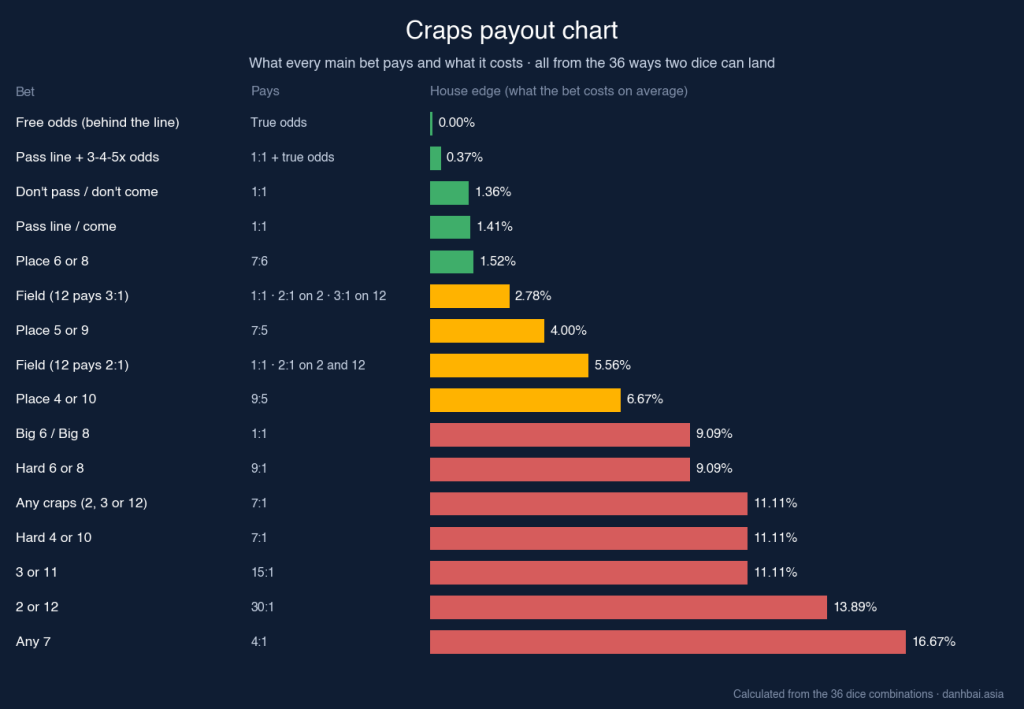
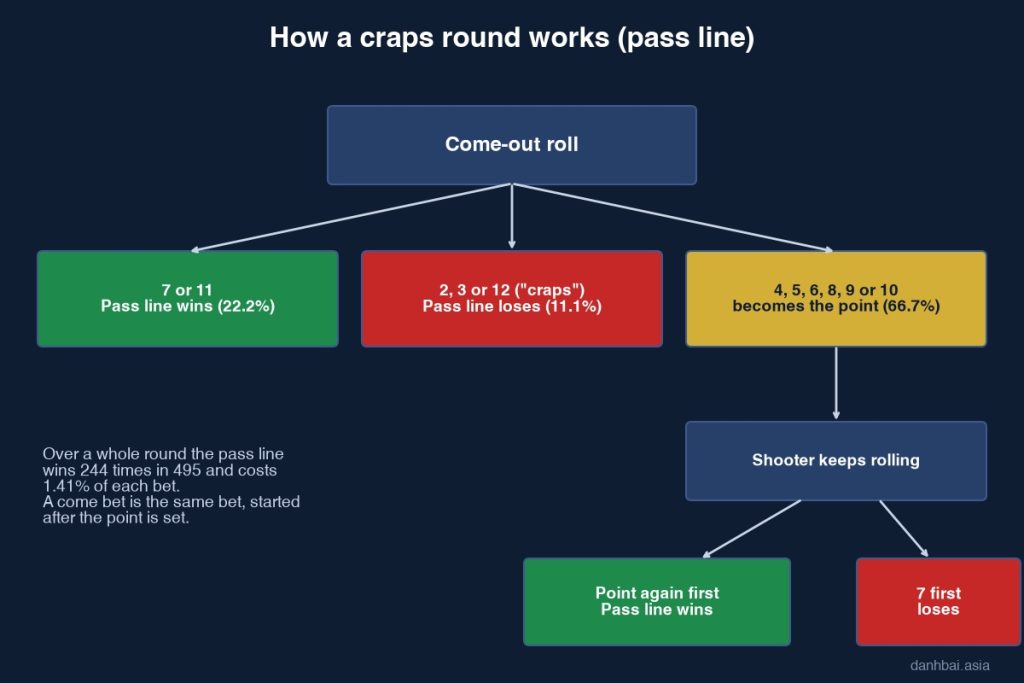
Craps has the widest range of any dice game — several dozen boxes on one layout, running from the best bet in the casino to some of the worst. The shooter throws two dice. On the come out roll, 7 or 11 wins the pass line and 2, 3 or 12 loses it; any other number becomes the point, and the shooter keeps rolling until either the point repeats (pass line wins) or a 7 arrives (pass line loses). Everything below follows from the 36 ways two dice can land.
The row that matters most is the third one. Big 6 and Big 8 are the same wager as place 6 and place 8 — you are betting a 6 or an 8 arrives before a 7 either way — but the place bet pays 7:6 and the Big bet pays even money, so the identical bet costs 1.52% in one box and 9.09% in the box next to it. Nothing on the layout tells you that.
The free odds bet is the other thing worth knowing. Once a point is set you can back your pass line bet with an additional wager paid at true odds, with no house margin at all. It is the only zero-edge bet available anywhere in a casino, and because it dilutes the 1.41% across a larger total wager, a pass line backed with 3-4-5x odds costs 0.37% overall. How much you are allowed to back is set by the table, so check the maximum before you sit down.
Free odds, buy and lay bets: what they pay
The odds bet pays the true odds of the point, so its payout depends on which number is the point. That is also why tables quote “3-4-5x odds”: three times your line bet on 4 or 10, four times on 5 or 9 and five times on 6 or 8 means a winning odds bet always pays six times the line bet.
A buy bet is a place bet paid at true odds, in exchange for a 5% commission; a lay bet is the opposite — a bet that a 7 comes before the number — with the commission charged on what it would win. On 4 or 10, where the place bet costs 6.67%, buying costs 4.76% if the commission is taken when you make the bet and 1.67% if it is taken only from wins; laying 4 or 10 costs 2.44% or 1.67%. On 6 or 8 the place bet (1.52%) is cheaper than buying, so few players buy those numbers.
Craps odds chart: how often each total rolls
Every price on the layout comes from this table. Two dice land 36 ways, and each total covers a fixed number of them:
Read a one-roll bet against it and the cost is plain: 12 comes 1 time in 36, so fair odds would be 35 to 1, and the 30:1 the layout pays is where its 13.89% edge comes from. The same table gives the point numbers’ odds against a 7: 6 to 3 for a 4 or 10 (so 2:1), 6 to 4 for a 5 or 9 (3:2) and 6 to 5 for a 6 or 8 (6:5) — exactly what the odds bet pays.
How to Play Craps: One Round, Step by Step
- Bet the pass line before the come-out roll. It is the basic craps bet, and the one the rest of the game is built around. (Don’t pass is the same round from the other side.)
- The come-out roll settles it at once a third of the time. A 7 or 11 wins (22.2% of come-out rolls), a 2, 3 or 12 loses (11.1%). Any other total — 4, 5, 6, 8, 9 or 10 — becomes the point (66.7%).
- Once there is a point, the shooter keeps rolling. If the point comes up again before a 7, the pass line wins even money; if a 7 comes first, it loses. Every other total in between does nothing to the pass line.
- Add free odds if you want the cheapest money on the table. Behind a pass line bet with a point set, the odds bet pays true odds: 2:1 on 4 or 10, 3:2 on 5 or 9, 6:5 on 6 or 8.
That is the whole game for most players. The other boxes on the layout are side bets on single rolls or single numbers, and the table above shows what each one costs.
What Is a Come Bet in Craps?
A come bet is a pass line bet made after the point is already set. The next roll acts as its own come-out roll: 7 or 11 wins the come bet, 2, 3 or 12 loses it, and any other number becomes the come bet’s own point, which then has to repeat before a 7. It pays even money and costs exactly what the pass line costs, 1.41%, and you can add free odds to it the same way. Players use it to have several numbers working at once without paying the higher edge of the place bets on 4, 5, 9 and 10. Don’t come is the mirror bet, at 1.36%.
How to Play Crapless Craps
Crapless craps removes the come-out loss. A 7 still wins on the come-out roll, but 2, 3, 12 and also 11 become points instead of deciding the bet, so every total except 7 is a point. Odds bets behind the new points pay true odds of 6:1 on 2 or 12 and 3:1 on 3 or 11.
It sounds friendlier and costs more. The come-out roll stops paying on 11 and the points 2, 3, 11 and 12 are hard to repeat before a 7 — a 2 or 12 point wins only one time in seven — so the pass line edge rises from 1.41% to 5.38%. Don’t pass is usually not offered at a crapless table at all. Our crapless craps guide prices every bet on the crapless layout.
What Is Bubble Craps?
Bubble craps is the casino-floor nickname for electronic craps machines that throw real dice inside a sealed clear dome. A burst of air from under the dome tumbles two regulation dice, sensors read the result, and every player at the machine bets on their own touchscreen. There is no dealer and no shooter to wait for. Interblock and Aruze Gaming make most of the cabinets, and a single-player or multi-seat version is common in Las Vegas and other US casinos.
The rules and the bets are the same as table craps, which is why the best bubble craps strategy is the table-craps one: pass or don’t pass, free odds behind them, and place 6 or 8, while staying away from the one-roll proposition boxes. Two things are worth checking on the screen before you play — how much free odds the machine allows, and whether the field pays 2:1 or 3:1 on 12, which doubles or halves that bet’s cost. Some cabinets run the crapless version described above. See how to play bubble craps for a step-by-step guide to the machines. The main appeal is the minimum bet, which on a machine can be a few dollars where a live table asks $15 or more. Online, the nearest equivalents are RNG craps and live-dealer craps, played on the same rules.
7 Up 7 Down: Rules, Payouts and Odds
7 Up 7 Down is a two-dice game played in Indian casinos, at home and in online RNG lobbies. Two dice are rolled and you bet on their total: 7 Down wins on 2 to 6, 7 Up wins on 8 to 12, and Lucky 7 wins on exactly 7. On the standard table, 7 Down and 7 Up pay 1:1 and Lucky 7 pays 4:1.
Every bet costs the same 16.67%. Seven is the most likely total of two dice, coming up on 6 of the 36 combinations, and both 7 Up and 7 Down lose when it does. That makes 7 Up 7 Down far more expensive than the craps pass line at 1.41% or Big and Small in sic bo at 2.78%. Lucky 7 would be a fair bet with no house edge at 5:1; a table that pays less than 4:1 costs more.
Charts of past rolls and “trick” sheets cannot change these figures, because every roll of two dice is independent of the one before. Online versions, such as King Midas Games’ 7 Up 7 Down and Funky Games’ 7 Up Down in the 22bet casino lobby, can add extra bets or use a different paytable, so check the payout table in the game’s help screen before you play.