


Phom Rules: How to Play Phỏm (Tá Lả), the Vietnamese Rummy
October 7, 2026
Phỏm, also called Tá Lả, is one of the most played card games in Vietnam, especially in the north. Unlike Tiến Lên or Sâm Lốc, where you race to empty your hand, Phỏm is a rummy-type game: you build melds and try to finish with the fewest points in unmatched cards. This guide covers the deal, melds, a turn, ù and móm, laying off, scoring, and the odds of being dealt a meld.
Setup
- Deck: a standard 52-card deck, no jokers.
- Players: usually 2 to 4.
- Deal: the first player gets 10 cards, everyone else 9.
- Stock (nọc): the rest of the deck is placed face down in the middle and used for drawing.
Melds (phỏm) and near-melds (cạ)
A phỏm is a valid set of at least three cards, in one of two forms:
- Set (phỏm ngang): three or more cards of the same rank, for example 7♣ 7♦ 7♥.
- Run (phỏm dọc): three or more consecutive cards of the same suit, for example 6♠ 7♠ 8♠. A-2-3 counts as a run; Q-K-A does not.
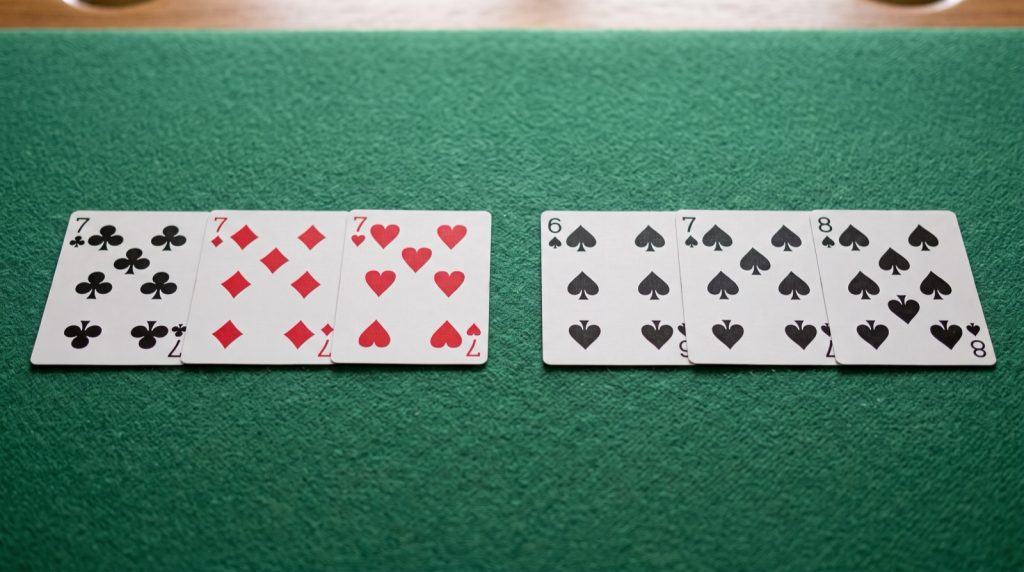
A cạ is a pair of cards one card short of a meld (7♣ 7♦, or 6♠ 7♠). Cards that are not part of any meld at the end of the round are deadwood (bài rác) and count against you.
A turn: take, draw, discard
The first player starts by discarding a card. On each turn after that you have two options:
- Take (ăn) the card the previous player just discarded, but only if it completes a meld with cards in your hand.
- Draw (bốc) a card from the stock if you do not take.
Either way, you then discard one card. A round usually runs four rounds of play, so each player discards four times.
Ù and móm
- Ù: every card in your hand is part of a meld, with no deadwood left. You win outright and the round ends at once.
- Móm: you reach the end of the round without a single meld. Móm is usually the heaviest loss at the table.
Phom odds: how often you are dealt a meld
Counting every hand that can be dealt from 52 cards (A-2-3 is a run, Q-K-A is not):
| Hand on the deal | 9 cards | 10 cards (first player) |
|---|---|---|
| At least one meld | 29.85% | 39.79% |
| No meld yet | 70.15% | 60.21% |
| Every card already in melds (instant ù) | about 1 in 37,700 | about 1 in 115,700 |
In other words, about 7 in 10 nine-card hands start without a single meld. Most melds are built during the four rounds of taking and drawing, so the near-melds you hold and when you take or draw matter more than the deal. An ù on the deal is extremely rare: of the more than 3.6 billion possible nine-card hands, only 97,624 are fully melded.
Laying down and laying off
In the last round, players lay their melds face up on the table. If one of your deadwood cards fits a meld someone else has laid down, you can lay it off (gửi) onto that meld, and it no longer counts against you. Laying off is the main way to cut your score at the end of a round.
Scoring
If nobody goes ù after four rounds, everyone adds up the deadwood left in hand:
- Ace = 1 point.
- 2 to 10 = face value.
- Jack = 11, Queen = 12, King = 13.
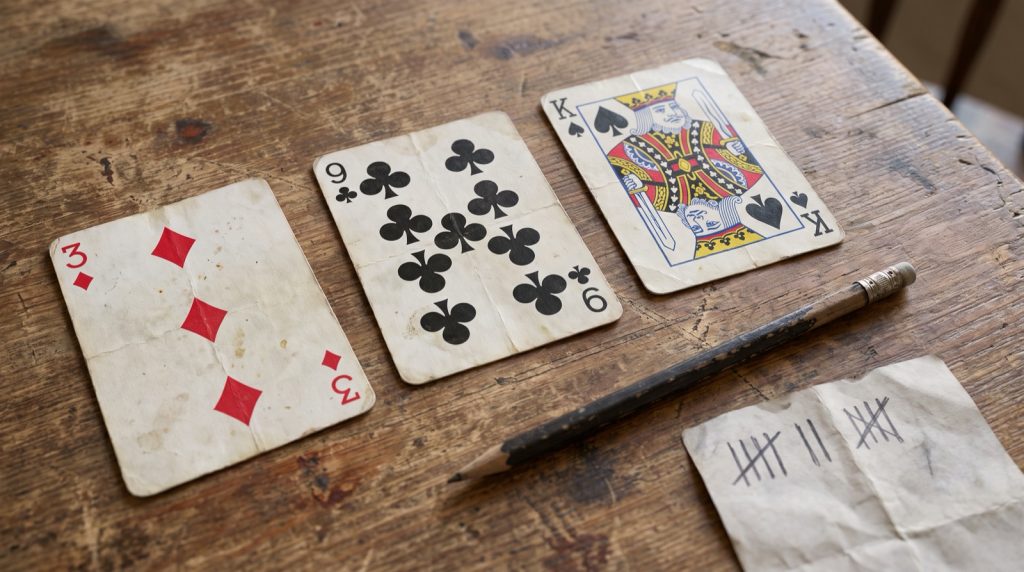
Example: you finish with 3♦, 9♣ and K♠ unmatched, so your score is 3 + 9 + 13 = 25 points. Because jacks, queens and kings are the most expensive cards, a lone picture card is usually the first deadwood to be discarded.
The lowest deadwood total wins. The highest score (or a móm) is the main loser of the round.
Taking the last discard (ăn chốt) and paying for ù
The last discard of a turn is called the chốt. If you take the chốt from the player before you and someone then goes ù, you may have to pay for it (đền) on that player’s behalf. Rules on ăn chốt, đền and calling are among the most varied at Vietnamese tables, so agree on them before you start.
Phom vs other Vietnamese card games
| Phỏm | Tiến Lên | Sâm Lốc | |
|---|---|---|---|
| Type | Rummy: build melds | Shedding: empty your hand | Shedding: empty your hand |
| Cards each | 9 (first player 10) | 13 | 10 |
| Players | 2–4 | 2–4 | 2–5 |
| Who wins | Ù, or lowest deadwood | First to go out | First to go out |
Because Phỏm is won by building melds and keeping deadwood low, it rewards counting, remembering what has been discarded, and deciding when to take. See all the Vietnamese card games, including Mậu Binh and Xì Dách.
Playing card games online
Phỏm itself is rarely found in international online casinos. The card games you will find there are live-dealer tables such as blackjack, baccarat and poker. 22bet’s live casino, for example, has more than 100 blackjack tables. If you want to play for real money, set a budget first.
Play responsibly
Played for money, Phỏm is a form of gambling. Treat it as entertainment with a cost, set limits on time and money before you start, and stop when they are reached. For adults 18 and over only.

22bet

20Bet
Phom FAQ
How many cards do you get in Phom?
The first player gets 10 cards and everyone else 9, from a standard 52-card deck without jokers. The rest of the deck is the stock you draw from.
What is a phom?
A valid meld of at least three cards: either three or more of the same rank (7♣ 7♦ 7♥) or three or more consecutive cards of one suit (6♠ 7♠ 8♠). A-2-3 is a run; Q-K-A is not.
What does ù mean in Phom?
Ù means every card in your hand is part of a meld, with no deadwood left. You win outright and the round ends immediately.
How is Phom scored?
If nobody goes ù after four rounds, add up your deadwood: ace = 1, 2 to 10 = face value, jack/queen/king = 11/12/13. The lowest total wins.
What are the odds of being dealt a meld in Phom?
About 29.85% of nine-card hands contain at least one meld, and 39.79% of the first player’s ten-card hands. About 70% of nine-card hands start with none, and an ù on the deal happens about once in 37,700 hands.
Is Phom the same as Tá Lả?
Yes. Phỏm and Tá Lả are two names for the same game, played with the same rules.