


To Tom Rules: How to Play Tổ Tôm, the Vietnamese 120-Card Game
October 8, 2026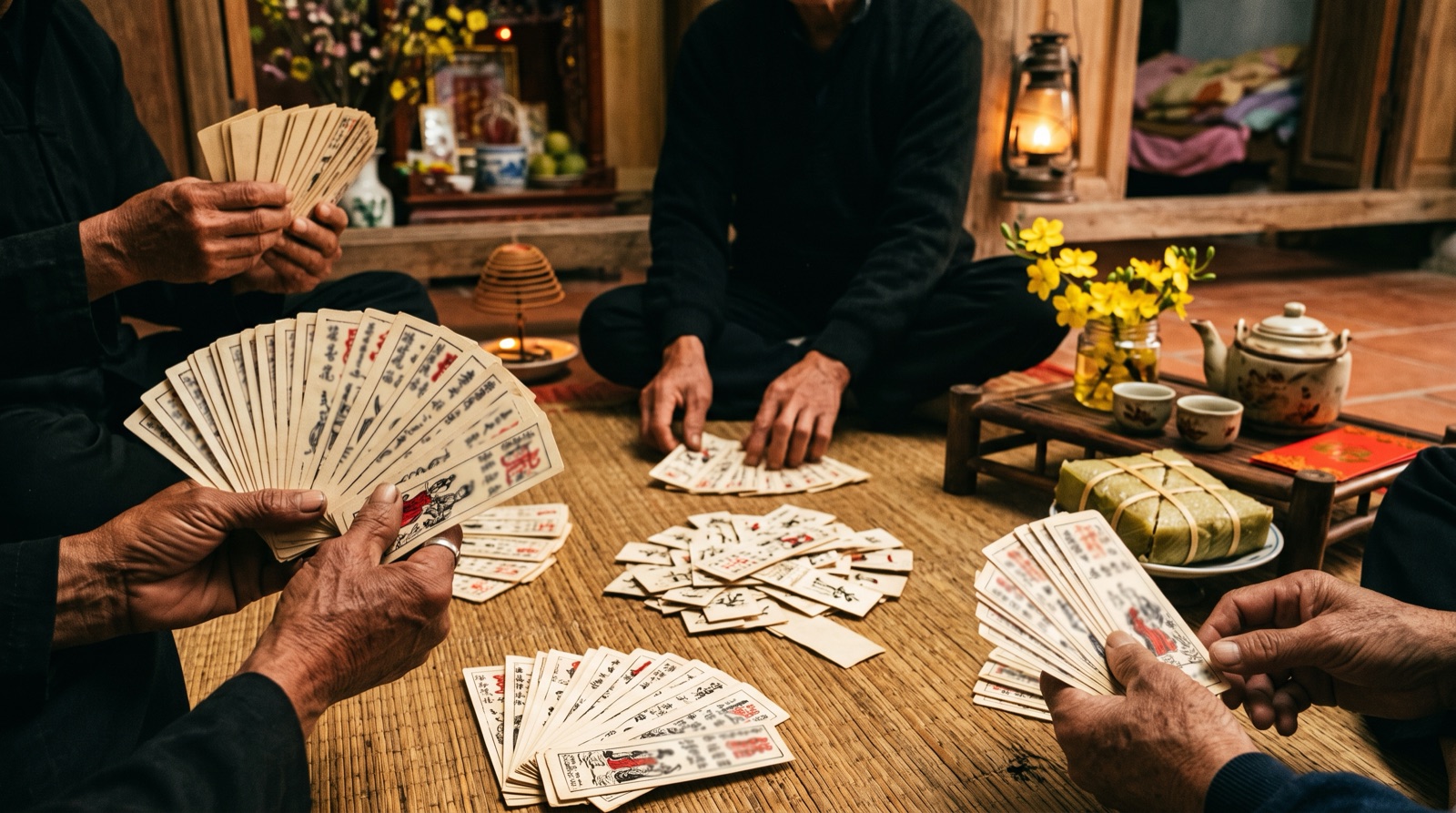
Tổ Tôm is the traditional Vietnamese card game with the reputation of being the hardest to learn. It uses its own deck of 120 long, narrow cards marked in Chinese characters, it takes five players, and it comes with a vocabulary that newcomers need a few sessions to absorb. It belongs to the rummy family: the aim is to arrange every card in your hand into valid combinations and declare a finished hand. This guide explains the deck, the deal, what phu and ù mean, how Tổ Tôm differs from Chắn — and why the cards show Japanese figures.
The 120-card Tổ Tôm deck
The deck has 30 different cards, four copies of each: 30 × 4 = 120.
- 27 suited cards: three suits — Vạn (萬, myriads), Sách (索, strings) and Văn (文, cash) — each running from 1 (nhất) to 9 (cửu). 3 × 9 = 27.
- 3 special cards: ông lão (the old man), thang thang and chi chi.
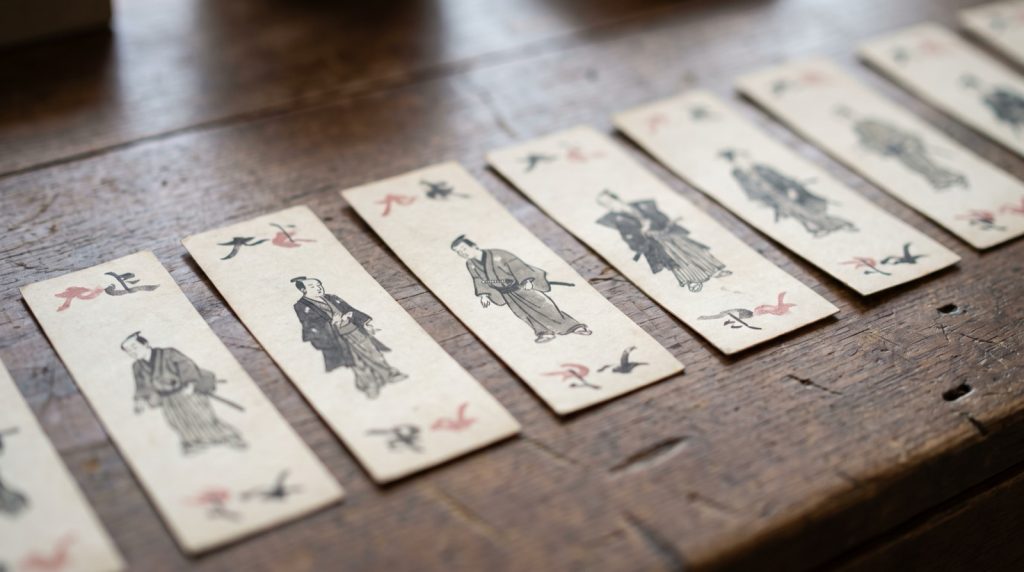
Each card shows its rank at one end and its suit at the other, both as Chinese characters. The full-length figure in the middle of the card has no bearing on its value. 28 cards are overprinted in red — the 8s and 9s of strings and myriads, and the special cards — and the other 92 are printed black on white.
Because every card exists exactly four times, experienced players keep count: once three copies of a card have appeared, only one is left. Reading the characters is the first hurdle — you have to learn the faces before you can learn the rules.
Why are there Japanese figures on Tổ Tôm cards?
This is the detail that surprises almost everyone. The figures on the cards are drawn in Japanese Edo-period dress — accounts describe 18 men, 4 women and 4 children — alongside very Japanese images such as carp, peaches, castles and boats. The deck as it is known today was printed by a French firm in Marseille during the colonial period.
Yet the Japanese do not play Tổ Tôm. Vietnamese press reports say Japanese readers who looked at the characters on the cards could not read them, or could only guess, and Japanese scholars including Professor Yumio Sakurai have studied the question without settling it. The pictures are Japanese, the game is Vietnamese, and the link between the two is still an open question — so “Tổ Tôm comes from Japan” is not an established fact.
The deal
- Tổ Tôm is played by five players.
- The 120 cards are split into six piles of 20.
- Five piles go to the five players; the sixth becomes the stock (nọc), which players draw from during the hand.
- The dealer ends up with 21 cards, one more than everyone else, and plays first.
Play then goes round the table: players draw from the stock, take discarded cards they can use, and discard, each trying to fit their whole hand into phu.
Phu: the valid combinations
A phu is a valid combination of three or more cards. There are two basic kinds:
- Phu dọc (run): three consecutive ranks in the same suit — for example 2, 3 and 4 of Vạn.
- Phu bí (set): the same rank in three different suits — for example the 5 of Vạn, the 5 of Sách and the 5 of Văn.
| Basic phu | How many kinds | Why |
|---|---|---|
| Phu dọc (runs) | 21 | 7 runs per suit (1-2-3 up to 7-8-9) × 3 suits |
| Phu bí (sets) | 9 | one for each rank, 1 to 9, using one card from each suit |
On top of these, some special groupings are accepted as phu by convention — for example 1 of Vạn, 1 of Sách and 9 of Văn. This is one of the areas where tables differ, so agree it before you start. If you know Phỏm, a phu is the same idea as a phỏm: a group of cards that belongs together.
Ù: winning the hand
Ù means going out and winning the hand. The basic conditions are:
- All 21 cards in your hand are in phu, with no loose card left over (a loose card is called què).
- The hand contains at least one lưng.
A lưng is a required condition for ù, but rule sets do not agree on one fixed definition of it, and it varies by region. The same goes for the scoring system (cước): Tổ Tôm has a great many special winning hands, each with its own value, and how they are scored differs a lot between rule sets. Ask how the table plays before the first deal.
Tổ Tôm vs Chắn
The two games use the same cards, and Chắn is essentially the reduced version of Tổ Tôm:
| Tổ Tôm | Chắn | |
|---|---|---|
| Cards | All 120 (30 kinds × 4) | 100 — the three 1s, thang thang and ông lão are removed (5 kinds × 4 = 20 cards); chi chi stays |
| Players | 5 | 4 in the usual chắn bí tứ format |
| Cards each | 20 (dealer 21) | 19 (dealer 20) |
| Learning curve | Steep | Gentler: fewer cards, tighter rules, faster rounds |
Because it is easier to learn, Chắn is far more widely played, especially in the north. If Tổ Tôm feels like too much, start with Chắn: same cards, same way of thinking, lighter rules. See all the Vietnamese card games and their decks.
Can you play Tổ Tôm at an online casino?
No. Tổ Tôm needs its own 120-card deck, so it is not in the lobbies of the online casinos we list. The card games they carry are baccarat, blackjack, poker and a handful of Asian three-card games. 22bet’s casino lobby has three versions of Bài Cào from King Midas Games plus live Teen Patti tables, and 20Bet’s live casino lists Three Card Poker and Teen Patti. If you play for real money, set a budget first.
Play responsibly
Tổ Tôm belongs to village life, festivals and Tết, and in that setting it is a game of skill and culture. Played for money, it is gambling, with a real risk of losing it. Treat it as entertainment, not a way to earn, and set limits before you play. For adults 18 and over only.

22bet

20Bet
To Tom FAQ
How many cards are in a Tổ Tôm deck?
120: thirty different cards with four copies of each. Twenty-seven are suited — three suits (Vạn, Sách, Văn) from 1 to 9 — and three are special cards: ông lão, thang thang and chi chi.
How many people play Tổ Tôm?
Five. The deck is split into six piles of 20: one for each player and one as the stock. The dealer ends with 21 cards and plays first.
Why do Tổ Tôm cards show Japanese figures?
The figures wear Japanese Edo-period dress, and the deck as known today was printed by a French firm in Marseille in the colonial period. The Japanese do not play the game, and scholars have not settled how the two are connected, so a Japanese origin is not an established fact.
What is a phu in Tổ Tôm?
A valid combination of three or more cards. A phu dọc is three consecutive ranks in one suit; a phu bí is the same rank in all three suits. Some extra groupings are accepted by convention at many tables.
What does ù mean in Tổ Tôm?
Ù is winning the hand: all 21 cards are in phu with no loose card (què), and the hand includes at least one lưng. How a lưng is defined varies by rule set, so agree it before playing.
What is the difference between Tổ Tôm and Chắn?
Same cards, but Chắn removes the three 1s, thang thang and ông lão — 20 cards — and plays with the remaining 100, usually four players with 19 cards each (dealer 20). It is simpler, faster and much more widely played.