


Tam Cuc Rules: How to Play Tam Cúc, the Vietnamese Tết Card Game
October 8, 2026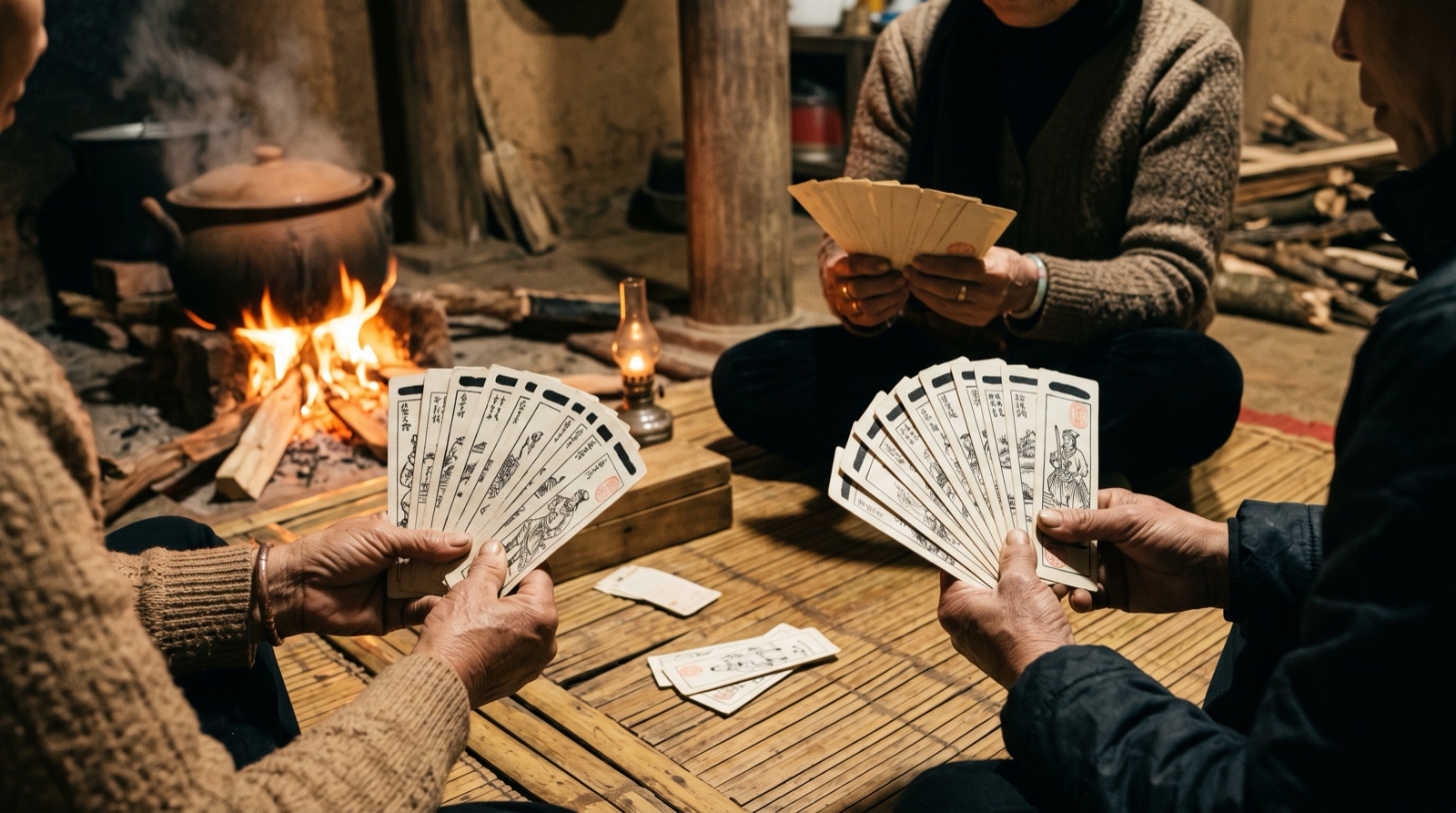
Tam Cúc (三菊, “three chrysanthemums”) is the traditional card game of northern Vietnam, and above all a Tết game: families in the Red River Delta spread a mat and play it while they wait for the bánh chưng to finish boiling. The deck is small, the rules fit in one hand, and it has left its mark on everyday Vietnamese — the phrase đi đêm, a secret side deal, comes from this game. This guide covers the 32-card deck, the ranking, the deal for two to four players, how a round works, and the endgame moves kết and đè.
The 32-card Tam Cúc deck
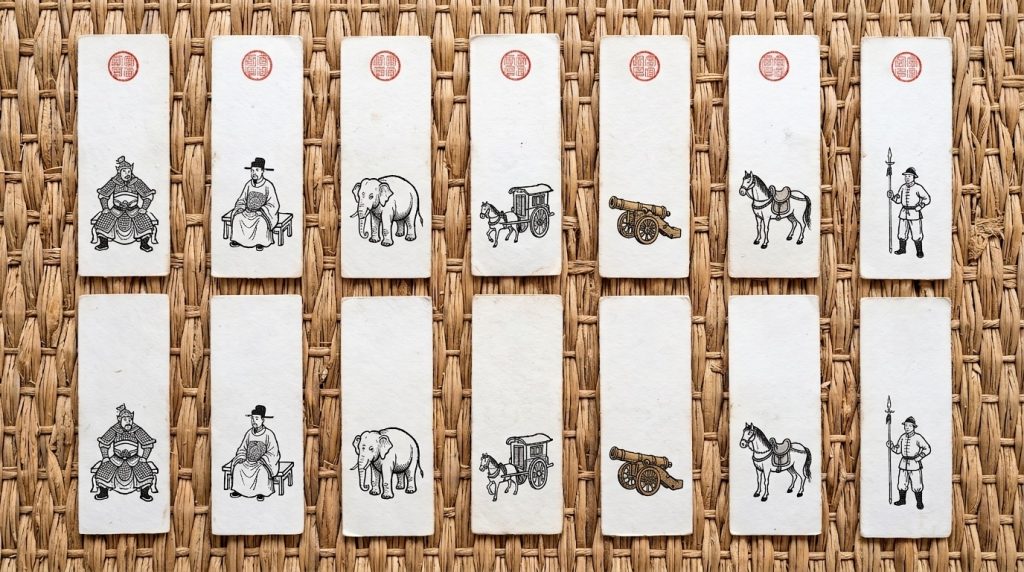
The deck has 32 long, narrow cards: 16 red and 16 black, named after the pieces of Chinese chess (cờ tướng). Each colour holds:
| Piece | Character | Per colour | In the deck |
|---|---|---|---|
| Tướng (general) | 將 | 1 | 2 |
| Sĩ (advisor) | 士 | 2 | 4 |
| Tượng (elephant) | 象 | 2 | 4 |
| Xe (chariot) | 車 | 2 | 4 |
| Pháo (cannon) | 砲 | 2 | 4 |
| Mã (horse) | 馬 | 2 | 4 |
| Tốt (soldier) | 卒 | 5 | 10 |
| Total | 16 | 32 |
Cards are white with the piece written in black Chinese characters — the red cards carry an extra round red seal — and a small picture: a general seated with flags behind him, an official in a winged hat, an elephant, a cart, a cannon, a horse, a soldier with a spear. The characters are the ones used for the black pieces in Chinese chess, even on the red cards. All 32 backs are identical.
Some cards have their own names at the table: the red general is tướng ông (“Mr General”), the black one tướng bà (“Mrs General”), the red advisor sĩ điều, and the elephants tượng hồng (red) and tượng thâm (black).
Card ranking
From highest to lowest: Tướng > Sĩ > Tượng > Xe > Pháo > Mã > Tốt. Between two cards of the same piece, red beats black. So the highest card in the deck is tướng ông and the lowest is a black soldier.
The rule newcomers get wrong: rank comes before colour. Colour only separates two cards of the same piece, so a black elephant still beats a red cannon. Note too that the cannon outranks the horse, the opposite of some Chinese games played with similar cards.
Valid combinations
- Pair (đôi): two identical cards of the same colour — two red advisors, two black cannons.
- Triple (ba): only two exist, both in one colour: Tướng–Sĩ–Tượng or Xe–Pháo–Mã. The first beats the second. Sĩ–Tượng–Xe, Tượng–Xe–Pháo, Pháo–Mã–Tốt or three soldiers are not triples — Tam Cúc triples are fixed groups, not runs.
- Four sons (tứ tử): four soldiers of one colour.
- Five sons (ngũ tử): all five soldiers of one colour.
Players and the deal
Tam Cúc is played by two, three or four, and the whole deck is dealt out — unlike Tứ Sắc, there is no stock to draw from.
- Four players: 8 cards each.
- Two players: 16 cards each. Some families instead deal as for three and leave one pile face down.
- Three players: 32 does not divide by three, so cards come out first. Either remove one red and one black soldier (30 cards, 10 each), or remove five cards — both generals, one red advisor, one red soldier and one black soldier (27 cards, 9 each). Agree which before dealing.
To pick the dealer (nhà cái), one player draws a card and counts round to the right reading Tướng, Sĩ, Tượng, Xe, Pháo, Mã, Tốt; the player the count stops on at the drawn card’s name is the dealer, who deals first and leads first.
How a round is played
- The leader plays and calls the number of cards: one, a pair or a triple. Everyone else must play the same number.
- Cards go down face down. When all have played, the leader turns theirs over first, then the others in turn.
- The highest play wins the round and the lead for the next one.
- A player may also chui — concede the round without turning their cards up, so nobody sees what they hold. Cards lost this way are discarded. It trades one lost round for information you keep hidden.
The opening restriction. On the very first lead of a hand the strongest cards are barred. With two or four players the saying is “cấm tướng, cấm sĩ, lấy tượng cầm đầu” — no generals, no advisors, the red elephant is the highest card you may lead. With three players it is “cấm sĩ, cấm tượng, lấy xe cầm đầu” — the red chariot is the highest. Leading a barred card forfeits the round.
Four sons and five sons
Because holding four or five soldiers of one colour is rare, Tam Cúc rewards it:
- Two or four players: with four sons you may lay them down and win them (tứ tử trình làng), but you do not take the lead. With five sons you may take the lead and lay them down at any time (ngũ tử cướp cái).
- Three players: four sons can be laid down at any time and take the lead. Five sons cannot happen, since a red and a black soldier were removed.
Laying down soldiers does not count as the first lead, so the opening restriction still applies afterwards.
How rare is it? The exact odds
| Table | Four or more soldiers of one colour | All five |
|---|---|---|
| 4 players, 8 cards — your hand | 1.72% (about 1 deal in 58) | 0.056% (about 1 in 1,800) |
| 4 players — anyone at the table | 6.75% (about 1 deal in 15) | — |
| 3 players, 30-card deck, 10 cards | 1.53% | impossible |
| 2 players, 16 cards | 31.6% | 4.33% |
At the common four-player table, someone lays down four sons roughly once every fifteen hands. Head to head with 16 cards each it happens almost one deal in three.
The endgame: kết and đè
The most interesting part of Tam Cúc is the last round. If the leader plays a pair of black soldiers — the weakest pair in the deck — on the final round and still wins it, that is kết đôi. Finishing with a Xe–Pháo–Mã triple is kết ba. If another player holds a higher combination — say a red Xe–Pháo–Mã against a black one — they can beat it, which is called đè.
So a kết is a deliberate gamble: you close the hand with your weakest cards and only win if nobody can beat them. Land it and you score a bonus; get beaten and the player who beat it scores instead.
Scoring
The basic ranking is simple: whoever has won the most cards finishes first, then second and third. Successful kết, and successful đè, add bonus points at the end of each hand — but there is no national scoring table, and values vary by region and family. One commonly quoted scale, as an example only:
| Finish | If it wins | If it is beaten (đè) |
|---|---|---|
| Kết đôi | +2 | 4 |
| Kết ba | +3 | 6 |
| Kết with four sons | +8 | 16 |
Under this scale the finishing pair, triple or four sons must be black. Settle the scale before the first hand.
Đi đêm, and other words from the game
Đi đêm — “walking at night” — is when two players secretly swap cards, face down, so both can build more combinations. Not every table allows it. The phrase passed into everyday Vietnamese for any quiet deal between two sides, as did tứ tử trình làng and ngũ tử cướp cái. Tam Cúc is in Vietnamese poetry too: Hoàng Cầm’s poem Cây Tam Cúc, later set to music by Phạm Duy, and Trần Đăng Khoa’s Đánh tam cúc.
See the other Vietnamese card games, including Tổ Tôm, traditionally the men’s game while Tam Cúc was played mostly by women.
Can you play Tam Cúc at an online casino?
No. Tam Cúc uses its own 32-card chess deck, so it is not in the lobbies of the online casinos we list. The card games they carry are baccarat, blackjack, poker and a handful of Asian three-card games. 22bet’s casino lobby has three versions of Bài Cào from King Midas Games plus live Teen Patti tables, and 20Bet’s live casino lists Three Card Poker and Teen Patti. If you play for real money, set a budget first.
Play responsibly
Tam Cúc is a family game for Tết, and at its best it stays that way. Played for money it is gambling, with a real risk of losing it: treat it as entertainment, do not chase losses, and set limits before you start. For adults 18 and over only.

22bet

20Bet
Tam Cuc FAQ
How many cards are in a Tam Cúc deck?
32: sixteen red and sixteen black. Each colour has one general, five soldiers, and two each of advisor, elephant, chariot, cannon and horse.
What is the order of cards in Tam Cúc?
General, advisor, elephant, chariot, cannon, horse, soldier. Between two cards of the same piece, red beats black. The highest card is the red general (tướng ông), the lowest a black soldier.
Does a black elephant beat a red cannon?
Yes. Rank comes first; colour only decides between two cards of the same piece. This is the rule newcomers most often get wrong.
How many players can play Tam Cúc?
Two to four, and the whole deck is dealt: 8 cards each for four players, 16 for two. Three players remove two soldiers (10 cards each) or five cards (9 each) first.
Which triples are valid in Tam Cúc?
Only two, both in one colour: general–advisor–elephant, or chariot–cannon–horse. Other three-card runs and three soldiers are not triples.
How often do you get four soldiers of one colour?
In a four-player game about 1.7% of your hands (1 in 58), and someone at the table has them in about 6.75% of deals. All five soldiers are about 1 hand in 1,800.