


No-Vig Calculator: Fair Odds, Vig and Bookmaker Margin
October 29, 2026
This no-vig calculator takes the odds of every outcome in a betting market and shows two things: the vig — the bookmaker’s margin built into the prices — and the fair odds with that margin removed. It works in American, decimal and fractional odds, for two-way markets like a point spread or a total and for three-way markets like a football 1X2, with all four common de-vig methods side by side.
The calculator needs JavaScript. The tables below cover the same figures.
How to use the no-vig calculator
- No-vig fair odds. Choose the odds format and enter the price of every outcome of one market from one sportsbook: both sides of a spread, total or moneyline, or home, draw and away for a 1X2 (add up to six outcomes for markets like a race or an outright). You get the vig, the overround, and a table of the fair odds and fair chance of each outcome under the multiplicative, additive, power and Shin methods. The method you pick is highlighted.
- What the vig costs. Enter the odds of a bet and the chance you think it really has — or press the button to take outcome 1 from the first tab — with a stake and a number of bets. The calculator shows the win rate the price needs to break even and the expected result per bet and over all of them.
What is the vig?
The vig — short for vigorish, and also called the juice, the hold or the bookmaker’s margin — is the share of the money staked that a sportsbook expects to keep. It is not charged as a fee: it is built into the odds, which are set a little shorter than the true chances.
You can see it by turning each price into an implied probability (1 ÷ decimal odds). For a fair coin-flip market both sides would be +100 (2.00), 50% each, adding up to exactly 100%. Priced at −110 on both sides (1.909), each side implies 52.38%, and the two add up to 104.76%. That total is the overround or “book”.
- Overround − 1 = 4.76%: how far the prices add up past 100%.
- Vig (hold) = 1 − 1 ÷ overround = 4.55%: the share of all money staked the book keeps if it takes the same amount on each side. Bet 110 on each side of a −110 / −110 line, 220 in total: whichever side wins is paid 210, and 10 of the 220 — 4.55% — stays with the book.
Both numbers are quoted as “the vig”, so a −110 market is described as 4.5% or 4.8% depending on the source. The calculator shows both.
How to calculate the vig and the fair odds
- Turn each price into decimal odds, and each decimal price into an implied probability: 1 ÷ odds.
- Add the implied probabilities: that is the overround. The vig is 1 − 1 ÷ overround.
- Scale the implied probabilities back down so they add up to 100% — those are the fair chances — and the fair odds are 1 ÷ fair chance.
Step 3 is where the methods differ: there is more than one way to take the margin back out. Common two-way prices:
| Prices | Overround | Vig (hold) | Fair odds, multiplicative | Fair odds, power |
|---|---|---|---|---|
| −105 / −105 | 102.44% | 2.38% | +100 / +100 | +100 / +100 |
| −110 / −110 | 104.76% | 4.55% | +100 / +100 | +100 / +100 |
| −115 / −115 | 106.98% | 6.52% | +100 / +100 | +100 / +100 |
| −115 / −105 | 104.71% | 4.50% | −104 / +104 | −105 / +105 |
| −120 / +100 | 104.55% | 4.35% | −109 / +109 | −110 / +110 |
| −150 / +130 | 103.48% | 3.36% | −138 / +138 | −140 / +140 |
| −200 / +170 | 103.70% | 3.57% | −180 / +180 | −186 / +186 |
| −300 / +240 | 104.41% | 4.23% | −255 / +255 | −275 / +275 |
When both sides carry the same price, every method gives +100 / +100. When one side is a clear favourite, the methods disagree, and the gap grows the more lopsided the market.
The four de-vig methods
- Multiplicative (also called proportional, or the basic or normalisation method): divide each implied probability by the overround. It assumes the margin is spread in proportion to each outcome’s chance. It is the simplest and the most widely used, including in the margin tab of our bet calculator.
- Additive: subtract the same amount from every implied probability — the excess divided by the number of outcomes. On a very long shot it can give a negative chance, which the calculator shows as n/a.
- Power: raise every implied probability to the same power k, choosing k so the results add up to 100%. Long shots shrink proportionally more than favourites.
- Shin: a model from economist Hyun Song Shin that treats the margin as the bookmaker’s protection against bettors with inside information, which matters most on long shots. In a two-way market Shin gives exactly the same answer as additive.
An example from 22bet’s NFL moneyline: New England at Miami, Patriots 3.66 (+266), Dolphins 1.28 (−357). The overround is 105.45% and the vig 5.17%. Multiplicative makes the Patriots’ fair price +286 (25.9%); additive and Shin +307 (24.6%); power +319 (23.9%). The same prices, three different fair odds for the underdog.
A three-way example, 22bet’s Premier League 1X2 for Tottenham v Crystal Palace at 1.525 / 4.44 / 5.75 (overround 105.49%, vig 5.20%):
| Method | Tottenham | Draw | Crystal Palace |
|---|---|---|---|
| Bookmaker odds | 1.525 (65.6%) | 4.44 (22.5%) | 5.75 (17.4%) |
| Multiplicative | 1.609 (62.2%) | 4.684 (21.4%) | 6.066 (16.5%) |
| Additive | 1.569 (63.7%) | 4.832 (20.7%) | 6.426 (15.6%) |
| Power | 1.566 (63.9%) | 4.871 (20.5%) | 6.411 (15.6%) |
| Shin | 1.579 (63.3%) | 4.794 (20.9%) | 6.327 (15.8%) |
Multiplicative leaves the most chance on the outsider and the least on the favourite; power and additive do the opposite, with Shin in between.
Which de-vig method is most accurate?
To see which method matches what actually happens, we took the average bookmaker odds for home, draw and away in every match of Europe’s top five leagues — the Premier League, La Liga, Serie A, the Bundesliga and Ligue 1 — from 2012–13 to 2024–25, as recorded by football-data.co.uk: 23,488 matches with an average vig of 4.78%. We removed the vig from each match with all four methods and compared the fair chances with the results.
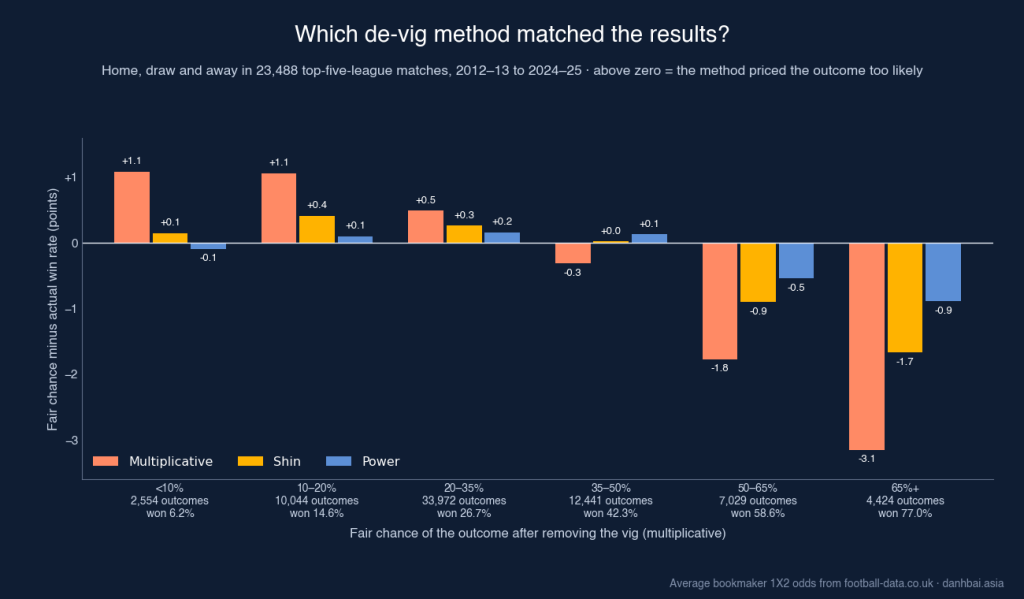
Grouped by fair chance, the multiplicative method priced long shots too high and favourites too low. Outcomes it rated under 10% won 6.19% of the time against 7.27% priced; outcomes it rated 65% or more won 76.99% against 73.84% priced. That is the favourite-longshot bias: bookmakers build more of their margin into the long shots than into the favourites, so spreading the margin in proportion — as the multiplicative method does — leaves the long shots too short. Power, additive and Shin all take more of the margin off the long shots and land closer to the results; power was within 0.9 points in every group.
| Method | Log loss (lower = closer to the results) | Favourites rated 65%+: priced / won | Long shots rated under 10%: priced / won |
|---|---|---|---|
| Power | 0.96529 | 76.10% / 76.99% | 6.10% / 6.19% |
| Additive | 0.96536 | 75.83% / 76.99% | 6.00% / 6.19% |
| Shin | 0.96542 | 75.32% / 76.99% | 6.34% / 6.19% |
| Multiplicative | 0.96592 | 73.84% / 76.99% | 7.27% / 6.19% |
The differences between power, additive and Shin are small enough that another set of seasons could order them differently; the gap to multiplicative is the clear result. That is why the calculator opens on the power method. For a two-way market priced close to even — most spreads and totals — all four methods give nearly the same fair odds, as the −110 / −110 and −115 / −105 rows above show. The choice matters for moneylines with a big favourite, 1X2 markets and outrights.
How much vig do sportsbooks charge?
The standard American price for spreads and totals is −110 on both sides, a vig of 4.55%. At 22bet the main NFL spreads and totals in week 8 of the 2026 season carried a margin of about 5% — 1.90 (−111) on each side is 5.0% — and Premier League 1X2 prices about 5.1%. The average odds football-data.co.uk records across bookmakers carried a 1X2 margin of 4.78% in our sample.
The margin varies by market. Alternative spreads and totals, player props and outrights usually carry more than the main line. And the margin compounds when you combine bets: a parlay multiplies the prices, so it multiplies the margin too — our accumulator bet guide shows how quickly it grows with each leg.
What the vig costs you
The second tab turns the vig into money. A bet at −110 needs to win 52.38% of the time to break even. If the outcome is really a coin flip, each 100 staked loses 4.55 on average, so 100 such bets of 100 cost about 455 — exactly the hold. For an even-priced two-way market, the expected loss per bet equals the vig.
Fair odds are also the reference for comparing prices. Measured against the no-vig closing price, that comparison is called closing line value. If the fair chance of a side is 50% and a sportsbook offers +105 on it, the expected result is +2.5% of the stake: 50% × 2.05 − 1. Fair odds are only an estimate, though — as good as the market they were taken from, and results vary widely from bet to bet. A fair chance from one bookmaker’s prices tells you what that bookmaker thinks, with its margin taken out. How much of a bankroll to stake when a price is above your fair odds is what the Kelly criterion calculator works out.
Sports betting is for adults 18 and over. The vig means the expected result of a typical bet is a small loss. Set a budget before you bet and stop when it is used up.

22bet
No-vig calculator FAQ
What is a no-vig calculator?
A tool that takes the odds of every outcome in a betting market, works out the bookmaker’s margin (the vig) and removes it, giving the fair odds and fair chance of each outcome. Enter both sides of a two-way market, or every outcome of a three-way market such as a football 1X2.
How do you calculate the vig?
Convert each price to an implied probability (1 ÷ decimal odds) and add them up to get the overround. The vig, or hold, is 1 − 1 ÷ overround. At −110 / −110 the implied probabilities are 52.38% each, the overround 104.76% and the vig 4.55%.
What is the vig on −110?
4.55% of the money staked on both sides (the hold), or 4.76% measured as the overround. A −110 bet needs to win 52.38% of the time to break even.
What does vigorish mean?
Vigorish is the bookmaker’s charge for taking a bet, built into the odds. The word came into English through Yiddish from the Russian vyigrysh, meaning winnings. Vig, juice and hold mean the same thing.
What is the difference between overround and vig?
The overround is how far the implied probabilities of a market add up past 100% — 104.76% for −110 / −110. The vig or hold is the share of the money staked the bookmaker keeps: 1 − 1 ÷ overround, or 4.55% for −110 / −110. Both are sometimes called the margin.
Which de-vig method is most accurate?
In 23,488 top-five-league football matches from 2012–13 to 2024–25, the power method matched the results most closely, with additive and Shin close behind. The multiplicative method was furthest off: it priced long shots too high and favourites too low. For two-way markets priced near even, all four give almost the same fair odds.
What are no-vig fair odds?
The odds a market would show if the bookmaker took no margin: each outcome’s fair chance turned back into a price, 1 ÷ fair chance. At −110 / −110 the fair odds are +100 on each side.