


Kelly Criterion Calculator: Stake Size, Half Kelly and Bankroll Simulation
October 29, 2026
This Kelly criterion calculator works out how much of your bankroll to stake on a bet, given the odds and the chance you think the bet has of winning. It shows the full Kelly stake and any fraction of it — half, quarter or one-tenth Kelly — with the edge and the expected growth per bet, and a second tab simulates a run of bets so you can see how much each stake size swings.
The calculator needs JavaScript. The tables below cover the same figures.
How to use the Kelly calculator
- Kelly stake. Enter the odds (American, decimal or fractional), your win chance as a percentage, your bankroll and the Kelly fraction you want to use. The calculator shows the stake, the full Kelly percentage, your edge, the break-even win rate for those odds and the expected growth per bet. If your chance is at or below break-even, the Kelly stake is zero.
- Simulate a run of bets. Choose a number of bets and press the button. The calculator plays the same 2,000 runs of bets at quarter, half, full and double Kelly (and your own fraction if it is different) and shows the median end bankroll, the 10th and 90th percentiles, how often a run ends below the start and how often it falls to half the starting bankroll at some point.
What is the Kelly criterion?
The Kelly criterion is a formula for the size of a bet. It was published in 1956 by John L. Kelly Jr., a researcher at Bell Labs, in a paper on information theory, and was later applied to blackjack and investing by the mathematician Edward Thorp. It answers one question: if you know the chance of winning and the odds, what share of your bankroll should you stake so that the bankroll grows fastest over many bets?
The formula:
Kelly stake = (b × p − q) ÷ b
- b = decimal odds − 1 (what you win per 1 staked: 1.10 at odds of 2.10, or +110)
- p = your chance of winning
- q = 1 − p, your chance of losing
A bet at +110 (2.10) that wins 50% of the time: (1.10 × 0.50 − 0.50) ÷ 1.10 = 4.55% of the bankroll. Its edge — the expected return per 1 staked, p × decimal odds − 1 — is 0.50 × 2.10 − 1 = +5%.
The same formula can be written as (p − break-even) ÷ (1 − break-even), where break-even is 1 ÷ decimal odds. That shows what drives the stake: how far your chance sits above the chance the price already implies. At even money each point above 50% adds 2% of the bankroll.
Kelly stakes at common odds
Full Kelly as a share of the bankroll, for a win chance 1, 2.5 and 5 points above the break-even of each price:
| Odds | Break-even | +1 point | +2.5 points | +5 points |
|---|---|---|---|---|
| −200 (1.50) | 66.7% | 3.00% | 7.50% | 15.00% |
| −110 (1.91) | 52.4% | 2.10% | 5.25% | 10.50% |
| +100 (2.00) | 50.0% | 2.00% | 5.00% | 10.00% |
| +150 (2.50) | 40.0% | 1.67% | 4.17% | 8.33% |
| +200 (3.00) | 33.3% | 1.50% | 3.75% | 7.50% |
| +400 (5.00) | 20.0% | 1.25% | 3.13% | 6.25% |
For the same number of points above break-even, Kelly stakes more on a favourite than on a long shot, because a long shot loses more often and the bankroll has to survive the losing runs.
Full, half and double Kelly over 1,000 bets
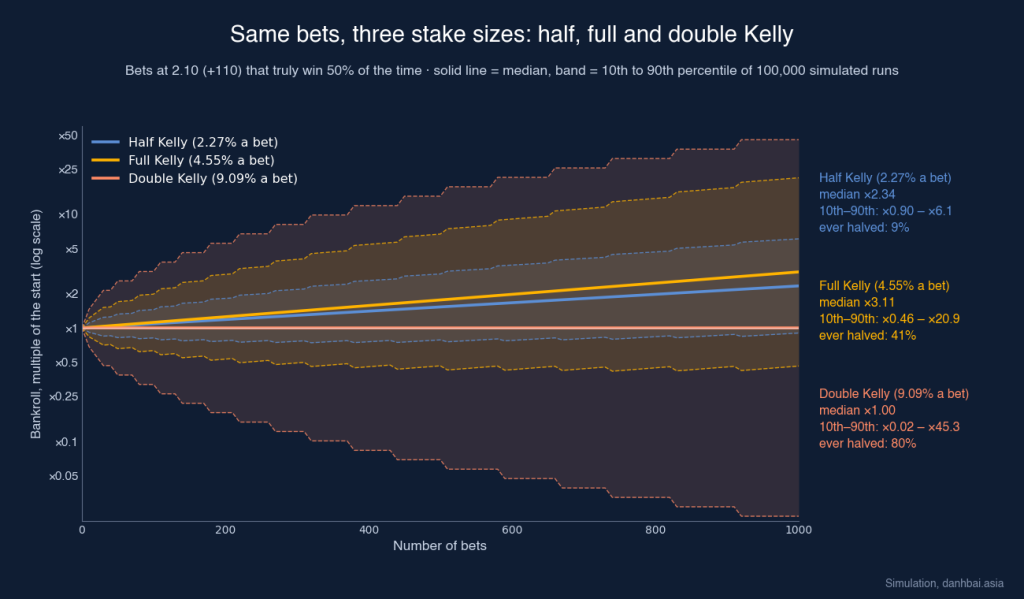
Kelly maximises the long-run growth rate of the bankroll — the average of its logarithm — not the result of any one bet. To see what that looks like, we simulated 100,000 runs of 1,000 bets at 2.10 (+110) that each win exactly 50% of the time, the same results for every stake size:
| Stake | % of bankroll a bet | Median after 1,000 bets | 10th – 90th percentile | Ends below the start | Ever halved |
|---|---|---|---|---|---|
| Quarter Kelly | 1.14% | ×1.64 | ×1.02 – ×2.65 | 9.9% | 0.3% |
| Half Kelly | 2.27% | ×2.34 | ×0.90 – ×6.08 | 13.6% | 9.2% |
| Full Kelly | 4.55% | ×3.11 | ×0.46 – ×20.9 | 23.7% | 41.1% |
| Double Kelly | 9.09% | ×1.00 | ×0.02 – ×45.3 | 50.0% | 79.9% |
Three things stand out:
- Full Kelly swings hard. Even with a 5% edge on every bet, 41% of runs fell to half the starting bankroll at some point, and almost a quarter ended the 1,000 bets below where they started. Over an unlimited number of bets the chance that full Kelly halves the bankroll at some point is about 50% (Thorp’s continuous approximation: the chance of ever falling to a share x of the start is x at full Kelly).
- Half Kelly keeps three-quarters of the growth. Its expected growth per bet is 75% of full Kelly’s, while the share of runs that ever halved dropped from 41% to 9%. That trade is why many bettors who use Kelly stake a fraction of it.
- Double Kelly grows nothing. At twice the Kelly stake the expected growth rate is zero — here exactly — and the median run ends where it began, with 80% of runs halving along the way. Beyond about twice Kelly the bankroll shrinks over time even though every bet has a positive edge.
Why the win chance matters most
Every number above assumes the 50% is exactly right. In practice nobody knows the true chance of a sports result; the win chance you enter is an estimate, and Kelly turns any error in it straight into the stake. Put the same +110 bet at 55% when it is really 50%, and Kelly stakes 14.09% of the bankroll — 3.1 times the right Kelly stake. At that size the expected growth per bet is −0.39%: the bankroll shrinks on average even though the bets have a real 5% edge. Overestimating the chance is the same as betting more than Kelly, which is the other reason fractional Kelly is common.
A starting point for the win chance is the market itself. Our no-vig calculator removes the bookmaker’s margin from a set of prices and gives the fair chance of each outcome. If you put that fair chance into the Kelly calculator against the same bookmaker’s price, the answer is always zero: the margin means the price is below fair, the edge is negative and Kelly stakes nothing. A standard −110 bet on a true coin flip has an edge of −4.55%.
The formula here is for one bet at a time. For several bets running at once, the stakes that maximise growth are somewhat smaller than the single-bet Kelly figure for each, and the calculator does not combine them. For converting odds and checking payouts, use the bet calculator; to compare the prices you took with where the market closed, the CLV calculator.
Sports betting is for adults 18 and over. A staking formula does not change the odds of a bet, and most bets carry a negative edge once the margin is counted. Set a budget before you bet and stop when it is used up.

22bet
Kelly criterion calculator FAQ
What is the Kelly criterion?
A formula for bet size, published by John L. Kelly Jr. in 1956: stake (b × p − q) ÷ b of your bankroll, where b is the decimal odds minus 1, p your chance of winning and q = 1 − p. It is the stake that maximises the long-run growth rate of the bankroll when p is known.
How do you calculate a Kelly bet?
Take the decimal odds minus 1 (b), multiply by your win chance (p), subtract your chance of losing (q) and divide by b. At +110 (2.10) and a 50% chance: (1.10 × 0.50 − 0.50) ÷ 1.10 = 4.55% of the bankroll. Multiply by 0.5 for half Kelly.
What is half Kelly?
Staking half of what the Kelly formula gives. In our simulation of 1,000 bets with a 5% edge, half Kelly kept 75% of full Kelly’s expected growth rate, while the share of runs that fell to half the starting bankroll at some point dropped from 41% to 9%.
What does a negative Kelly number mean?
That the bet has no edge at your win chance: the chance is at or below the break-even for those odds, so the expected return is zero or negative. Kelly’s answer is to stake nothing; the calculator shows 0.
What happens if you bet more than Kelly?
The swings grow and the growth rate falls. At twice the Kelly stake the expected growth rate is about zero, and beyond that the bankroll shrinks over time even if every bet has a positive edge. Overestimating your win chance has the same effect, because Kelly then sizes the stake on a chance that is too high.
Is the Kelly criterion used in sports betting?
Yes, as a staking rule by bettors who estimate their own probabilities, usually as a fraction of full Kelly because those estimates are uncertain. It needs a positive edge to recommend any stake: on a bet whose fair chance comes from the same bookmaker’s prices, the margin makes the edge negative and Kelly stakes nothing.