


Closing Line Value (CLV): Meaning, Calculator and What the Data Shows
October 29, 2026
Closing line value (CLV) measures how the odds you took compare with the odds when betting closed — the last price before the event started. If you took 2.10 and the price closed at 1.95, the market moved towards your bet and you have positive CLV. The calculator below works it out for one bet, against the closing price or the no-vig closing price, and for a whole list of bets.
The calculator needs JavaScript. The worked examples below cover the same steps.
How to use the CLV calculator
- CLV of one bet. Enter the odds you took and the closing odds of the same side. You get the CLV against the closing price and the chance each price implies. To measure against the no-vig close, also enter the other closing prices of the market — the other side of a spread, total or moneyline, or the draw and the other team in a 1X2. The calculator removes the margin and shows the fair closing odds and your CLV against them.
- CLV of a list of bets. Paste one bet per line — the odds you took, then the closing odds — and the calculator shows the average CLV and how many of the bets beat, matched or missed the close.
What is closing line value?
The closing line is the last price a sportsbook offers before an event starts. By then the price has absorbed everything the market has learned — team news, line-ups, weather and the money already bet — so it is the market’s best estimate of the chance of each outcome. Closing line value is the difference between the price you got and that final price.
- Positive CLV: your odds are longer than the closing odds. You bet the Lakers at +150 and they closed at +130; you bet over 2.5 goals at 2.10 and it closed at 1.95.
- Negative CLV: the price drifted after you bet. You took 1.80 and it closed at 1.95.
Bettors track CLV because it settles faster than profit. A single bet wins or loses, and it takes thousands of bets for results to separate skill from luck. CLV can be measured on every bet the moment the event starts.
How to calculate CLV
There are three common ways, from simplest to most precise:
- Against the closing price: CLV = your odds ÷ closing odds − 1. At 2.10 against a close of 1.95: 2.10 ÷ 1.95 − 1 = +7.7%.
- As a change in implied probability: 1 ÷ 1.95 = 51.3% at the close, against 1 ÷ 2.10 = 47.6% at your price, a move of 3.7 points.
- Against the no-vig close: remove the bookmaker’s margin from all the closing prices of the market to get the fair closing chance, then CLV = your odds × fair chance − 1. If the 1X2 closed at 1.95 / 3.80 / 4.20 (a margin of 1.4%), the fair chance of the 1.95 side is 50.8% and your CLV is 2.10 × 0.508 − 1 = +6.7%.
The third version is the one that estimates what the bet was worth, because the closing price itself still contains the margin. That can change the answer. You bet a spread at −110 (1.91) and it closed −115 / −105 (1.87 / 1.95): against the closing price your CLV is +2.1%, but with the margin removed the fair closing chance of your side is 51.1% and your CLV is −2.4%. The line moved your way, by less than the margin. Our no-vig calculator explains the de-vig methods; this calculator uses the power method.
Why the closing line is the benchmark
To see how prices behave between the early market and kick-off, we took every match in Europe’s top five leagues — the Premier League, La Liga, Serie A, the Bundesliga and Ligue 1 — from 2019–20 to 2024–25: 10,699 matches with Pinnacle’s 1X2 prices recorded twice by football-data.co.uk, once early (on Friday afternoon for weekend games and Tuesday afternoon for midweek games) and once at the close.
| Early price | Closing price | |
|---|---|---|
| Log loss of the no-vig chances against results (lower = more accurate) | 0.97173 | 0.96902 |
| Pinnacle margin | 2.89% | 2.63% |
| Average margin across bookmakers | 4.38% | 4.30% |
The closing prices predicted the results better than the early ones, and the margin was lower at the close. Prices also move a lot in between: the median price changed by 4.4% from the early market to the close, 45.6% of all home, draw and away prices moved by 5% or more, 18.9% by 10% or more, and only 2.4% did not move at all.
CLV and results: 32,097 football outcomes
For each of the 32,097 home, draw and away outcomes in those matches we worked out the CLV of a bet at Pinnacle’s early price against the no-vig closing price, grouped the outcomes by CLV, and compared it with what a bet of 1 on every outcome in the group actually returned:
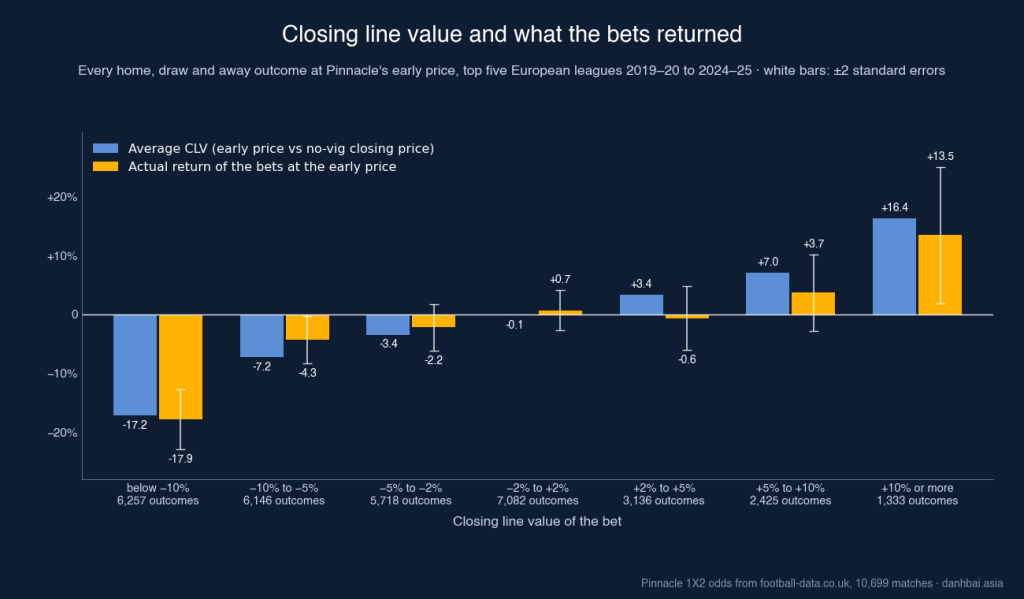
| CLV of the bet | Outcomes | Average CLV | Actual return | ± 2 standard errors |
|---|---|---|---|---|
| Below −10% | 6,257 | −17.2% | −17.9% | ± 5.1 |
| −10% to −5% | 6,146 | −7.2% | −4.3% | ± 4.1 |
| −5% to −2% | 5,718 | −3.4% | −2.2% | ± 4.0 |
| −2% to +2% | 7,082 | −0.1% | +0.7% | ± 3.5 |
| +2% to +5% | 3,136 | +3.4% | −0.6% | ± 5.4 |
| +5% to +10% | 2,425 | +7.0% | +3.7% | ± 6.4 |
| +10% or more | 1,333 | +16.4% | +13.5% | ± 11.6 |
Across all the outcomes, each point of CLV went with about 0.89 points of return (standard error 0.10), which is close to one for one: CLV against the no-vig close is a good estimate of what a bet is worth. The table also shows why bettors use CLV rather than profit to judge their bets. Even with 1,333 bets in a group, the actual return could sit 11 points either side of the expected one by chance; the CLV of each bet is known at kick-off.
Two cautions. This is hindsight: the closing price is only known when the market closes, and at the time of betting nobody knows which way a price will move. And most outcomes went the other way — 56.5% had a CLV below −2% at the early price, and only 21.5% had a CLV above +2%. Over all 32,097 outcomes, betting every one at the early price returned −3.8%, and at the closing price −3.5%.
Which closing line to use
- Use a sharp, high-limit market if you can. Pinnacle’s closing prices, with a low margin and high limits, and the average across many bookmakers are the usual references. The closing price at the sportsbook where you bet works too, but it measures that book’s line, not the market’s.
- Compare like with like: the same market, the same line and the same settlement rules. A spread of −3.5 is not comparable with a close of −3; in a 1X2, use all three closing prices to remove the margin.
- Thin markets close less accurately. Lower leagues, player props and niche sports attract less money, so their closing prices are a weaker benchmark than a Premier League or NFL main line.
- Live bets have no closing line in the same sense; CLV applies to bets placed before the start.
To turn a price into fair odds and a stake, see the no-vig calculator and the Kelly criterion calculator; to convert odds or work out a payout, the bet calculator.
Sports betting is for adults 18 and over. CLV measures prices, not results, and a run of bets can lose whatever their CLV. Set a budget before you bet and stop when it is used up.

22bet
Closing line value FAQ
What does CLV mean in betting?
Closing line value: how the odds you took compare with the closing odds, the last price before the event started. Taking 2.10 on a price that closed at 1.95 is positive CLV; taking 1.80 on a price that closed at 1.95 is negative CLV.
How do you calculate CLV?
The simple version is your odds ÷ closing odds − 1: 2.10 against a close of 1.95 is +7.7%. The more precise version removes the margin from all the closing prices of the market and uses your odds × fair closing chance − 1.
Why does closing line value matter?
Because the closing price is the market’s most accurate estimate of the chance of each outcome. In 10,699 top-five-league matches, Pinnacle’s closing 1X2 prices predicted results better than its prices from the Friday or Tuesday before, and bets grouped by CLV returned close to their CLV: about 0.89 points of return per point of CLV.
What is a good CLV?
A positive average CLV against the no-vig close of a sharp market means your bets were priced better than the market’s final estimate. In our football sample only 21.5% of outcomes had a CLV above +2% at the early price, and 56.5% were below −2%.
What is the closing line?
The last odds a sportsbook offers on a market before the event starts. For a football match it is the price at kick-off; after that the market either closes or moves to in-play betting.
Can you have positive CLV and still lose money?
Yes. CLV measures the price, not the result, and results vary a lot over a small number of bets. In our data, a group of 1,333 bets could return 11 points more or less than its CLV by chance.