


Bet Calculator: Payouts for American, Decimal and Fractional Odds
October 25, 2026
Enter your odds and stake and the bet calculator shows what the bet pays: the total payout, the profit, the implied probability of the price, and the same odds in American, decimal and fractional form. Four calculators in one: a single bet, a parlay (accumulator) of up to 12 legs, an each-way bet, and the bookmaker’s margin with the fair, no-vig odds.
The calculator needs JavaScript. The formulas below give the same results.
How to use the bet calculator
- Single bet: pick the odds format, type the odds as your bookmaker shows them (−110, 1.91 or 10/11) and your stake. The payout includes your stake; the profit does not.
- Parlay / accumulator: enter the odds of each leg. The calculator multiplies them into the parlay price and shows the payout. Add or remove legs with the buttons.
- Each way: enter the odds, the stake per way, the place terms (1/4 or 1/5 of the odds are the usual ones in horse racing) and the result.
- Margin / no-vig: enter the prices of every outcome in a market — both sides of a spread or a total, or home, draw and away in a 1X2 — to see the bookmaker’s margin and what each price would be without it.
How to calculate a bet payout
Every odds format describes the same thing — how much a winning bet pays — in a different way. The quickest way to work out any payout is to turn the odds into decimal odds and multiply by the stake.
| Format | What it means | Profit on a winning bet |
|---|---|---|
| American, minus (−110) | Stake needed to make 100 profit | stake × 100 ÷ 110 |
| American, plus (+150) | Profit on a 100 stake | stake × 150 ÷ 100 |
| Decimal (2.50) | Total payout per 1 staked, stake included | stake × (2.50 − 1) |
| Fractional (3/2) | Profit relative to the stake | stake × 3 ÷ 2 |
To convert: decimal odds = 1 + American ÷ 100 for a plus price, and 1 + 100 ÷ |American| for a minus price; decimal odds = 1 + fraction for fractional odds. Then payout = stake × decimal odds and profit = payout − stake. Four worked bets:
| Bet | Decimal odds | Profit | Total payout |
|---|---|---|---|
| 100 at −110 | 1.909 | 90.91 | 190.91 |
| 100 at +150 (3/2) | 2.50 | 150.00 | 250.00 |
| 50 at −200 (1/2) | 1.50 | 25.00 | 75.00 |
| 20 at +250 (5/2) | 3.50 | 50.00 | 70.00 |
The −110 line is the standard price on both sides of a point spread or a total in US sports: you risk 110 to make 100. Our moneyline and 1X2 guide explains how favourites and underdogs are priced, and the Asian odds guide covers the Hong Kong and Malay formats used by Asian bookmakers.
Odds conversion chart
Common prices in all three formats, with the implied probability — the chance the price says the outcome has, before the bookmaker’s margin is taken out.
| American | Decimal | Fractional | Implied probability |
|---|---|---|---|
| −1000 | 1.10 | 1/10 | 90.91% |
| −500 | 1.20 | 1/5 | 83.33% |
| −300 | 1.33 | 1/3 | 75.00% |
| −250 | 1.40 | 2/5 | 71.43% |
| −200 | 1.50 | 1/2 | 66.67% |
| −150 | 1.67 | 2/3 | 60.00% |
| −120 | 1.83 | 5/6 | 54.55% |
| −110 | 1.91 | 10/11 | 52.38% |
| −105 | 1.95 | 20/21 | 51.22% |
| +100 | 2.00 | 1/1 (evens) | 50.00% |
| +110 | 2.10 | 11/10 | 47.62% |
| +120 | 2.20 | 6/5 | 45.45% |
| +150 | 2.50 | 3/2 | 40.00% |
| +200 | 3.00 | 2/1 | 33.33% |
| +250 | 3.50 | 5/2 | 28.57% |
| +300 | 4.00 | 3/1 | 25.00% |
| +500 | 6.00 | 5/1 | 16.67% |
| +1000 | 11.00 | 10/1 | 9.09% |
Implied probability = 1 ÷ decimal odds. For American odds that is |odds| ÷ (|odds| + 100) for a minus price and 100 ÷ (odds + 100) for a plus price: −110 is 110 ÷ 210 = 52.38%.
How parlay payouts are calculated
A parlay (an accumulator, or “acca”, in Europe) pays only if every leg wins, and its price is the product of the legs’ decimal odds. Three legs at −110: 1.909 × 1.909 × 1.909 = 6.958, so a 10 stake pays 69.58 — American odds of +596. If a leg is void or pushes, it usually drops out and the parlay is paid on the remaining legs, as a two-leg parlay in this example. Our accumulator guide covers system bets and round robins. Legs from one match are not multiplied: see the same game parlay guide.
The price multiplies, and so does the bookmaker’s margin. If every leg is a true 50/50 priced at −110, the single bet costs you 4.55% of the stake on average; each leg you add takes another 4.55% off what is left:
| Legs at −110 | Parlay pays | Fair price for 50/50 legs | Expected loss |
|---|---|---|---|
| 2 | +264 | +300 | 8.88% |
| 3 | +596 | +700 | 13.03% |
| 4 | +1228 | +1500 | 16.98% |
| 5 | +2436 | +3100 | 20.75% |
| 6 | +4741 | +6300 | 24.36% |
| 8 | +17545 | +25500 | 31.08% |
| 10 | +64208 | +102300 | 37.20% |
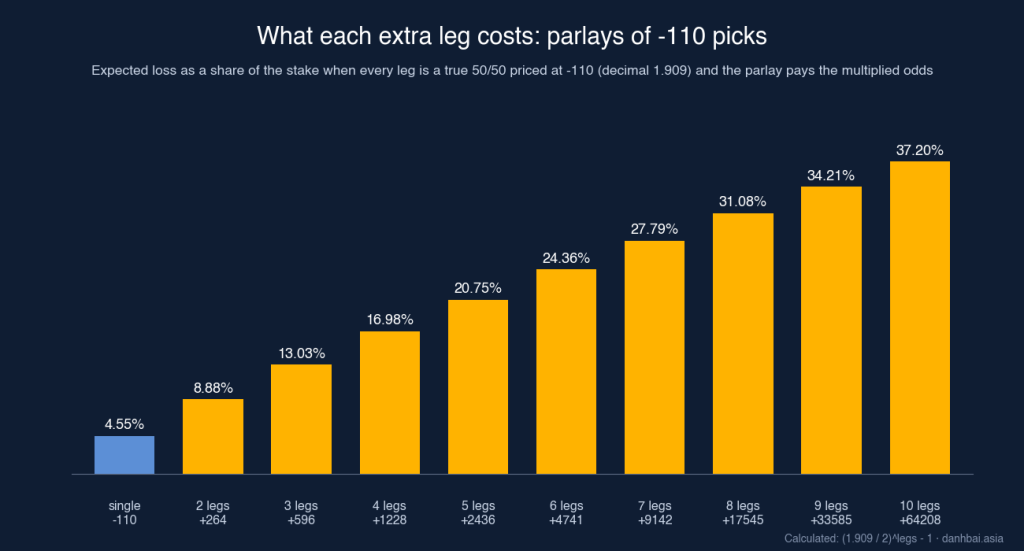
The formula is (1.909 ÷ 2)legs − 1. Real legs are not exact coin flips, but the pattern holds for any price: the margin compounds with every leg you add. The same arithmetic is behind the casino figures in our house edge guide.
Each-way bets
An each-way bet, common in horse racing and golf, is two bets of the same stake: one on the selection to win and one on it to place (finish in the paid places). A 10 each-way bet costs 20. The place part is paid at a fraction of the win odds — the place terms, usually 1/4 or 1/5 of the odds depending on the number of runners.
| 10 each way at 8/1, place terms 1/5 | Win part | Place part (8/5 = 1.6/1) | Total payout |
|---|---|---|---|
| The horse wins | 90.00 | 26.00 | 116.00 |
| The horse places but does not win | 0 | 26.00 | 26.00 |
| The horse finishes outside the places | 0 | 0 | 0 |
A selection that only places returns 26 on a 20 outlay here, a profit of 6; at shorter prices a place-only result can return less than the total stake. Our horse racing betting guide explains win, place and show betting on the US tote.
Implied probability and the bookmaker’s margin
Add up the implied probabilities of every outcome in a market and the total comes to more than 100%. The excess is the bookmaker’s margin, also called the vig or juice:
- Two outcomes at −110 / −110: 52.38% + 52.38% = 104.76% (the overround). The margin on the amount staked is 1 − 1 ÷ 1.0476 = 4.55%.
- A football 1X2 at 2.10 / 3.40 / 3.60: 47.62% + 29.41% + 27.78% = 104.81%, a margin of 4.59%.
To find the fair, no-vig price, divide each implied probability by the total: in the 1X2 example the home win is 47.62 ÷ 104.81 = 45.43%, a fair price of 2.20 instead of 2.10; the draw becomes 28.06% (3.56) and the away win 26.50% (3.77). This proportional method is what the margin calculator above uses. Comparing the margin on the same market at different bookmakers is the simplest way to see which one prices it more tightly.
Things the bet slip may do differently
- Rounding. Bookmakers show odds rounded to two decimals or to a whole American number, so the payout on the slip can differ from the calculator by a cent or two.
- Void legs. A void single returns the stake; a void parlay leg is normally removed and the rest stays live.
- Dead heats. When two selections tie for a paid position, the stake is usually divided by the number tied: a dead heat for first between two horses pays half the stake at the full odds and loses the other half.
- Each-way terms and the number of places paid are set per race, so check them on the slip before you bet.
Bet only what you can afford to lose. A calculator shows what a bet pays; it does not change the odds of it winning.

22bet

20Bet
Bet calculator FAQ
How do you calculate a bet payout?
Convert the odds to decimal and multiply by the stake: payout = stake × decimal odds, and profit = payout − stake. A 100 bet at decimal 2.50 (+150, 3/2) pays 250, a profit of 150.
How much does a 100 bet at −110 pay?
190.91 in total: your 100 back plus 90.91 profit. At −110 you risk 110 to make 100, so every 1 staked makes 0.909.
What does +200 mean in betting?
A 100 bet makes 200 profit if it wins, a total payout of 300. In decimal odds that is 3.00, in fractional odds 2/1, and the implied probability is 33.33%.
How is a parlay payout calculated?
Multiply the decimal odds of every leg and multiply the result by the stake. Three legs at −110 give 1.909 × 1.909 × 1.909 = 6.958, so 10 pays 69.58. All legs must win; a void leg is normally removed.
What is implied probability?
The chance of an outcome that a price implies: 1 ÷ decimal odds. −110 implies 52.38%, +150 implies 40%. Across all outcomes of a market the implied probabilities add up to more than 100%; the excess is the bookmaker’s margin.
How do you calculate the vig or margin?
Add the implied probabilities of every outcome to get the overround, then margin = 1 − 1 ÷ overround. At −110 on both sides the overround is 104.76% and the margin 4.55%.
How does an each-way bet pay?
It is two bets: a win bet and a place bet of the same stake. 10 each way at 8/1 with 1/5 place terms costs 20; if the horse wins it pays 116 (90 + 26), if it only places it pays 26.
Does the payout include my stake?
With decimal odds, yes: decimal odds are the total return per 1 staked. American and fractional odds show the profit only, so add the stake back to get the payout.