


What Is the Spread in Betting? Point Spreads Explained
October 20, 2026
The spread, or point spread, is a handicap that the sportsbook gives the favourite so that betting on either team is close to an even choice. The favourite is listed with a minus number and has to win by more than that many points; the underdog is listed with the same number as a plus and can lose by fewer points, or win outright. A bet on the spread is not a bet on who wins the game. It is a bet on the winning margin.
How the point spread works
Take a line of Favourite −3.5 against Underdog +3.5. Subtract 3.5 points from the favourite’s final score (or add 3.5 to the underdog’s) and see who comes out ahead. That team has covered the spread.
| Final result | Favourite −3.5 | Underdog +3.5 |
|---|---|---|
| Favourite wins by 4 or more | Wins | Loses |
| Favourite wins by 1, 2 or 3 | Loses | Wins |
| Game tied (where ties are possible) | Loses | Wins |
| Underdog wins | Loses | Wins |
The same game usually has a moneyline too, which is a bet on the winner alone at uneven prices: a short price on the favourite, a long one on the underdog. The spread does the opposite. It keeps the prices close to even on both sides and moves the finishing line instead.
What +7, −3, +1.5 and −1.5 mean
- +7: the team is a 7-point underdog. The bet wins if the team wins, or loses by 6 or fewer. A loss by exactly 7 is a push (stake returned); a loss by 8 or more loses.
- −3: the team is a 3-point favourite. It has to win by 4 or more; a 3-point win is a push.
- +1.5: the team can lose by 1 point or win. In baseball and hockey this is the standard run line and puck line, where the spread is almost always 1.5.
- −1.5: the team has to win by 2 or more.
- PK (pick’em): a spread of zero; whoever wins the game wins the bet.
The −110 next to the spread
A spread is quoted with a price as well, most often −110 on both sides. In American odds that means you stake 110 to win 100, so a winning bet returns 210 in total. As decimal odds that is 1.909.
The price is where the sportsbook’s margin sits. To break even at −110 a bettor has to be right 52.38% of the time, not 50%, and a market priced −110 on both sides carries a bookmaker margin of 4.55%. When one side is priced −115 and the other −105, the book is leaning the line toward one team without moving the number itself. The odds formats guide converts American odds into decimal and Asian formats.
Pushes and the half point
A spread with a whole number can land exactly on the margin. Then the bet is a push and the stake comes back. A spread with a half point, such as 3.5 or 7.5, cannot push, because no game ends with half a point; bettors call that half point the hook.
How often a whole-number line pushes depends on how common that margin is. Across NFL games with a closing line of exactly 3 from 1999 to 2025, 9.0% ended with the favourite winning by exactly 3. At a line of 7 it was 6.5%, and at 10 it was 6.6%.
NFL key numbers: 3 and 7
Football scores come in 3s (a field goal) and 7s (a touchdown plus the extra point), so some winning margins turn up far more often than others. These are the key numbers.
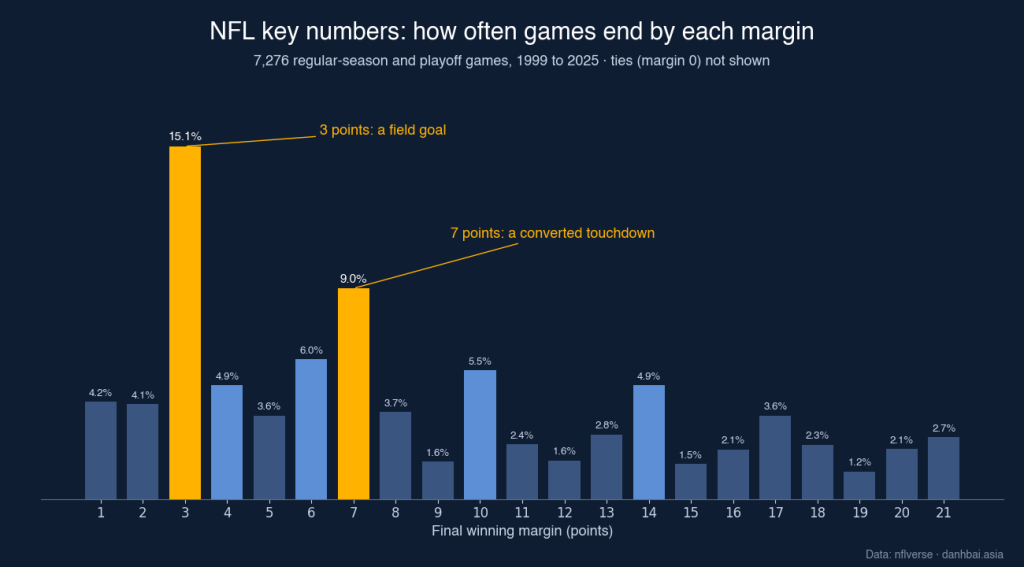
Of 7,276 NFL games from 1999 to 2025, 15.1% were decided by exactly 3 points and 9.0% by exactly 7. The next most common margins were 6 (6.0%), 10 (5.5%), and 4 and 14 (4.9% each). That is why the most common closing spread in those games was 3 (15.9% of games) and the next was 3.5 (9.4%), and why a line moving from 2.5 to 3.5 changes far more than a line moving from 5.5 to 6.5: the first move crosses the margin that decides roughly one game in seven.
How often the favourite covers
The spread is meant to make both sides close to an even bet, so the answer is close to half. Against the closing spread in those 7,276 games, favourites covered 47.4% of the time, underdogs 49.9%, and 2.7% were pushes; 31 games had no favourite at all.
Winning and covering are different questions. The same favourites won outright 66.4% of the time. A 3-point favourite won the game 58.0% of the time but covered only 43.3%, with 9.0% pushes; a 7-point favourite won 75.6% and covered 47.0%. The spread grows with the gap between the teams, so a team that wins far more often than not still covers less than half the time.
Point spread, handicap and spread betting
- Point spread and handicap are the same idea. In football (soccer) the line is quoted in goals, often with quarter lines that split your stake across two handicaps — see Asian handicap.
- Run line and puck line are the baseball and hockey spreads, nearly always set at 1.5.
- In table tennis betting the same match carries two handicaps, one in points and one in games.
- Spread betting in the UK is a different product. Instead of a fixed price, you win or lose a stake per point above or below the firm’s spread, so the result is not capped at one stake. The name is the same; the bet is not.
Sports betting is for adults 18 and over. Set a budget before you bet and stop when it is used up.

22bet

20Bet
Point Spread FAQ
What is the spread in betting?
A handicap in points given to the favourite so that both sides are close to an even bet. The favourite has to win by more than the spread; the underdog covers if it wins or loses by less than the spread.
What does +7 mean in betting?
The team is a 7-point underdog. The bet wins if the team wins or loses by 6 or fewer, is a push (stake returned) on a 7-point loss, and loses on a loss by 8 or more.
What does −3 mean on a spread?
The team is a 3-point favourite and has to win by 4 or more. A win by exactly 3 is a push.
What does +1.5 mean?
The team can lose by 1 point, or win, and the bet still wins. In baseball and hockey, +1.5 and −1.5 are the standard run line and puck line.
What happens if the game lands exactly on the spread?
It is a push and your stake is returned. Spreads with a half point, such as 3.5, cannot push.
What does −110 mean next to the spread?
The price: stake 110 to win 100, or decimal odds of 1.909. At −110 you have to win 52.38% of your bets to break even, and a −110/−110 market carries a 4.55% bookmaker margin.
What are key numbers in the NFL?
The winning margins that come up most often: 3 (15.1% of NFL games from 1999 to 2025) and 7 (9.0%), then 6, 10, 4 and 14. Lines on or around 3 and 7 are where a half point matters most.
Is the point spread the same as a handicap?
Yes. Point spread is the American term; handicap, including Asian handicap in football, is the same idea quoted in goals.