


Horse Racing Betting Guide: How to Bet on Horses, Every Bet Type Explained
October 21, 2026
Horse racing betting starts with one question: which horse finishes where. The simplest bets pick one horse to win or to finish near the front; the exotic bets pick the exact order of two, three, four or five horses, or the winners of several races in a row. This guide explains every common bet type, what each one costs, how the payout is worked out at the track, and how the same race is priced at a bookmaker.
Two ways the bets are priced
- Pari-mutuel (the tote). This is how racetracks and their betting apps work. Every bet of the same type goes into one pool, the track keeps a share (the takeout), and the rest is shared among the winning tickets. The odds on the tote board keep moving until the race starts, and your payout is set by the final odds.
- Fixed odds (a bookmaker). The price is fixed when you place the bet. 22bet, for example, lists each race with two markets: Winner at a fixed price, and Winner, Starting Price (SP), which is settled at the official price when the race starts.
Win, place and show
- Win: the horse has to finish first.
- Place: the horse has to finish first or second.
- Show: the horse has to finish first, second or third.
- Across the board: three separate bets on one horse, to win, place and show. At $2 each it costs $6.
Place and show are easier to cash and pay less, because the place pool is shared between the backers of two horses and the show pool between three. At Churchill Downs the minimum for each of these bets is $2.
At a bookmaker, the nearest thing is an each-way bet: two equal stakes, one to win and one to place, where the place part pays a fraction of the win odds (such as a quarter or a fifth) for a set number of places. The terms are shown on the bet slip.
Exotic bets: exacta, quinella, trifecta, superfecta
| Bet | You pick | Minimum at Churchill Downs |
|---|---|---|
| Exacta | 1st and 2nd in exact order | $2 |
| Quinella | 1st and 2nd in either order | Varies by track |
| Trifecta | 1st, 2nd and 3rd in exact order | $0.50 |
| Superfecta | 1st to 4th in exact order | $0.10 ($1 on Kentucky Oaks and Derby days) |
| Super Hi-Five | 1st to 5th in exact order | $1 |
At a bookmaker the exacta is usually called a forecast and the trifecta a tricast.
Boxes, keys and wheels
A box covers every order of the horses you choose, and it costs one base bet for every order. A key fixes one horse in a position, usually first, and puts the others in every order behind it. A wheel is a key with every other runner in the race behind it.
| Horses boxed | Exacta box | Trifecta box | Superfecta box |
|---|---|---|---|
| 2 | 2 bets · $4 at $2 | – | – |
| 3 | 6 bets · $12 at $2 | 6 bets · $3 at $0.50 | – |
| 4 | 12 bets · $24 at $2 | 24 bets · $12 at $0.50 | 24 bets · $2.40 at $0.10 |
| 5 | 20 bets · $40 at $2 | 60 bets · $30 at $0.50 | 120 bets · $12 at $0.10 |
| 6 | 30 bets · $60 at $2 | 120 bets · $60 at $0.50 | 360 bets · $36 at $0.10 |
A key is cheaper than a box. One horse keyed on top of a trifecta with four horses for 2nd and 3rd is 4 × 3 = 12 bets ($6 at $0.50), half the cost of a four-horse box.
Multi-race bets: daily double and pick bets
A daily double picks the winners of two races in a row; a Pick 3, Pick 4, Pick 5 or Pick 6 picks the winners of three to six races in a row. You can choose more than one horse in a leg, and the number of bets is the number of horses in each leg multiplied together: 2 × 3 × 1 × 4 in a Pick 4 is 24 bets, or $12 at $0.50. At Churchill Downs the daily double minimum is $1 and the Pick 3, 4 and 5 minimum is $0.50.
Why the exotics pay more
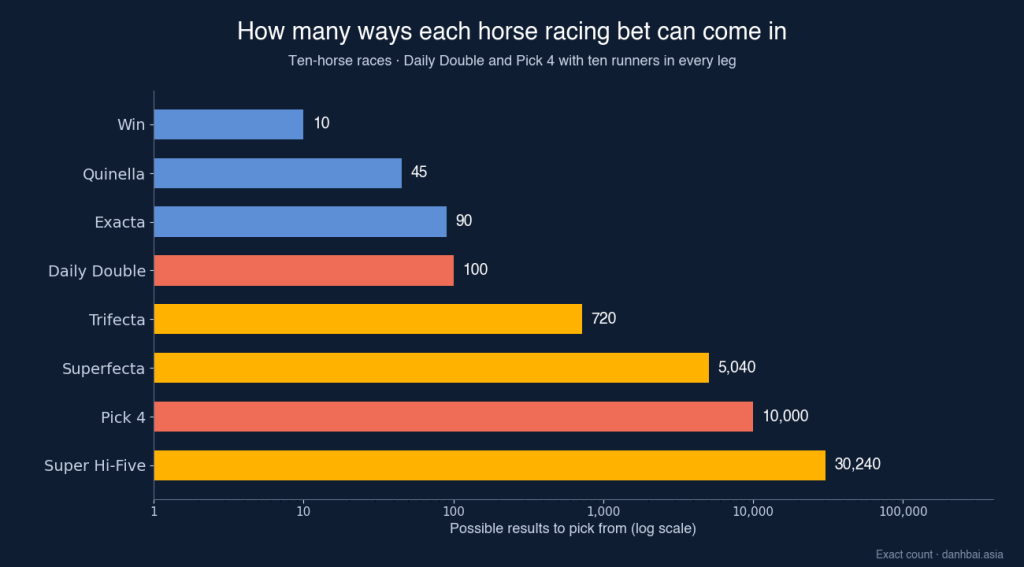
Each step up the ladder multiplies the number of possible results. In a ten-horse race there are 10 possible winners, but 90 possible exactas, 720 trifectas and 5,040 superfectas:
| Runners | Exacta | Quinella | Trifecta | Superfecta | Super Hi-Five |
|---|---|---|---|---|---|
| 6 | 30 | 15 | 120 | 360 | 720 |
| 8 | 56 | 28 | 336 | 1,680 | 6,720 |
| 10 | 90 | 45 | 720 | 5,040 | 30,240 |
| 12 | 132 | 66 | 1,320 | 11,880 | 95,040 |
| 14 | 182 | 91 | 2,184 | 24,024 | 240,240 |
Horses are not equally likely to finish anywhere, so these are counts, not probabilities. They show why a box gets expensive quickly, and why the hardest bets pay the most when they do come in.
How tote odds turn into a payout
US tracks quote payouts for a $2 bet. A horse at odds of A-B pays $2 plus $2 × A ÷ B, so a 3-1 winner pays $8.00 for $2 and a $10 bet on it returns $40.
| Tote odds | $2 pays | Tote odds | $2 pays |
|---|---|---|---|
| 1-5 | $2.40 | 2-1 | $6.00 |
| 2-5 | $2.80 | 5-2 | $7.00 |
| 1-2 | $3.00 | 3-1 | $8.00 |
| 4-5 | $3.60 | 5-1 | $12.00 |
| 1-1 (even money) | $4.00 | 8-1 | $18.00 |
| 6-5 | $4.40 | 10-1 | $22.00 |
| 3-2 | $5.00 | 20-1 | $42.00 |
A worked example of the pools
Say the win pool is $10,000 and the track’s takeout is 17% (each track and state sets its own rate; this one is only for the example). That leaves $8,300 to pay out. If $2,000 was bet on the winner, every $1 returns $8,300 ÷ $2,000 = $4.15, so a $2 ticket pays $8.30, which the board shows as about 3-1.
Place is worked out differently. Suppose the place pool is $6,000, so $4,980 is left after the 17% takeout. The two horses that finished first and second had $1,500 and $600 bet on them to place; those stakes are paid back first, leaving $2,880 of profit, which is split into two halves of $1,440. The first horse’s backers share one half, so a $2 place ticket pays $2 × (1 + 1,440 ÷ 1,500) = $3.92; the second horse’s backers share the other half, so theirs pays $2 × (1 + 1,440 ÷ 600) = $6.80. Show works the same way with three horses and three shares. Real payouts are also rounded down slightly, which is called breakage.
Before you bet on a race
- Tell the teller, or the app, five things in order: track, race number, amount, bet type and the horse’s program number, as in “Churchill Downs, race 5, $2 to show on number 3.”
- Check the minimum and the base amount for boxes and pick bets; the total is the base amount times the number of bets.
- Know which price you are taking: the tote’s final odds, a bookmaker’s fixed price, or the starting price.
- Prices in other formats are converted in the odds formats guide.
Betting is for adults 18 and over. Set a budget before you bet and stop when it is used up.

22bet

BC.GAME
Horse Racing Betting FAQ
How much is a $2 win, place, show bet?
$6. “Across the board” is three separate $2 bets on the same horse: one to win, one to place and one to show.
What does show mean in horse racing?
A show bet wins if the horse finishes first, second or third. It pays less than a win or place bet because the show pool is shared among the backers of three horses.
What is the difference between an exacta and a quinella?
Both pick the first two horses. An exacta needs them in the exact order; a quinella pays in either order. An exacta box of two horses covers both orders at twice the cost.
How much does a trifecta box cost?
One base bet for every order of the horses: 3 horses = 6 bets ($3 at $0.50), 4 horses = 24 bets ($12), 5 horses = 60 bets ($30).
How much does a 3-1 horse pay?
$8.00 for a $2 bet: your $2 back plus 3 × $2. A $10 bet returns $40.
What is a key bet?
A bet that fixes one horse in a position, usually first, with your other choices in every order behind it. It costs less than boxing the same horses.
What does SP mean in horse racing betting?
Starting Price: the bet is settled at the official price when the race starts, instead of the price shown when you placed it.
What is the takeout?
The share of every pari-mutuel pool that the track keeps before paying winners. Each track and state sets its own rate, usually different for straight and exotic bets.