


Same Game Parlay: How SGPs Work and Why the Odds Are Not Multiplied
October 25, 2026
A same game parlay (SGP) is a parlay whose legs all come from one match: for example, a team to win, over 2.5 goals and both teams to score in the same football game. In the UK and on many international sites the same bet is called a bet builder. Like any parlay, every leg has to win. Unlike an ordinary parlay, the price is not the product of the legs’ odds — and the reason is the most useful thing to understand before you place one.
This guide explains how a same game parlay is built and settled, why its odds differ from a normal parlay, and what that looks like in real prices and in the results of 17,937 football matches.
How a same game parlay works
- Pick two or more selections from one match — result, totals, both teams to score, handicaps, corners, cards or player markets, depending on what the sportsbook offers.
- The sportsbook prices the combination as one bet. You see a single price for the whole slip.
- All legs must win. One losing leg loses the bet.
- Void legs are usually removed and the bet is repriced on the remaining legs; some sportsbooks void the whole same game parlay instead. The house rules on the bet slip decide.
- Impossible combinations are blocked. You cannot combine “home team wins” with “away team wins”, or “under 1.5 goals” with “both teams score and over 2.5”.
An ordinary parlay or accumulator combines selections from different matches. Because the results of separate matches have nothing to do with each other, the sportsbook can multiply the odds. Within one match that no longer works.
Why same game parlay odds are not multiplied
Outcomes in the same match are connected. If both teams score, the match already has at least two goals, so “over 2.5 goals” needs only one more. If the match ends 0-0 or 1-0, both “under 2.5” and “not both teams to score” win together. Statisticians call this correlation: one leg winning changes the chance of the other.
Multiplying odds assumes the legs are independent. In 17,937 matches in Europe’s top five leagues from 2016-17 to 2025-26, they were not:
| Combination | Both happened | Rate if independent | Fair odds of the combination | Fair odds multiplied |
|---|---|---|---|---|
| Over 2.5 goals & both teams score | 41.8% | 28.5% | 2.39 | 3.51 |
| Under 2.5 goals & not both teams score | 35.0% | 21.7% | 2.86 | 4.60 |
| Draw & under 2.5 goals | 18.5% | 11.7% | 5.40 | 8.52 |
| Home win & over 2.5 goals | 27.8% | 23.4% | 3.60 | 4.28 |
| Home win & both teams score | 20.4% | 23.7% | 4.89 | 4.23 |
| Over 2.5 goals & not both teams score | 11.3% | 24.6% | 8.84 | 4.07 |
Over 2.5 goals came in 53.1% of matches and both teams scored in 53.7%. Multiply them and you would expect both together in 28.5% of matches — but it happened in 41.8%. If a sportsbook simply multiplied the two prices, it would pay odds of 3.51 on something that happens often enough to be worth only 2.39. That is why every sportsbook prices same game combinations as one market.
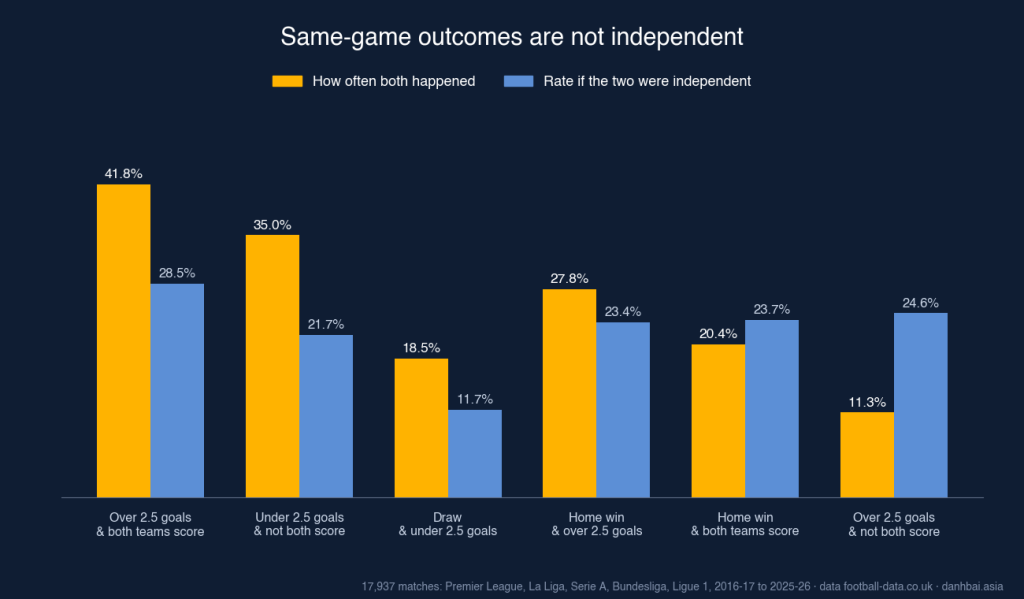
Correlation works in both directions. Legs that tend to happen together (positive correlation) are priced shorter than the multiplied odds. Legs that tend to exclude each other (negative correlation), such as “over 2.5 goals but not both teams to score” — which needs one team to score three or more on its own — are priced longer than the multiplied odds, because they are rarer than independence suggests.
Real same game prices on a Premier League match
20Bet’s football match pages have a Combo tab with ready-priced pairs from the same match: result and both teams to score, result and total goals, total goals and both teams to score, double chance combinations, half-time combinations and more. Here are its prices for Hull City v Brentford in the Premier League on 25 October 2026, next to what multiplying the single prices would give:
| Combination | Single odds | Multiplied | Combo price |
|---|---|---|---|
| Over 2.5 goals & both teams score | 1.66 × 1.66 | 2.76 | 1.96 |
| Under 2.5 goals & not both teams score | 2.24 × 2.23 | 5.00 | 2.75 |
| Draw & under 2.5 goals | 4.00 × 2.24 | 8.96 | 5.20 |
| Brentford win & over 2.5 goals | 1.68 × 1.66 | 2.79 | 2.34 |
| Brentford win & both teams score | 1.68 × 1.66 | 2.79 | 3.15 |
| Over 2.5 goals & not both teams score | 1.66 × 2.23 | 3.70 | 7.00 |
| Under 2.5 goals & both teams score | 2.24 × 1.66 | 3.72 | 7.60 |
The pattern matches the ten seasons of results. The combinations that happen together more often than independence suggests — goals and both teams scoring, a tight low-scoring match, a draw with few goals — are priced well below the multiplied odds. The ones that rarely happen together — over 2.5 without both teams scoring, under 2.5 with both scoring (which means exactly 1-1) — are priced well above it. A favourite winning while both teams score falls in between: the winning team often keeps a clean sheet, so that pair is priced a little above the multiplied odds.
What this means when you build one
- Do not compare an SGP price with the multiplied odds. For correlated legs the multiplied figure is not a fair benchmark; the useful comparison is with the real chance of the combination.
- Every leg carries the bookmaker’s margin. A combined market splits one match into more outcomes, and each one includes part of the margin, so the total margin across a combined market is larger than on a single market. The margin tab of our bet calculator shows how the margin of a two- or three-way market is worked out.
- More legs, more margin. As with any parlay, each leg you add compounds the cost.
- Read the void rules before betting on player markets, where a player who does not start can void a leg.
For the single markets behind these combinations, see our guides to both teams to score, over/under goals and the 1X2 and moneyline, and how to bet on soccer for the full list of football markets.
Bet only what you can afford to lose. Correlation decides the price, not the outcome.

20Bet

22bet
Same game parlay FAQ
What is a same game parlay?
A parlay with two or more selections from the same match, such as a team to win and over 2.5 goals. Every leg must win. It is also called a bet builder.
Why do same game parlays pay less than a normal parlay?
Because outcomes in one match are correlated. Over 2.5 goals and both teams to score happened together in 41.8% of 17,937 top-league matches, against 28.5% if they were independent, so the combination is priced shorter than the multiplied odds.
Can a same game parlay pay more than the multiplied odds?
Yes, when the legs rarely happen together. Over 2.5 goals with not both teams scoring happened in 11.3% of matches against 24.6% if independent; one Premier League price for it was 7.00 against 3.70 multiplied.
What happens if a leg in a same game parlay is void?
Most sportsbooks remove the void leg and reprice the bet on the remaining legs; some void the whole same game parlay. The sportsbook’s house rules decide.
What does SGP mean in betting?
Same game parlay: a parlay built from selections in one game, priced as a single bet.
Is a bet builder the same as a same game parlay?
Yes. “Bet builder” is the UK and European name; “same game parlay” is the US name. Some sportsbooks offer ready-priced pairs instead, such as 20Bet’s Combo tab with result and both teams to score, or total goals and both teams to score.
Which combinations are not allowed in a same game parlay?
Contradictory ones, such as both teams to win, or under 1.5 goals with both teams to score and over 2.5. The bet slip rejects them or does not offer the pair.