


Hedge Calculator: How Much to Bet to Hedge a Bet or Parlay
November 12, 2026
Hedging a bet means placing a second bet against it, so that you win something, or lose less, whichever way it goes. It is most useful when a bet has gone well: the last leg of a parlay, a futures ticket, or a price that has moved in your favour. This hedge calculator works out how much to put on the other side to break even or to lock in the same profit on every result, for two-way and three-way markets, and compares a full hedge with a cash-out offer.
The calculator needs JavaScript. The worked examples below cover the same figures.
How to use the hedge calculator
- Your bet. Enter the stake and either the odds you took or, for a parlay or a futures ticket, the potential return shown on the bet slip. The odds can be American (+250, −200), decimal (3.50, 1.50) or fractional (5/2, 1/2).
- The hedge. Choose one hedge bet for a market with two results (a moneyline, a point spread, an over/under) or two for a market with three, such as a football match result, where you need to cover both the draw and the other team. Enter the odds available for the hedge now.
- Read the table. It shows your profit on each result with no hedge, with a hedge that gets your stake back if your bet loses, and with a hedge that pays the same whatever happens. Enter your own hedge stake to see that too; the second table shows a quarter, half and three quarters of the full hedge.
- Cash out. The second tab compares the full hedge with a cash-out offer from your bookmaker.
The hedge formulas
All three come from writing down what each result pays. Use decimal odds: S is the stake on your bet at odds A, and the hedge is at odds B.
- Same profit on every result: hedge stake = S × A ÷ B. The hedge then returns exactly what your bet would, S × A.
- Break even if your bet loses: hedge stake = S ÷ (B − 1). If the hedge wins it returns your stake plus its own, and if your bet wins you keep its profit less the hedge stake.
- Locked profit with the full hedge = S × A × (1 − 1/A − 1/B). The term 1/A + 1/B is the sum of the two implied probabilities. It has to be below 1 (100%) for a profit to be locked.
With two hedge bets (a draw and an away win, say), each hedge stake is S × A ÷ its own odds, and the locked profit is S × A × (1 − 1/A − 1/B₁ − 1/B₂).
Example: hedging the last leg of a parlay
Say you put 20 on a four-team NFL parlay for Sunday 15 November 2026 at 22bet’s match-winner prices on 11 November: the Vikings (2.38), the Falcons (2.475), the Cowboys (2.72) and the Steelers (2.56). Together that is odds of 41.02, a potential return of 820.33. The first three win, and the Steelers play the Bengals in the last game of the night, with the Bengals at 1.51.
| Hedge | Stake on the Bengals | Profit if the Steelers win | Profit if the Bengals win |
|---|---|---|---|
| No hedge | 0.00 | +800.33 | −20.00 |
| Break even if the Steelers lose | 39.22 | +761.11 | 0.00 |
| Half of the full hedge | 271.63 | +528.70 | +118.53 |
| Same profit either way | 543.26 | +257.07 | +257.07 |
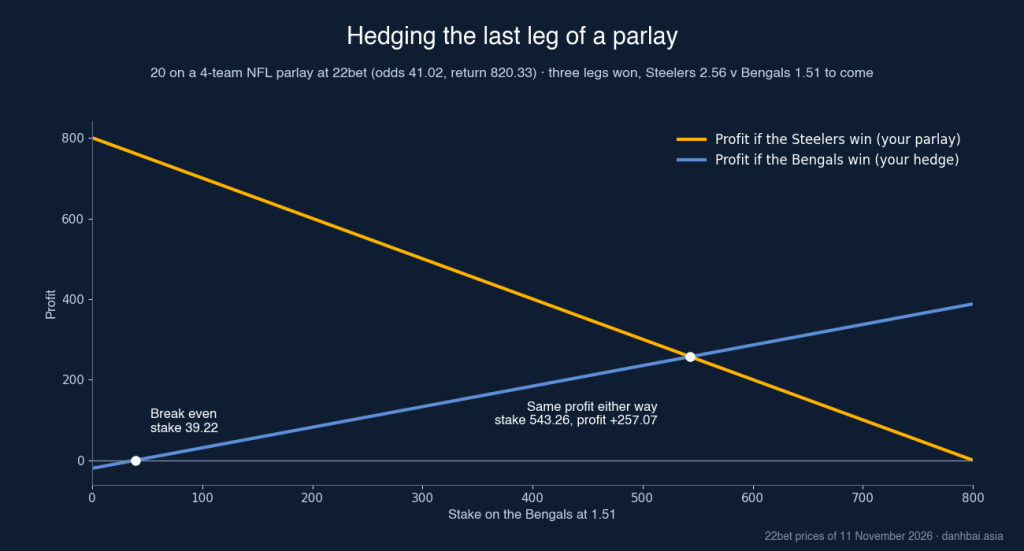
The full hedge needs 543.26 on the Bengals and leaves 257.07 profit whoever wins. A break-even hedge costs only 39.22: if the Bengals win you get back everything you staked, and if the Steelers win you keep 761.11. Anything in between trades some of the top payout for a better result if the Steelers lose.
What a hedge costs
A hedge is a bet at the bookmaker’s price, so it carries the bookmaker’s margin like any other. On the Steelers–Bengals prices the margin is 5.29%; with it taken out, the Steelers have about a 37.1% chance, so the parlay ticket is worth about 304.35 on average. The full hedge turns that into a certain 277.07 (the 257.07 profit plus the 20 stake back). The 27.28 difference is the average cost of the margin on a 543.26 bet. In other words, hedging gives up a little expected value in exchange for certainty. Whether that is worth it depends on how large the possible payout is next to the rest of your bankroll. More on margins on the house edge page, and on taking the margin out of a price with the no-vig calculator.
When a hedge locks a profit, and when it locks a loss
Everything depends on how the price has moved since you placed your bet. Take 100 on a team at +250 (3.50):
- If the other side is now −200 (1.50), the full hedge is 233.33 and locks +16.67 on either result. A break-even hedge of 200.00 leaves +50.00 if your team wins and 0 if it loses.
- If the other side is −400 (1.25), the implied probabilities add up to more than 100%, and the full hedge (280.00) locks a loss of 30.00 whatever happens. A hedge at that price only makes sense to cut the size of a possible loss.
The calculator shows the sum of the implied probabilities under the table. Below 100%, a profit can be locked; above it, the full hedge loses money on every result.
Hedging a three-way bet
On a football match result you need two hedge bets, one on the draw and one on the other team. Say you put 50 on the home team at 2.50 before kick-off, when the draw was 3.40 and the away team 3.00. Hedging at those prices would lock a loss of 3.43: the three prices carry the bookmaker’s margin. If the home team goes 1-0 up and the in-play prices move to 3.40 for the draw and 9.00 for an away win, the full hedge is 36.76 on the draw and 13.89 on the away team (50.65 in total), and it locks +24.35 on every result. The break-even hedge is 24.73 and 9.34, which leaves +40.93 if the home team holds on. Set “Hedge bets” to 2 in the calculator for this kind of market.
Hedge or cash out?
Many bookmakers offer to buy back an open bet before it is settled. At 22bet this is called Bet slip sale: it works on singles, accumulators and system bets, you can sell all of a bet or part of it, and an Auto sell option sells the slip automatically once the offer reaches an amount you set. The offer changes with the odds while the event is running.
A full hedge pays the same on every result, so it can be compared directly with a cash-out offer. In the parlay example the full hedge leaves 277.07 in your account whoever wins. If your bookmaker still offers to buy the slip back at that point, an offer below that is worth less than hedging at 1.51 and one above it is worth more. The hedge needs 543.26 of extra stake to place, though, while a cash-out needs nothing. The second tab of the calculator makes the comparison for your own bet.
Hedging and arbitrage
An arbitrage is the same calculation done before the event, with both bets placed at once at two bookmakers whose prices add up to less than 100%. The calculator works for that too: enter one bookmaker’s price as your bet and the other’s as the hedge. Such gaps are small and close quickly. To split one stake over several selections in the same market, use the dutching calculator. The bet calculator works out the return of a single bet or a parlay, the round robin calculator covers system bets, and the accumulator guide explains how parlay odds are built.

22bet
Hedge Calculator: FAQ
How do you calculate a hedge bet?
With decimal odds, to get the same profit on every result bet stake × odds of your bet ÷ odds of the hedge on the other side. To get your money back if your bet loses, bet stake ÷ (hedge odds − 1). The calculator on this page does both, for two-way and three-way markets.
What does hedging a bet mean?
Placing a second bet on the other side of a bet you already have, so that you win something, or lose less, whichever way it goes. It is most common on the last leg of a parlay and on futures bets.
How do you hedge a parlay?
When all legs but the last have won, bet on the other side of the last leg. Enter the parlay stake and its potential return in the calculator, then the odds of the other side. In our example, 20 on a four-team parlay returning 820.33 needs 543.26 on the other side at 1.51 to lock 257.07 profit either way, or 39.22 to break even if the last leg loses.
Can you always lock in a profit by hedging?
No. Only when the implied probabilities of your price and the hedge price add up to less than 100%, which usually means the price has moved your way since you bet. Otherwise a full hedge locks in a small loss on every result.
Is it better to hedge or cash out?
Compare the cash-out offer with the money a full hedge leaves you on every result. If the offer is lower, hedging at the available price is worth more; if it is higher, the cash-out is. Hedging needs extra stake to place, while a cash-out does not.
How do you hedge a bet on a football match result?
A match result has three outcomes, so you need two hedge bets: the draw and the other team. Each hedge stake is your stake × your odds ÷ that hedge’s odds. Set the calculator to two hedge bets.
Does 22bet have cash out?
Yes. 22bet calls it Bet slip sale: it works on singles, accumulators and system bets, can sell all or part of a bet, and has an Auto sell option that sells the slip when the offer reaches an amount you set.