


Dutching Calculator: Split Your Stake for an Equal Return
November 12, 2026
Dutching means backing several selections in the same event and splitting the stake so that whichever of them wins, the return is the same. It turns several bets into one bet on “any of these”, at a combined price you can work out in advance. This dutching calculator splits a total stake, or a return you want to make, across 2 to 12 selections, shows the combined odds and the profit, and compares the dutch with a single price for the same outcomes.
The calculator needs JavaScript. The worked examples below cover the same figures.
How to use the dutching calculator
- Odds format and selections. Pick decimal (7.50), American (+650) or fractional (13/2) odds and the number of selections, then enter the odds of each one. Names are optional; they only label the table.
- Total stake or target return. Enter how much you want to stake in total, or how much you want back if any selection wins.
- Rounding. Bookmakers take stakes to the cent or to a fixed step. Rounding the stakes changes each return by a few cents, and the table shows the exact figures.
- Compare. If the bookmaker sells the same group of outcomes as one bet, such as Double Chance, enter its price to see which pays more.
How dutching works
Every price has an implied probability: 1 divided by the decimal odds. A selection at 4.00 implies 25%, one at 2.00 implies 50%. To make every selection return the same, each stake is the total stake times that selection’s implied probability, divided by the sum of the implied probabilities of all the selections:
- Stake on a selection = total stake × (1 ÷ its odds) ÷ Σ(1 ÷ odds).
- Dutch odds = 1 ÷ Σ(1 ÷ odds). That is the price of the whole dutch, as if it were one bet.
- Return = total stake × dutch odds, whichever selection wins.
Take two selections at 2.00 and 4.00. Their implied probabilities are 50% and 25%, 75% in all, so the dutch odds are 1 ÷ 0.75 = 1.333. With 100 to stake, 66.67 goes on the first and 33.33 on the second, and either one returns 133.33. If neither wins, the 100 is lost.
If your selections cover every possible result of the event and their implied probabilities still add up to less than 100%, the dutch makes a profit whatever happens. That is an arbitrage, and it needs prices from different bookmakers or prices that have moved since you bet: within one bookmaker’s market covering every outcome, the implied probabilities add up to more than 100%, and the excess is the bookmaker’s margin.
Example: four correct scores at 22bet
Liverpool play Manchester United on Sunday 22 November 2026. On 12 November 22bet’s four shortest prices in the correct score market were 1-1 at 7.5, 2-1 at 8.0, 1-0 at 9.5 and 2-0 at 10.0. Dutching all four with a total stake of 20:
| Score | 22bet odds | Implied probability | Stake | Stake rounded to 0.10 | Return with the rounded stake |
|---|---|---|---|---|---|
| 1-1 | 7.5 | 13.3% | 5.75 | 5.80 | 43.50 |
| 2-1 | 8.0 | 12.5% | 5.39 | 5.40 | 43.20 |
| 1-0 | 9.5 | 10.5% | 4.54 | 4.50 | 42.75 |
| 2-0 | 10.0 | 10.0% | 4.31 | 4.30 | 43.00 |
The four implied probabilities add up to 46.36%, so the dutch odds are 2.157: any of the four scores returns 43.14, a profit of 23.14. Any other score loses the 20. Rounded to the nearest 0.10 the stakes still total 20.00 and the returns range from 42.75 to 43.50.
Check the bookmaker’s own price first
Some groups of outcomes are sold as a single bet. The most common is Double Chance: “home or draw” (1X), “home or away” (12) or “draw or away” (X2). On the same Liverpool match, dutching Liverpool (1.70) and the draw (4.20) gives odds of 1.210: 100 split 71.19 and 28.81 returns 121.02. 22bet’s Double Chance 1X price is 1.24, which returns 124.00 on the same 100, 2.98 more.
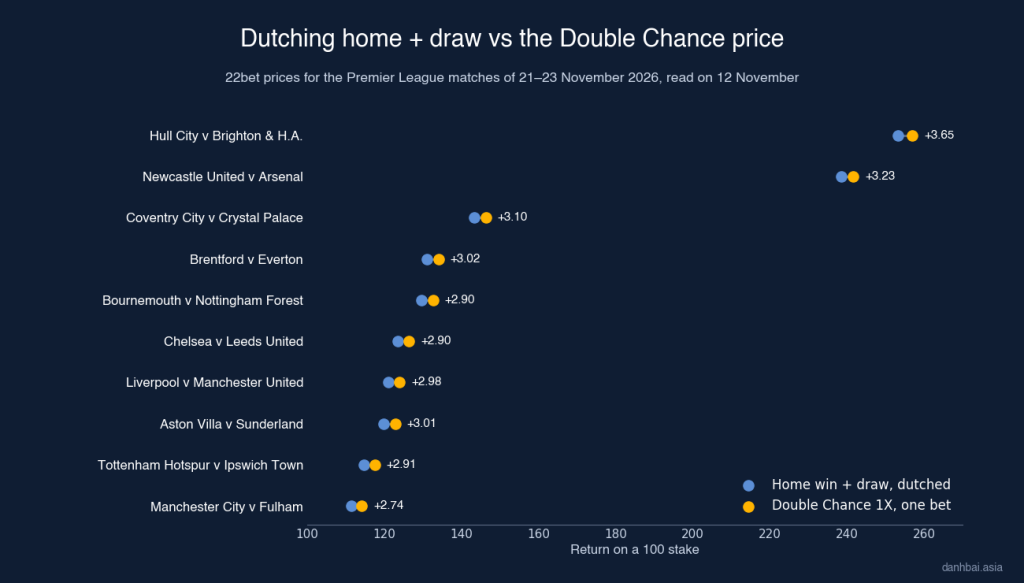
That was not a one-off. Across all ten Premier League matches of 21–23 November, 22bet’s 1X price was higher than dutching the home win and the draw:
| Match (21–23 November) | Home | Draw | Home + draw dutched | Double Chance 1X |
|---|---|---|---|---|
| Manchester City v Fulham | 1.448 | 4.84 | 1.115 | 1.142 |
| Aston Villa v Sunderland | 1.71 | 4 | 1.198 | 1.228 |
| Bournemouth v Nottingham Forest | 2.015 | 3.64 | 1.297 | 1.326 |
| Chelsea v Leeds United | 1.816 | 3.86 | 1.235 | 1.264 |
| Coventry City v Crystal Palace | 2.355 | 3.66 | 1.433 | 1.464 |
| Tottenham Hotspur v Ipswich Town | 1.544 | 4.46 | 1.147 | 1.176 |
| Newcastle United v Arsenal | 5.45 | 4.24 | 2.385 | 2.417 |
| Hull City v Brighton & Hove Albion | 5.9 | 4.44 | 2.533 | 2.57 |
| Liverpool v Manchester United | 1.7 | 4.2 | 1.210 | 1.24 |
| Brentford v Everton | 2.03 | 3.7 | 1.311 | 1.341 |
The same check applies to other combined markets: “win to nil”, a winning margin, “score in a range”, or an over/under line can cover the outcomes you were going to dutch, at one price. Enter that price in the calculator’s comparison box.
What dutching costs
Each selection in a dutch carries the bookmaker’s margin, and the dutch carries the margin of all of them together. Dutching changes how the stake is split, not the price of the outcomes, so the expected return is the same as betting each selection at its own odds. What it does change is the shape of the result: one known return if any selection wins, and the whole stake lost if none does. Our house edge page explains the margin, and the no-vig calculator takes it out of a set of prices.
Dutching, hedging and arbitrage
Dutching splits a stake across several selections before the event. Hedging is the same calculation done later, against a bet you already have; the hedge calculator does that, including for three-way markets. An arbitrage is a dutch across bookmakers whose prices add up to less than 100%. For a single bet or a parlay use the bet calculator, and for system bets the round robin calculator.

22bet
Dutching Calculator: FAQ
What is dutching in betting?
Backing several selections in the same event and splitting the stake so that whichever of them wins, the return is the same. It works like one bet on “any of these” at a combined price.
How do you calculate dutching stakes?
For each selection, stake = total stake × (1 ÷ its decimal odds) ÷ the sum of (1 ÷ odds) over all the selections. The combined dutch odds are 1 ÷ that sum. With 100 on selections at 2.00 and 4.00, stake 66.67 and 33.33; either returns 133.33.
Is dutching profitable?
Dutching does not change the price of the outcomes, so the expected return is the same as betting each selection separately. It makes a profit whatever happens only when the selections cover every possible result and their implied probabilities still add up to less than 100%, which needs prices from different bookmakers or prices that have moved.
Is dutching the same as Double Chance?
They cover the same outcomes, but the price can differ. On 22bet’s Premier League matches of 21–23 November 2026, the Double Chance 1X price paid more than dutching the home win and the draw in all ten games; on Liverpool v Manchester United, 124.00 against 121.02 on 100.
How many selections can you dutch?
Any number, as long as they cannot win together. The calculator takes 2 to 12. The more selections, the shorter the combined odds.
What is the difference between dutching and hedging?
Dutching splits one stake over several selections before the event. Hedging adds a bet against a bet you already hold, often after the price has moved. Both use the same arithmetic of implied probabilities.