


Blackjack Trainer: Play Free Blackjack and Learn Basic Strategy
November 14, 2026
This blackjack trainer lets you play free blackjack with virtual chips and tells you, after every decision, whether it was the best play for your cards. The first tab deals full hands from a shuffled shoe, with splits, doubles and the dealer playing out the hand. The second tab is a strategy drill: one decision after another, so you can work through the hard totals, the soft totals and the pairs until you know the chart.
The trainer needs JavaScript. The strategy and the figures below come from the same maths.
How to use the blackjack trainer
- Set the table rules. Choose 1, 2, 4, 6 or 8 decks, whether the dealer stands or hits on soft 17, whether you may double after a split and whether late surrender is offered. Match them to the table you plan to play, because the best play changes with the rules.
- Play hands. Pick a bet and press Deal. Use the Hit, Stand, Double, Split and Surrender buttons, or the keys H, S, D, P and R once you have clicked inside the trainer. After each decision the trainer says whether it was right; if it was not, it names the best play and what your choice cost on average.
- Turn on the hints while you learn. “Show the best play before I choose” works as a cheat sheet beside the table. “Show the expected return of every option” shows the numbers behind each answer.
- Drill the hands you get wrong. In the Strategy drill tab, choose all hands, hard totals 9 to 16, soft totals or pairs. Each hand is one decision, and the score keeps your accuracy by hand type, so you can see which part of the chart still needs work.
The score panel counts your decisions, the share you got right and the total you gave away through mistakes, in bets. The last eight mistakes are listed below it.
How the trainer decides what is right
For every decision the trainer works out the expected return of each option you have: hitting, standing, doubling, splitting and, where it is offered, surrendering. It uses the same model as our blackjack calculator: your cards and the dealer’s upcard are taken out of a full shoe of the chosen size, and the dealer, who has already checked for blackjack, draws to 17. The option with the highest expected return is the best play. If yours was within 0.0005 of a bet of it, the trainer counts it as correct.
A close example is hard 16 (10-6) against a dealer 10 in a six-deck game. Hitting returns −0.535 per unit bet and standing −0.542, so both lose about half the bet on average and hitting loses slightly less. The trainer marks standing as a mistake costing 0.007 of the bet. Splitting 8-8 against a 10 is a clearer case: it returns −0.485 against −0.535 for hitting, a loss either way, but a smaller one.
Because it uses your exact cards, the trainer now and then disagrees with a printed chart on a hand of three or more cards. Hard 16 made of 4-4-4-4 against a 10 is a stand, not a hit, because four small cards have left the shoe and the next card is more likely to be big.
What the way you play costs
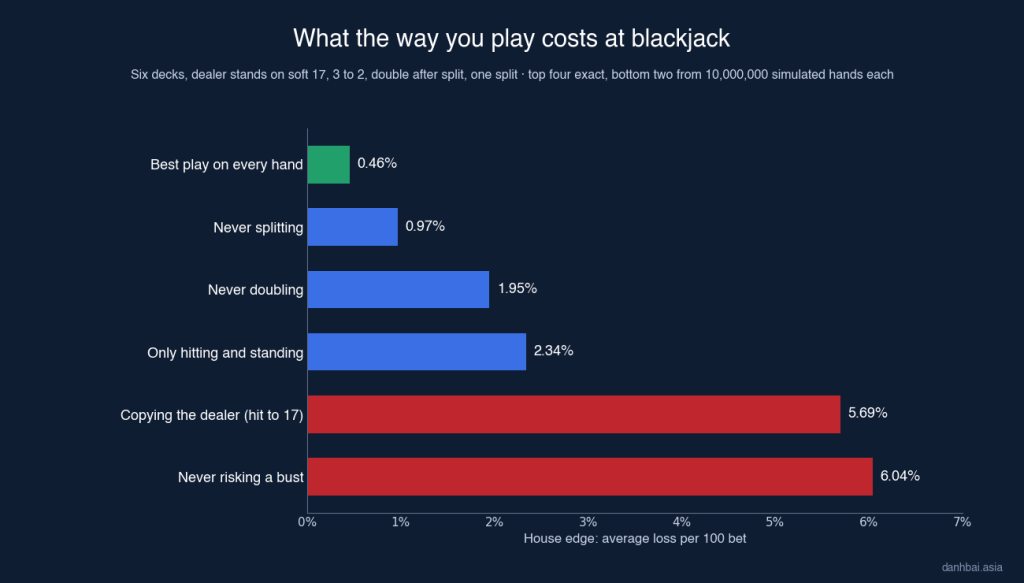
The house edge is the share of each bet you lose on average over many hands. With the trainer’s default rules (six decks, the dealer stands on soft 17 and checks for blackjack, blackjack pays 3 to 2, double on any two cards and after a split, split a pair once) it is 0.46% if you make the best play on every hand. The chart shows how it grows when parts of the strategy are left out.
| How you play | House edge | Average loss per 1,000 bet |
|---|---|---|
| Best play on every hand | 0.46% | 4.57 |
| Best play, but never split | 0.97% | 9.69 |
| Best play, but never double | 1.95% | 19.46 |
| Only hit or stand, best choice each time | 2.34% | 23.38 |
| Copy the dealer: hit to 17, never double or split | 5.69% | 56.92 |
| Never risk a bust: stand on hard 12 or more, hit soft hands to 18 | 6.04% | 60.37 |
The first four rows are exact calculations. The last two come from 10,000,000 simulated hands each from a six-deck shoe, accurate to about ±0.06 points; the same simulation, run with a player who always stands, matched the exact figure to within 0.02 points. Doubling and splitting together are worth almost two points, which is most of what separates a careful player from someone who only hits and stands. Copying the dealer costs more than five points, because the player who busts loses even when the dealer busts afterwards.
The rules move the figure too. With the best play, a dealer who hits soft 17 adds 0.22 points (0.67%), losing double after split adds 0.12 (0.58%), eight decks instead of six add 0.03 (0.49%), and late surrender takes off 0.07 (0.38%). The blackjack variants guide lists what other rule changes cost.
Which hands to learn first
Not every hand needs the chart. Counting every first two cards from a six-deck shoe against every upcard:
| Your first two cards | Share of rounds | The decision |
|---|---|---|
| Hard 12 to 16 | 35.1% | Needs the chart: stand or hit depends on the upcard |
| Hard 9 to 11 | 11.3% | Needs the chart: when to double |
| Soft 13 to 18 (ace-2 to ace-7) | 6.8% | Needs the chart: hit, double or stand |
| Pairs other than two tens | 4.9% | Needs the chart: when to split |
| Hard 17 or more | 14.7% | Stand |
| Two ten-value cards | 9.0% | Stand (never split) |
| Hard 5 to 8 | 6.8% | Hit |
| Soft 19 or 20 | 2.3% | Stand |
| Your blackjack | 4.7% | No decision |
| Dealer blackjack (dealer checks before you act) | 4.5% | No decision |
About 58% of rounds need a decision from the chart, and hard 12 to 16 alone is more than a third of all rounds. That is the place to start in the drill: set it to hard totals and practise until 12 to 16 against each upcard comes without thinking. Then the doubles on 9, 10 and 11, then the soft totals, and the pairs last, because they come up least.
Basic strategy in a few lines
For six decks, the dealer standing on soft 17, double on any two cards and double after split allowed. The full grid is on our blackjack basic strategy chart page; the trainer gives the same answers for two-card hands.
- Hard 8 or less: hit. Hard 9: double against 3 to 6, otherwise hit. Hard 10: double against 2 to 9. Hard 11: double against 2 to 10, hit against an ace.
- Hard 12: stand against 4 to 6, otherwise hit. Hard 13 to 16: stand against 2 to 6, hit against 7 to ace. Hard 17 or more: stand.
- Soft 13 and 14: double against 5 and 6, otherwise hit. Soft 15 and 16: double against 4 to 6, otherwise hit. Soft 17: double against 3 to 6, otherwise hit.
- Soft 18: double against 3 to 6, stand against 2, 7 and 8, hit against 9, 10 and ace. Soft 19 or more: stand.
- Pairs: always split aces and 8s; never split 10s, and play 5-5 as a hard 10. Split 2s, 3s and 7s against 2 to 7, 6s against 2 to 6, 4s against 5 and 6, and 9s against 2 to 6, 8 and 9 (stand against 7, 10 and ace).
- Insurance: do not take it. Without counting cards it costs more than it pays; the blackjack insurance guide shows the numbers.
Rule changes alter a few answers, and the trainer follows them when you change its settings. With late surrender, surrender hard 16 against 9, 10 and ace and hard 15 against a 10. When the dealer hits soft 17, also double 11 against an ace, soft 18 against a 2 and soft 19 against a 6. Without double after split, hit 2-2 and 3-3 against 2 and 3, 4-4 against 5 and 6, and 6-6 against a 2.
Practising for an online table
Read the rules screen of the game you will play and copy them into the trainer’s settings. Among the computer-dealt games in 22bet’s casino, Red Rake’s Vegas Strip uses four decks, a dealer who stands on 17 and checks for blackjack, and 3 to 2 blackjack, with a stated return of 99.78%; set the trainer to four decks. Red Rake’s Atlantic City uses eight decks with late surrender (99.54% stated); set eight decks and late surrender. European blackjack, where the dealer takes no hole card, plays differently on a few hands; our European blackjack guide covers those.
22bet’s live casino also runs Free Bet, Infinite, Lightning and Power Blackjack from Evolution and other studios. Free Bet Blackjack changes the doubling and splitting rules, so the standard chart does not fit it exactly; the Free Bet Blackjack guide has its strategy. Blackjack is for players aged 18 and over. Set a limit before you play and stop when you reach it.

22bet
Blackjack Trainer: FAQ
Is this blackjack trainer free?
Yes. It runs in your browser with virtual chips; there is no account, no download and no money involved.
How does the blackjack trainer know the right play?
It calculates the expected return of every option for your cards and the dealer’s upcard, with those cards taken out of a full shoe of the size you chose, and marks the option with the highest return as the best play. For two-card hands in a six-deck game its answers are the standard basic strategy chart.
What is the best way to learn basic strategy?
Start with hard 12 to 16, which make up more than a third of all rounds, then the doubles on 9, 10 and 11, then the soft totals and the pairs. Drill each group until you answer without thinking, then play full hands with the hints off.
How much does basic strategy lower the house edge?
With six decks, the dealer standing on soft 17 and 3 to 2 blackjack, the best play on every hand gives a house edge of 0.46%. Copying the dealer (hit to 17, never double or split) gives 5.69% in 10 million simulated hands, and never hitting a hand that could bust gives 6.04%.
Why does the trainer sometimes disagree with a strategy chart?
A chart gives one answer per total; the trainer uses the exact cards. On some hands of three or more cards, or with a different number of decks, that changes the best play. Hard 16 made of four 4s against a dealer 10 is a stand, because four small cards have left the shoe.
Does the trainer offer insurance?
No. Without counting cards, insurance costs more than it returns, so basic strategy never takes it.