


What Is Insurance in Blackjack? How It Works, the Odds and Even Money
October 14, 2026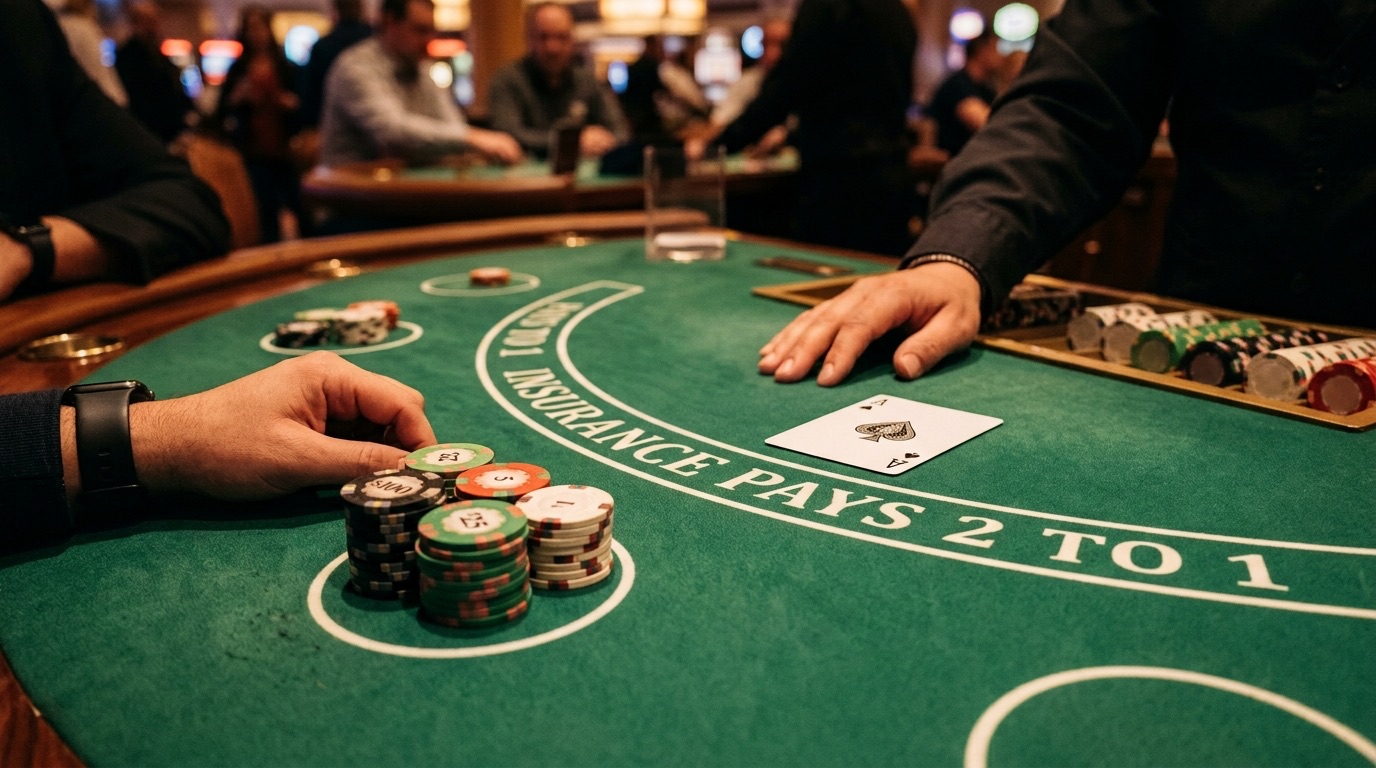
Insurance in blackjack is a side bet you are offered when the dealer’s face-up card is an ace. You stake up to half of your original bet that the dealer has blackjack, meaning that the hidden card is a ten, jack, queen or king. If the dealer does have blackjack, insurance pays 2:1. If not, the insurance stake is lost and the hand carries on as normal. This guide shows how the bet is settled, why “even money” is the same bet under another name, and exactly what insurance costs with one to eight decks.
How insurance works, step by step
- The dealer’s face-up card is an ace. Before anyone plays their hand, the dealer offers insurance.
- You can place an insurance bet of up to half your main bet. With a 100 bet, the most you can insure is 50.
- The dealer checks the hidden card. If it is a ten-value card, the dealer has blackjack: insurance pays 2:1 (your 50 returns 150) and your main bet loses, unless you also have blackjack, in which case it is a push.
- If the dealer does not have blackjack, the insurance bet is lost and the round continues: you hit, stand, double or split as usual.
A full-size insurance bet is built to break even on that round when the dealer has blackjack: you lose 100 on the hand and collect 100 on insurance. That is where the name comes from. It insures the hand against the dealer’s blackjack.
Why insurance is a losing bet
Insurance pays 2:1, so it breaks even only if the dealer’s hidden card is a ten more than one time in three. In a full deck, ten-value cards are 16 of 52, or 30.77%. That is short of one in three, so over time every unit you put on insurance loses about 7.7%.
The exact figure depends on how many decks are in the shoe and on your own two cards, because any ten you are holding is one fewer ten that can be the dealer’s hidden card:
| Decks | Your hand | Chance dealer has blackjack | Cost of insurance |
|---|---|---|---|
| 1 | No tens (e.g. 9-7) | 32.65% | −2.04% |
| 1 | One ten (e.g. 10-6) | 30.61% | −8.16% |
| 1 | Two tens (10-10) | 28.57% | −14.29% |
| 2 | No tens | 31.68% | −4.95% |
| 2 | Two tens | 29.70% | −10.89% |
| 6 | No tens | 31.07% | −6.80% |
| 6 | Two tens | 30.42% | −8.74% |
| 8 | No tens | 30.99% | −7.02% |
| 8 | Two tens | 30.51% | −8.47% |
The cost is the average loss per unit staked on insurance. Even in the most favourable case (a single deck with no tens in your hand) the dealer has blackjack less than one time in three. Most online and live tables use six or eight decks, where insurance costs about 7% to 9% of what you put on it, several times the house edge of the main game played with basic strategy (about 0.5% at a table with good rules; see our house edge guide).
Notice that a player holding 20 is the most tempted to protect a good hand, and that is exactly when insurance is worst: both of your tens are missing from the shoe.
Even money is insurance under another name
If you have blackjack and the dealer shows an ace, many tables offer even money: you take a 1:1 payout on your blackjack straight away instead of waiting for the hand to finish. It looks like a different offer, but it pays exactly the same as taking full insurance. With a 10 bet at a table that pays blackjack 3:2:
| Dealer’s hidden card | Blackjack + full insurance (5) | Even money |
|---|---|---|
| Ten-value (dealer blackjack) | Main hand pushes (0), insurance wins 10: +10 | +10 |
| Anything else | Blackjack wins 15, insurance loses 5: +10 | +10 |
Declining even money gives +15 about seven times in ten and 0 the rest of the time, which works out higher on average than a guaranteed +10. The certainty of even money is paid for in the same way as insurance.
When insurance is worth taking
Only when more than one in three of the cards left to be dealt are tens. That cannot happen with a fresh shoe; it can happen late in a hand-dealt shoe after many small cards have come out, which is why card counters take insurance and other players should not. Two things rule it out online:
- RNG blackjack normally deals every hand from a freshly shuffled shoe, so the proportion of tens is always the starting one.
- Live dealer blackjack deals from a six- or eight-deck shoe. With that many cards, the share of tens moves far less as the shoe is dealt than it does in a single deck, so the price of insurance stays close to the figures above.
“Insuring a good hand” and “insuring when you feel the dealer is due” do not change the maths. Each decision is the same side bet with the same price.
Insurance at tables where the dealer does not check for blackjack
At some tables, often called European or no-hole-card blackjack, the dealer takes the second card only after the players have finished. Insurance is still offered when the dealer shows an ace and is still settled at 2:1 when the dealer completes a blackjack. What changes is what happens to your other bets: at some of these tables, extra money you put in by doubling or splitting is also lost to a dealer blackjack. Read the table’s rules before you double or split against an ace.
Where to play live blackjack
20Bet’s live casino has a dedicated blackjack section with tables such as Gravity Blackjack, Blackjack VIP A and Blackjack De Luxe B, and BC.GAME runs its own branded Evolution blackjack tables. On any of them, the insurance offer comes up whenever the dealer shows an ace; the figures above tell you what it costs. For the decisions that matter more, see our guides to blackjack strategy and the ace in blackjack.
Play responsibly
Blackjack is for players aged 18 and over. No side bet removes the house edge. Set a budget before you sit down and only play with money you can afford to lose.

20Bet

BC.GAME
Blackjack Insurance FAQ
What is insurance in blackjack?
A side bet offered when the dealer’s face-up card is an ace. You stake up to half your original bet that the dealer has blackjack. It pays 2:1 if the dealer’s hidden card is a ten-value card and is lost otherwise; your main hand is settled separately.
How much does blackjack insurance pay?
2:1. A 50 insurance bet returns 150 (the 50 stake plus 100) when the dealer has blackjack. Because the maximum insurance is half the main bet, a full insurance bet exactly offsets the loss of the main hand to a dealer blackjack.
Should you take insurance in blackjack?
No, unless you know that more than one in three of the remaining cards are tens, which only card counting late in a hand-dealt shoe can tell you. With six or eight decks, insurance loses about 7% to 9% of every unit you stake on it.
What are the odds the dealer has blackjack when showing an ace?
About 31%. With six decks and no tens in your own hand it is 96 tens out of 309 unseen cards, or 31.07%; with one deck and no tens in your hand it is 32.65%. Insurance needs more than 33.3% to break even.
Is even money the same as insurance?
Yes. When you hold blackjack against a dealer ace, taking even money pays you 1:1 whatever the dealer has, which is exactly the result of taking full insurance on your blackjack. It costs the same as insurance on average.
Can you take insurance in online blackjack?
Yes. Online tables, both RNG and live dealer, offer insurance when the dealer shows an ace and pay it at 2:1, up to half your main bet. RNG tables usually shuffle before every hand and live tables use six or eight decks, so the odds stay at the levels in the table above.