


The Ace in Blackjack: 1, 11, and What It Is Actually Worth
October 14, 2026
The rules answer is that an ace counts as 1 or 11, whichever suits your hand. Every guide says so, and it tells you almost nothing.
The useful answer is what an ace is worth in money. Played with basic strategy, an ace as your first card is worth +50.4% of your bet. A ten-value card is worth +14.3%. Every other card in the deck is a loser before you even see the second one, and the worst of them — a 6 — is worth −21.0%. That is a 71-point gap between the best card and the worst.
This page works through where those figures come from: what each card is worth, why an ace makes a hand that cannot bust, what the dealer’s ace really means, and the one table rule that costs more than every playing mistake most people make. 18+, informational only.
Table of Content
Card values in blackjack, and the one card with two of them
Blackjack is played with one to eight decks. Every card scores its face value, the picture cards score ten, and only the ace has a choice:
| Card | Value | How many in a 52-card deck | Share of the deck |
|---|---|---|---|
| Ace | 1 or 11 | 4 | 7.69% |
| 2 to 9 | face value | 4 of each | 7.69% each |
| 10, J, Q, K | 10 | 16 | 30.77% |
The ace is the rarest useful card and the only one whose value you get to choose after seeing what comes next. You will hold at least one in your first two cards about 14.8% of the time in a six-deck game — roughly one hand in seven.
What an ace is actually worth
Take every possible starting hand and every dealer upcard, play each one the way basic strategy says to, and you can ask a question the usual guides never answer: given that my first card is an ace, what is my expected result?
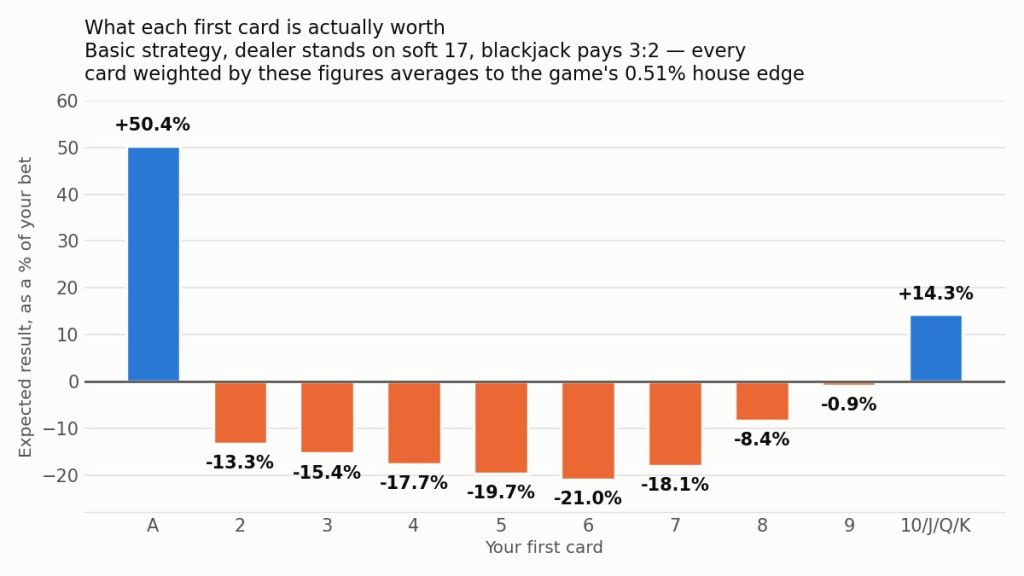
| Your first card | Expected result | Verdict |
|---|---|---|
| Ace | +50.40% | by far the best card in the deck |
| 10, J, Q, K | +14.35% | the only other card worth having |
| 9 | −0.94% | close to break-even |
| 8 | −8.39% | |
| 2 | −13.29% | |
| 3 | −15.39% | |
| 4 | −17.70% | |
| 7 | −18.07% | |
| 5 | −19.65% | |
| 6 | −20.98% | the worst card you can be dealt |
Two things are worth pausing on. First, only two cards in the deck are worth having, and the ace is worth three and a half times the other one. Second, the table checks itself: weight each figure by how often that card comes out — four thirteenths for the tens, one thirteenth for everything else — and the average is −0.51%, which is exactly the house edge of the game being modelled. The good cards and the bad cards have to add up to it, and they do.
The figures above are for a shoe game with basic strategy, dealer standing on soft 17, doubling allowed on any two cards and after a split, splitting to four hands, no surrender, and blackjack paying 3:2. Change those rules and the numbers move — the last section shows by how much.
Why an ace makes a hand that cannot bust
Here is the mechanism the “1 or 11” answer hides. When an ace is counted as 11, it is holding a spare value in reserve. Draw a card that would take you over 21 and the ace quietly drops to 1 instead. A hand with an ace counted as 11 cannot bust on the next card, ever.
That is what a “soft” hand means, and it is worth a great deal. Compare the same printed total with and without an ace in it, each played the best way available:
| Dealer shows | Soft 17 (A-6) | Hard 17 (10-7) | Difference |
|---|---|---|---|
| 6 | +25.61% | +1.17% | 24.4 points |
| 7 | +5.38% | −10.68% | 16.1 points |
| 10 | −19.69% | −41.97% | 22.3 points |
| Ace | −17.96% | −47.80% | 29.8 points |
Both hands say 17. The soft one is worth up to thirty points more, because it can be improved without risk while the hard one is stuck. Against a dealer 6 the soft 17 is not merely better, it is a hand you double on — something you would never do with a hard 17.
Once you draw a card that forces the ace down to 1, the hand becomes hard and behaves like any other. A-6-10 is a hard 17, not a soft one.

How often a blackjack comes, and what the payout is worth
An ace with any ten-value card is a natural, and it is the reason the ace is worth what it is. The exact frequency depends on the number of decks, because in a single deck the ace you just drew is one of only four:
| Decks | Chance of a natural | Roughly |
|---|---|---|
| 1 | 4.8265% | 1 hand in 20.7 |
| 2 | 4.7797% | 1 in 20.9 |
| 4 | 4.7566% | 1 in 21.0 |
| 6 | 4.7489% | 1 in 21.1 |
| 8 | 4.7451% | 1 in 21.1 |
Now the part that matters more than any decision you will make at the table. A natural is supposed to pay 3:2 — 15 back on a 10 bet. Many tables, especially the low-minimum ones, pay 6:5 instead: 12 back on the same bet.
Run the same solver under both payouts and the difference is 1.3529 percentage points of house edge. Check it the short way and you get the same answer: you make a natural the dealer does not match on about 4.51% of hands, and on each of those you are handed 0.3 of a bet less, which is 4.51% x 0.3 = 1.35 points.
To put that in scale: the whole house edge of a 3:2 game with these rules is 0.51%. Moving to 6:5 makes it 1.86%. The payout change costs more than two and a half times the entire edge of the game it replaces — and it costs it whether you play perfectly or badly, because it is taken from the one hand you cannot influence. Check the felt for “Blackjack pays 3 to 2” before you sit down; it is the single most valuable thing you can read at a blackjack table.
 Online Poker
 Mobile Casinos
 Cashback Bonus
 Online Slots
The ace at a glance
The whole rule in three lines: the ace takes 11 whenever 11 fits, and 1 whenever it does not, and the change happens by itself as the cards come.
| When | The ace counts | Example |
|---|---|---|
Ace as 11 keeps you at 21 or under |
11 |
A + 6 = soft 17 |
Ace as 11 would take you over 21 |
1 |
A + 6 + 9 = hard 16 |
Ace with any ten-value card |
11 |
A + K = 21, a natural |
The dealer’s ace, and a number most charts get wrong
An ace in front of the dealer is the worst thing you can see, and the usual explanation — “the dealer almost never busts with an ace” — is right but quoted at the wrong number.
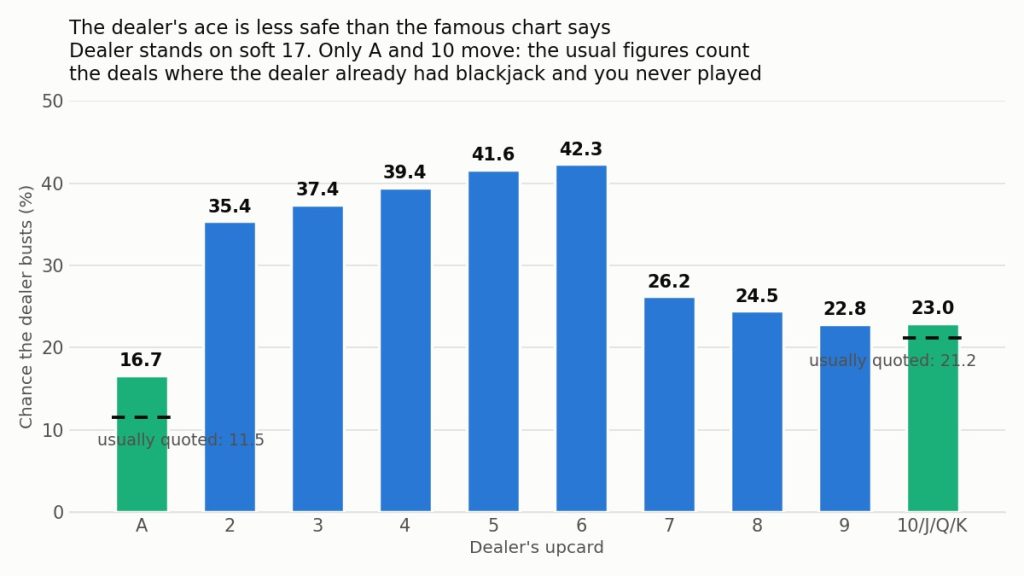
| Dealer shows | 17 | 18 | 19 | 20 | 21 | Busts |
|---|---|---|---|---|---|---|
| Ace | 18.89 | 18.89 | 18.89 | 18.89 | 7.78 | 16.65 |
| 2 | 13.98 | 13.49 | 12.97 | 12.40 | 11.80 | 35.36 |
| 3 | 13.50 | 13.05 | 12.56 | 12.03 | 11.47 | 37.39 |
| 4 | 13.05 | 12.59 | 12.14 | 11.65 | 11.12 | 39.45 |
| 5 | 12.23 | 12.23 | 11.77 | 11.31 | 10.82 | 41.64 |
| 6 | 16.54 | 10.63 | 10.63 | 10.17 | 9.72 | 42.32 |
| 7 | 36.86 | 13.78 | 7.86 | 7.86 | 7.41 | 26.23 |
| 8 | 12.86 | 35.93 | 12.86 | 6.94 | 6.94 | 24.47 |
| 9 | 12.00 | 12.00 | 35.08 | 12.00 | 6.08 | 22.84 |
| 10, J, Q, K | 12.07 | 12.07 | 12.07 | 37.07 | 3.74 | 22.98 |
All figures are percentages, dealer standing on soft 17.
Nearly every dealer-bust chart online puts the ace at 11.5%. That number is not wrong, it is answering a different question: it counts every deal in which an ace was showing, including the ones where the dealer turned over a ten and the hand was finished before you did anything. Those deals are not decisions you face.
Once the dealer has checked the hole card and play continues — the only situation in which you would ever consult a bust chart — the ace busts 16.65% of the time. The same correction applies to a ten up: 21.2% becomes 22.98%. Every other upcard is identical either way, because there is no blackjack to remove. That is what makes the correction easy to check rather than something you have to take on trust.
Either way the ranking is unchanged and so is the advice it leads to: the dealer is most likely to bust showing a 6 (42.32%) and least likely showing an ace.
Insurance is the ace bet you should never take
When the dealer shows an ace you are offered insurance: a side bet, up to half your stake, that the hole card is a ten. It pays 2:1.
A 2:1 payout breaks even if the hole card is a ten one time in three. Ten-value cards are 16 of every 52 — less than one in three. The bet is short before anyone deals a card:
| Decks | Chance the hole card is a ten | Needed to break even | Your expected result |
|---|---|---|---|
| 1 | 32.65% | 33.33% | −2.04% |
| 2 | 31.68% | 33.33% | −4.95% |
| 6 | 31.07% | 33.33% | −6.80% |
| 8 | 30.99% | 33.33% | −7.02% |
Those figures are calculated for the case that favours insurance most: neither of your own cards is a ten, so the maximum number of tens is still in the shoe. Even then, a six-deck insurance bet loses 6.8% — more than thirteen times the house edge of the game you are sitting at.
The version dealers offer as “even money” when you hold a blackjack is the same bet wearing a different name, and it is bad for the same reason: it trades an average of 1.04 bets for a guaranteed 1.00.
A pair of aces: always split
Two aces played together are a soft 12, which is a weak hand for two cards that are individually the best in the deck. Split them and each ace starts a fresh hand with a +50% card in it:
| Dealer shows | Play A-A as soft 12 | Split the aces | Gain |
|---|---|---|---|
| 6 | +18.60% | +66.74% | 48.1 points |
| 10, J, Q, K | −7.00% | +17.97% | 25.0 points |
| Ace | −2.05% | +10.91% | 13.0 points |
The gain is large against every upcard, including the ones where soft 12 is already ahead, which is why “always split aces” is one of the few pieces of blackjack advice with no exceptions in a normal game. Against a ten or an ace, soft 12 is a losing hand and splitting makes it a winning one outright.
Two rules apply almost everywhere and are worth knowing before you do it: each split ace gets exactly one card and you cannot hit again, and a ten on a split ace is 21, not a natural — it pays 1:1, not 3:2, and it pushes against a dealer blackjack rather than beating it. Both are already priced into the figures above.
The rules that change what an ace is worth
The same ace is worth more at some tables than others. Measured against the baseline used throughout this page:
| Rule | What it costs you |
|---|---|
| Blackjack pays 6:5 instead of 3:2 | 1.3529 points |
| Dealer hits soft 17 instead of standing | 0.2194 points |
| No doubling after a split | 0.1416 points |
The order is the message. The payout rule costs six times what the soft-17 rule costs and nearly ten times what the double-after-split rule costs. A player who finds a 3:2 table and plays it adequately is far better off than one who plays flawlessly at 6:5.
Everything on this page is arithmetic about how the game pays, not a way to beat it: the house keeps an edge under every rule set listed here. Blackjack is entertainment you pay for. Set deposit and time limits before you start, play only with money you can afford to lose, and use self-exclusion if it stops being fun. Free confidential help is available at BeGambleAware. 18+ only.

22bet
Casino package up to 39,800,000 VND + 150 free spins
FAQ
How much is an ace worth in blackjack?
By the rules it counts as 1 or 11, whichever keeps your hand at 21 or under. In money it is the most valuable card in the deck: dealt as your first card and played with basic strategy, an ace is worth about +50.4% of your bet, against +14.3% for a ten-value card and −21.0% for a 6, the worst card you can start with.
What are the card values in blackjack?
Cards 2 to 9 score their face value. The 10, Jack, Queen and King all score 10, which is why 16 of every 52 cards are worth ten. The ace scores 11 whenever that keeps the hand at 21 or under, and 1 otherwise — and the switch happens automatically as you draw, which is why an ace counted as 11 can never bust on the next card.
What is the difference between a soft hand and a hard hand?
A soft hand contains an ace still counted as 11, so it cannot bust on the next card — the ace simply drops to 1. A hard hand has no such reserve. The distinction is worth real money: played correctly, soft 17 against a dealer 6 returns +25.6% while hard 17 returns +1.2%, and against a dealer ace it is −18.0% versus −47.8%. Once the ace is forced down to 1, the hand is hard.
Should I always split a pair of aces?
Yes, in any normal game. Splitting gains against every upcard, and against a ten or an ace it turns a losing hand into a winning one. Against a dealer 6 the split is worth +66.7% instead of +18.6%; against a ten, +18.0% instead of −7.0%; against an ace, +10.9% instead of −2.1%. Note the two standard restrictions: each split ace receives exactly one card, and a ten on a split ace counts as 21 rather than a natural, so it pays 1:1 and pushes against a dealer blackjack.
Should I take insurance when the dealer shows an ace?
No. Insurance pays 2:1, so it needs the hole card to be a ten more than one time in three, and ten-value cards are only 16 of every 52. In a six-deck game the chance is 31.07% against the 33.33% needed, an expected loss of 6.80% — and that is calculated for the case most favourable to insuring, where neither of your own cards is a ten. “Even money” on your own blackjack is the same bet under another name.
How often do you get a blackjack?
About once every 21 hands. Exactly: 4.8265% with one deck, 4.7566% with four, 4.7489% with six and 4.7451% with eight. It gets slightly rarer as decks are added because the ace you have already drawn depletes a smaller fraction of the shoe.
Is a 6:5 blackjack table worth avoiding?
It is the most expensive thing at the table. Paying 6:5 on a natural instead of 3:2 adds 1.3529 percentage points to the house edge — more than two and a half times the entire 0.51% edge of the same game at 3:2, and about six times what the dealer-hits-soft-17 rule costs. It applies whether you play well or badly, because it is taken from the one hand you cannot play at all.
How often does the dealer bust with an ace showing?
About 16.65% of the time in the hands you actually play. The 11.5% figure quoted on most charts counts the deals where the dealer turned over a ten and the hand ended before you acted; once the dealer has checked for blackjack and play continues, the true figure is 16.65%. The same correction applies to a ten upcard, 21.2% becoming 22.98%. Every other upcard is unaffected.
Can I double down on a hand with an ace?
Yes, wherever the table allows doubling on any two cards, and soft hands are among the best doubling spots there are. Soft 17 against a dealer 6 is a double rather than a hit or a stand, which is a large part of why that hand is worth +25.6%. Doubling after a split is a separate rule; where it is not offered, the game costs you an extra 0.14 percentage points.