


Blackjack Variants: European, Double Exposure, Switch and More
October 27, 2026
Every version of blackjack has the same goal: finish closer to 21 than the dealer without going over. What changes from one variant to the next is a handful of rules — how many decks, whether the dealer checks for blackjack, what a blackjack pays, when you can double — and those rules decide the house edge and the right way to play each hand.
This guide covers the blackjack variants you will find in an online casino lobby: European blackjack, double exposure, Blackjack Switch, Atlantic City and Vegas Strip, plus the live versions. For each one you get the rules from the game’s own rules screen, the return the game states, and what changes in your strategy. At the end, a chart shows what each single rule is worth.
Blackjack variants compared
These are the RNG versions in 22bet’s casino lobby, with the rules and the theoretical return each game publishes in its help screen. The house edge is 100% minus the return.
| Variant (provider) | Decks | What is different | Stated return | House edge |
|---|---|---|---|---|
| Blackjack Switch (Red Rake) | 6 | Two hands; you may swap their second cards. Blackjack pays 1:1, a dealer 22 pushes, dealer hits soft 17 | 99.92% | 0.08% |
| Vegas Strip (Red Rake) | 4 | Dealer stands on 17 and checks for blackjack; blackjack pays 3:2 | 99.78% | 0.22% |
| Atlantic City (Red Rake) | 8 | Dealer stands on 17 and checks for blackjack; late surrender allowed | 99.54% | 0.46% |
| European Blackjack (Betsoft) | 6 | European rules, multi-hand | 99.38% | 0.62% |
| European Blackjack (Red Rake) | 6 | No hole card; double on 9, 10 or 11 only | 99.34% | 0.66% |
| Double Exposure (Red Rake) | 6 | Both dealer cards face up; blackjack pays 1:1; dealer wins ties except blackjack against blackjack | 99.04% | 0.96% |
All of these assume you play every hand correctly for that game’s rules. A return is a long-run average over millions of hands, not what one session will look like, and playing by feel instead of strategy costs more than any difference between the variants.
European blackjack
In European blackjack the dealer takes only one card at the start. The second card comes after every player has finished, so there is no hole card and the dealer cannot check for blackjack before you act. If the dealer’s second card then makes a blackjack, the usual rule is that you lose everything you have put on the hand — including the extra money from a double or a split. Red Rake’s European Blackjack also limits doubling to totals of 9, 10 or 11, including after a split; Play’n GO’s European Blackjack also allows doubling on hard 9 to 11 only, with one split.
The no-hole-card rule adds about 0.11 percentage points to the house edge and doubling on 9 to 11 only about 0.10, which together explain most of the gap between a European table and an American-style one with the same deck count. Our calculation for Red Rake’s rules gives a house edge of 0.66% — the same as the 99.34% return the game states.
How strategy changes. Because a doubled or split hand can still lose twice to a dealer blackjack, you avoid putting more money out when the dealer shows a 10 or an ace:
- Hard 11 against a 10: hit, do not double.
- A pair of 8s against a 10 or an ace: hit instead of splitting.
- A pair of aces against an ace: hit instead of splitting. Against a 10 you still split aces.
Everything else follows the usual basic strategy chart.
Double exposure blackjack
In double exposure blackjack both of the dealer’s cards are dealt face up, so you always know the total you have to beat. The game takes that advantage back in two ways: a blackjack pays 1 to 1 instead of 3 to 2, and the dealer wins ties. The one tie that does not lose is blackjack against blackjack — a push at Red Rake’s table, while Play’n GO’s version pays the player. A dealer blackjack is visible straight away and beats every other hand.
Red Rake’s Double Exposure uses six decks, the dealer stands on 17, you can double on 9, 10 or 11 only, split once and not double after a split; the game states a return of 99.04%.
Seeing both cards changes almost every decision. Some plays from our calculation for these rules:
| Dealer’s two cards | Your hand | Best play |
|---|---|---|
| Hard 12 to 16 | Any hard 12 or more | Stand — the dealer must draw and may bust |
| Hard 12 to 16 | 9 or 11 | Double |
| Hard 15 or 16 | Soft 18 (ace-7) | Hit |
| 17 (hard or soft) | Hard 12 to 17 | Hit — a tie at 17 loses |
| 18 | 18 | Hit — a tie loses |
| 19 or 20 | Anything below the dealer’s total | Hit, including a hard 19 against 19 |
| Hard 10 or 11 | Hard 12 or 13 | Hit; stand from hard 15 against a 10 and from hard 14 against an 11 |
Double exposure has the highest house edge of the variants in the table above, and its strategy is the furthest from the standard chart.
Blackjack Switch
In Blackjack Switch you play two hands at once, with equal bets, and before anything else you may swap the second card of each hand. Dealt 10-6 and 5-10 against a dealer 6, for example, you can switch to 10-10 and 5-6 — two weak hands become a 20 and an 11 to double.
To pay for the switch, the game changes two rules. A blackjack pays 1 to 1, and a dealer total of 22 pushes every hand that has not busted, where it would normally lose for the dealer; a player blackjack still wins against a dealer 22. Red Rake’s Blackjack Switch deals six decks, the dealer hits soft 17 and does not check for blackjack, you may split once and double after a split, and it states a return of 99.92%.
The switch is what makes the game. With the same rules and no swap, our calculation puts the house edge near 9.8%; with the swap it falls below 0.1%. Two habits to unlearn from ordinary blackjack:
- Look at both arrangements before you play. Compare your hands as dealt and as switched, and keep the pair that gives you the better combination, not just one strong hand.
- Double and split less often. A dealer 22 pushes a doubled bet that would otherwise win, so several standard doubles become hits — 11 against a 10, for example — and a pair of 8s against a 10 or an ace is hit rather than split.
Atlantic City and Vegas Strip blackjack
These two are classic American rule sets: the dealer gets a hole card and checks for blackjack when showing a 10 or an ace, so you only ever lose your original bet to a dealer blackjack, and a blackjack pays 3 to 2.
- Atlantic City (Red Rake): eight decks, dealer stands on 17, double on any two cards and after a split, one split per hand, and late surrender — you can give up half your bet after the dealer has checked for blackjack. Stated return 99.54%.
- Vegas Strip (Red Rake): four decks, dealer stands on 17, double on any two cards and after a split, one split per hand, no surrender. Stated return 99.78%.
The standard basic strategy chart is the right one for both. In Atlantic City, add the surrender plays: give up hard 16 against a 9, 10 or ace and hard 15 against a 10.
What each blackjack rule is worth
Every variant is a bundle of rules, and each rule moves the house edge by a fixed amount. Starting from a common six-deck game — dealer stands on soft 17, double on any two cards and after a split, one split, dealer checks for blackjack, 3:2 — the house edge with basic strategy is 0.46%. Changing one rule at a time:
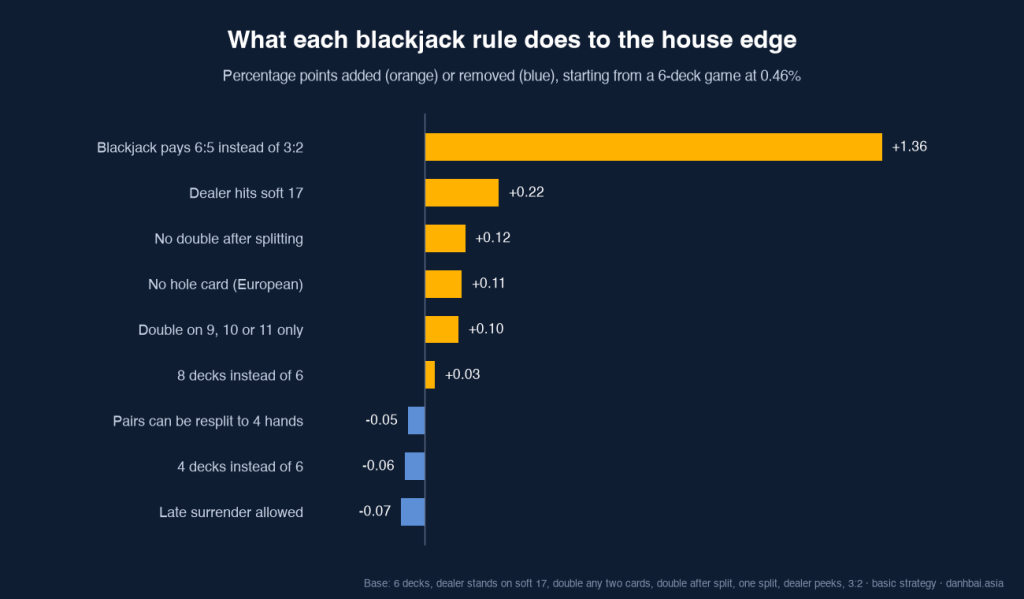
| Rule | Change in house edge |
|---|---|
| Blackjack pays 6:5 instead of 3:2 | +1.36 points |
| Dealer hits soft 17 | +0.22 |
| No double after splitting | +0.12 |
| No hole card (European) | +0.11 |
| Double on 9, 10 or 11 only | +0.10 |
| 8 decks instead of 6 | +0.03 |
| Pairs can be resplit up to 4 hands | −0.05 |
| 4 decks instead of 6 | −0.06 |
| Late surrender allowed | −0.07 |
The 6:5 payout is the rule to look for first. It costs more than the entire house edge of the 3:2 game, and more than playing with a single deck gives back — which is why single-deck tables that pay 6:5, such as Play’n GO’s Single Deck Blackjack, are not the bargain the deck count suggests. Dealer-hits-soft-17 is the next most expensive, and it is usually printed on the felt. For more on how the edge is calculated, see our house edge guide; our blackjack calculator gives the house edge for any combination of these rules.
How many decks are used in blackjack?
Most blackjack is dealt from six or eight decks shuffled together. Of the games above, Red Rake’s Vegas Strip uses four decks; its Blackjack Switch, European Blackjack and Double Exposure, and Betsoft’s European Blackjack, use six; Red Rake’s Atlantic City uses eight. Play’n GO’s Single Deck Blackjack uses one and pays 6:5 on a blackjack. Live tables list their deck count on the rules screen.
Other rules being equal, fewer decks mean a lower house edge. With the dealer standing on soft 17, doubling on any two cards and after a split, one split and a 3:2 blackjack:
| Decks | House edge |
|---|---|
| 1 | −0.15% (a 0.15% edge for the player) |
| 2 | 0.23% |
| 4 | 0.40% |
| 6 | 0.46% |
| 8 | 0.49% |
The difference comes from how much each card dealt changes what is left. With one deck, holding an ace leaves a larger share of tens behind, so a blackjack comes up 4.83% of the time against 4.75% from six decks. That is why a single-deck game almost never comes with the full rules in the table: Play’n GO’s pays 6:5, which costs far more than the extra decks would. In software blackjack the cards are reshuffled before every round, so there is no shoe to work through and the deck count on the rules screen is the whole story.
Live blackjack variants
Live-dealer studios run their own versions. In 22bet’s live casino you will find, among others:
- Free Bet Blackjack (Evolution, Pragmatic Play and others): the game puts up the extra stake for doubles on hard 9, 10 or 11 and for splitting most pairs, so you risk only your original bet. In return, a dealer 22 pushes every hand that has not busted.
- Infinite Blackjack (Evolution): any number of players share the same first two cards, and each one then decides how to play the hand.
- Lightning Blackjack and Power Blackjack (Evolution), and Speed and BlackjackX tables (Evolution and Pragmatic Play).
Each live table has a rules screen that lists its decks, dealer rules and payouts. Read it before you sit down — the same name can hide different rules from one provider to the next. If you are new to the live game, our guide to playing blackjack at a casino table explains the table, the signals and how a round runs. Play with money you can afford to lose, and set a limit before you start.

22bet
Blackjack variants FAQ
What are the main blackjack variants?
The ones you meet most often online are classic American rules (Atlantic City, Vegas Strip), European blackjack (no hole card), double exposure (both dealer cards face up), Blackjack Switch (two hands with swapped cards), and live-dealer versions such as Free Bet and Infinite Blackjack. They share the goal of beating the dealer without going over 21 and differ in a few rules that change the house edge.
What is European blackjack?
A version in which the dealer takes the second card only after the players have finished, so there is no hole card and no early check for blackjack. If the dealer makes blackjack, you usually lose doubled and split bets too. Doubling is often limited to 9, 10 or 11. Red Rake’s six-deck version states a return of 99.34%.
What is double exposure blackjack?
Blackjack in which both dealer cards are dealt face up. In exchange, a blackjack pays 1 to 1 and the dealer wins ties, except blackjack against blackjack. Red Rake’s version states a return of 99.04%.
Which blackjack variant has the lowest house edge?
Among the RNG variants in 22bet’s lobby, Red Rake’s Blackjack Switch states the highest return, 99.92% (a 0.08% edge), followed by Vegas Strip at 99.78%. Those figures assume perfect strategy for each game; Switch in particular needs its own strategy.
What is Blackjack Switch?
You play two hands with equal bets and may swap the second cards between them before playing. A blackjack pays 1 to 1, and a dealer total of 22 pushes every hand that has not busted.
What is the difference between Atlantic City and Vegas Strip blackjack?
Both use American rules with a hole card and 3:2 blackjack. In Red Rake’s versions, Atlantic City uses eight decks and offers late surrender, while Vegas Strip uses four decks and no surrender.
Is basic strategy the same for every blackjack variant?
No. The standard chart fits American-rule games such as Atlantic City and Vegas Strip. European rules change a few plays (hit 11 against a 10; do not split 8s against a 10 or ace), and double exposure and Blackjack Switch need strategies of their own.
What is Free Bet blackjack?
A live variant in which the game funds the extra stake for doubles on hard 9, 10 or 11 and for splitting most pairs, so you risk only your original bet. In return, a dealer total of 22 pushes every hand that has not busted.
Where can I play these blackjack variants online?
22bet’s casino lobby carries all of them: Red Rake’s European, Double Exposure, Switch, Atlantic City and Vegas Strip, Play’n GO’s and Habanero’s double exposure games, Betsoft’s and Platipus’ European blackjack, and live Free Bet, Infinite, Lightning and Power Blackjack.
How many decks are used in blackjack?
Usually six or eight. Of the games in this guide, Red Rake’s Vegas Strip uses four decks, Atlantic City eight and most of the others six. Fewer decks lower the house edge: under the same rules, eight decks instead of six add 0.03 points and four decks take off 0.06.