


How to Play Blackjack at a Casino: Hand Signals and Table Steps
October 20, 2026
Blackjack at a casino table is the same game you can learn on a screen, but the table has its own routine: how you get chips, where your bet goes, how you tell the dealer what you want, and what you must not touch. None of it is complicated, and dealers expect beginners. This guide walks through one visit from sitting down to collecting your chips, with the hand signals for every decision.
The rules of the game itself — card values, what beats what, what each hand pays — are in our blackjack rules guide, and the right play for every hand is in the blackjack basic strategy chart.
Before you sit down: read the table
Every blackjack table tells you its terms before you sit. Look for two things.
- The limits sign. A small sign on the table gives the minimum and maximum bet per hand. The minimum is the smallest bet you can place on a hand, so pick a table whose minimum suits your budget.
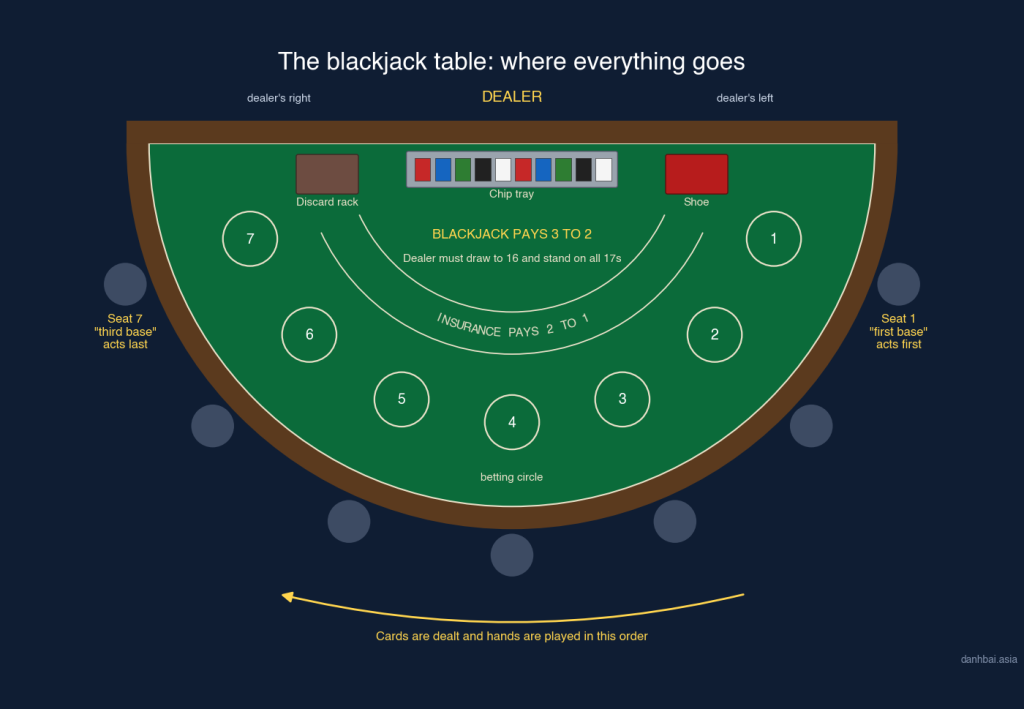
- The rules printed on the felt. Two lines matter most. “Blackjack pays 3 to 2” is the standard; a table that says 6 to 5 pays less on every blackjack. “Dealer must stand on all 17s” or “Dealer must hit soft 17” tells you how the dealer plays an ace-six, which changes a few cells of the strategy chart.
Any open seat is yours to take between hands. Seats are numbered from the dealer’s left. The seat on the dealer’s far left is called first base and acts first; the seat on the far right is third base and acts last, just before the dealer.
Buying in
You play with chips, not cash. Wait until the current hand is over, then lay your cash flat on the table in front of you — not in the betting circle, and not into the dealer’s hand. Dealers do not take money from a player’s hand: the cash stays on the felt where the cameras can see it. The dealer spreads the notes out, counts them aloud, and pushes the same amount back to you in chips.
Leave the chips in a stack in front of you. When you leave, take them to the cashier’s cage to change them back into cash; you can also ask the dealer to “color up” your small chips into fewer large ones first.
How a round of blackjack works at a casino table
- Bet. Before any card is dealt, place your chips inside the betting circle in front of your seat. Once the cards start coming, the bet stays where it is: you may not touch, add to or take back chips until that hand has been paid or collected.
- The deal. Starting with first base and going around the table, the dealer gives every player one card face up, then one face up to the dealer, then a second card face up to every player, and a second card face down to the dealer. The face-down card is the hole card. Most tables deal from a shoe holding several decks; some deal one or two decks by hand, with players’ cards face down.
- Insurance and the peek. If the dealer’s face-up card is an ace, the dealer offers insurance: a side bet of up to half your bet, paying 2 to 1 if the hole card is a ten-value card. With an ace or a ten showing, the dealer then checks the hole card. If it makes a blackjack, the round ends there and every hand without a blackjack loses its bet.
- Your turn. Starting again at first base, the dealer turns to each player in order. A blackjack is paid straight away. Otherwise you choose: hit, stand, double down, split a pair, or — where the table allows it — surrender. You can keep hitting until you stand or go over 21.
- The dealer’s turn. After the last player, the dealer turns over the hole card and draws until reaching 17 or more, following the rule printed on the felt. The dealer has no choices to make.
- Payment. A winning hand is paid 1 to 1, a blackjack 3 to 2, and a tie (a “push”) keeps its bet for the next round. Losing bets are collected. Wait until the dealer has paid you before you pick anything up.
Some casinos outside the US deal the dealer’s second card only after all players have finished. At those tables there is no peek, so a dealer blackjack shows up at the end of the round; check the table’s rules for what happens to doubles and splits then.
Blackjack hand signals
At a casino table you tell the dealer your decision with your hand, even if you also say it out loud. The cameras over the table record the gesture, which settles any dispute about what you asked for. The signals depend on whether your cards are dealt face up from a shoe or face down by hand.
| Decision | Shoe game (your cards face up) | Hand-held game (your cards face down) |
|---|---|---|
| Hit | Tap the table behind your cards with a finger. | Scrape the edge of your cards lightly on the felt, toward you. |
| Stand | Wave your hand flat, palm down, over your cards. | Slide your cards face down under your chips, without moving the chips. |
| Double down | Place a second stack, up to the size of your bet, beside your bet — not on top of it — and hold up one finger. | Turn your cards face up, place the second stack beside your bet, and hold up one finger. |
| Split | Place a stack equal to your bet beside it and hold up two fingers in a V. | Turn your cards face up, place an equal stack beside your bet, and hold up two fingers. |
| Surrender | Say “surrender”. Some casinos also accept a finger drawn in a line behind your bet. | Say “surrender”. |
| Insurance | When offered, place up to half your bet on the insurance line. | Same. |
Two rules go with the signals. In a shoe game, do not touch your cards at all — they are dealt face up so that nobody needs to. In a hand-held game, pick the cards up with one hand only and keep them above the table where the dealer can see them.
Doubling, splitting and surrender at the table
- Double down: you add up to your original bet and receive exactly one more card, often dealt sideways so it is clear the hand is finished. If the dealer turns out to have a blackjack, only your original bet is lost.
- Split: with two cards of the same value, you add a bet equal to the first and the dealer separates the cards into two hands. The hand on the dealer’s left is played to the end first, then the second. How many times you can split again, and whether you can double after splitting, is up to the casino.
- Surrender: you give up half your bet and keep the other half, before making any other decision on the hand. Not every table offers it; ask the dealer.
Which of these to use, and when, is the whole of basic strategy: our strategy chart gives the play for every hand against every dealer card.
How to deal blackjack
The dealer has no decisions to make, only a procedure to follow, and casinos follow it step by step so that every round can be checked afterwards. This is how a regulated casino table deals a shoe game:
- Shuffle and cut. The decks are shuffled together and offered to a player to cut. The player pushes a blank plastic cut card into the stack at least ten cards from either end, and the dealer moves the cards above it to the bottom. The dealer then places the cut card at least a quarter of the way up from the bottom of the stack and loads the shoe. When that card comes out, the round is finished and the cards are shuffled again.
- Burn a card. The first card out of a fresh shoe goes face down into the discard rack without being played.
- Deal. Starting at the dealer’s left: one card face up to each betting circle with a bet, one face up to the dealer, a second face up to each circle, and a second face down to the dealer.
- Insurance and the peek. With an ace showing, the dealer offers insurance. With an ace or a ten showing, the dealer then checks the hole card for a blackjack, at many casinos by sliding it over a reader so that nobody, the dealer included, sees it. A dealer blackjack is turned over and the round is settled straight away.
- Play each hand in turn. Moving clockwise from the dealer’s left, the dealer pays any player blackjack and then waits for each player’s signal, dealing every extra card face up. A doubled hand gets one card, often placed sideways. Split hands are played one at a time, the hand on the dealer’s left first.
- Play the dealer’s hand. The dealer turns the hole card over and draws until reaching 17 or more, following the soft-17 rule printed on the table and calling out the total after each card. If every player has already bust or surrendered, the dealer does not draw at all.
- Settle and clear. Losing bets are collected and winning bets paid, usually working from the dealer’s right. The cards are then picked up in order and placed in the discard rack, so that any hand can be rebuilt if a player disputes it.
Dealing at home follows the same steps without the reader and the surveillance. Agree the rules before the first hand — whether the dealer stands or hits on soft 17, and that blackjack pays 3 to 2 — and pass the shoe or the dealer’s seat round the table so that nobody stays the house all night.
Table etiquette in short
- Place your bet before the deal, and leave it alone until it is settled.
- Use the hand signals, and wait for the dealer to come to you.
- Do not touch your cards in a shoe game, or other players’ chips at any time.
- Join a table between rounds, not in the middle of a hand.
- Decide on your budget before you buy in, and leave when it is spent.
The same table online: live dealer blackjack
A live dealer blackjack table follows the same routine through a screen. The dealer deals from a real shoe in a studio, your bet goes on with a click before the timer runs out, and hit, stand, double and split are buttons that appear on your turn. Classic live tables have a fixed number of seats; variants such as Evolution’s Infinite Blackjack have no seat limit, so a place is always free.

22bet
Casino Blackjack FAQ
What are the hand signals in blackjack?
In a shoe game with cards face up: tap the table to hit, wave your hand flat over your cards to stand, place a second stack beside your bet and hold up one finger to double, and place a matching stack and hold up two fingers to split. In a hand-held game: scrape your cards toward you to hit and tuck them under your chips to stand.
How do you buy in at a blackjack table?
Between hands, lay your cash flat on the table in front of you. The dealer counts it and gives you the same amount in chips. Do not hand money to the dealer or put it in the betting circle.
Can you touch your cards in blackjack?
Not in a shoe game, where the cards are dealt face up. In a single- or double-deck game dealt face down by hand you pick them up, with one hand only, and keep them above the table.
Do you have to use hand signals at a casino?
Yes in practice. Saying what you want is fine, but the dealer will wait for the signal too, because the cameras over the table record gestures, not voices.
Where should a beginner sit at a blackjack table?
Every seat plays the same odds, so any open seat will do. First base, on the dealer’s far left, acts first; third base, on the far right, acts last, just before the dealer.
How much can you bet on insurance?
Up to half of your original bet. It is offered only when the dealer shows an ace, and pays 2 to 1 if the dealer’s hole card is a ten, jack, queen or king.
What does "dealer must stand on all 17s" mean?
The dealer stops drawing at any total of 17, including a soft 17 such as ace-six. At a table that says “dealer hits soft 17”, the dealer draws again on ace-six; that rule is slightly worse for players and changes a few plays on the strategy chart.
Is live dealer blackjack online played the same way?
Yes. The dealer deals real cards in a studio and the decisions are the same; you bet and act with on-screen buttons within a time limit instead of chips and hand signals.
Does the dealer check for blackjack with a 10 showing?
Yes, at tables that use a hole card. With an ace or any ten-value card showing, the dealer checks the hole card before anyone plays, and the round ends at once if it makes a blackjack. At tables that deal the dealer’s second card only after the players have finished, there is no check.
What are the dealer's rules in blackjack?
The dealer must draw to 16 and stand on 17 or more, with no choices. The only variation is soft 17 (a 17 that includes an ace counted as 11): the sign on the table says whether the dealer stands or hits on it.