


Blackjack Calculator: Best Move and Odds for Any Hand
October 27, 2026
This blackjack calculator tells you the best move for any hand. Set the table’s rules, pick the dealer’s upcard and tap your cards: it shows what hitting, standing, doubling, splitting and surrendering are each worth, and which one costs you the least. It also gives the house edge of the rules you chose.
The calculator needs JavaScript. The tables below show the best move for the most common close decisions.
How to use the blackjack calculator
- Set the table rules. Most are printed on the felt or in the game’s rules screen: the number of decks, whether the dealer stands or hits on soft 17, what a blackjack pays, and whether you can double after splitting. “No hole card” is the European rule, where the dealer takes the second card only after you have played.
- Pick the dealer’s upcard. Tens, jacks, queens and kings all count as 10.
- Tap your cards in the order you received them. After a third card the calculator only offers hit or stand, as at the table.
- Read the result. The move in blue is the best one. The table lists every legal move with its expected return per 100 bet: −20.0 means that, on average, playing the hand that way loses 20 of every 100 you have on it.
Expected return covers the whole hand: if you hit, it assumes you keep playing correctly afterwards. With a dealer ace or 10 at a table where the dealer checks for blackjack, the figures apply after the check — which is when you actually decide.
How the calculator works
The calculator works out every way the hand can finish rather than simulating it. It takes the shoe you selected, removes your cards and the dealer’s upcard, and calculates the probability of every final dealer total from that upcard, including busting. It then works backwards through your options: standing is compared with every total the dealer can reach, hitting with every card you might draw, doubling with exactly one more card at twice the stake, and splitting with each new hand played correctly. Removing the cards already on the table is why it can tell a two-card 16 from a 16 made of four small cards.
The house edge figure applies the same calculation to every starting hand against every upcard, weighted by how often each one is dealt. For a six-deck game where the dealer stands on soft 17, you can double any two cards and after a split, split once, and the dealer checks for blackjack, it gives 0.46%. Our blackjack variants guide shows what each rule does to that number.
Close calls the calculator settles
Most blackjack decisions are obvious. These are the ones players argue about, with the calculator’s figures for the six-deck game above (expected return per 100 bet):
| Your hand | Dealer shows | Best move | Next best |
|---|---|---|---|
| Hard 16 (10-6) | 10 | Hit −53.5 | Stand −54.2 |
| Hard 16 of four cards (2-3-4-7) | 10 | Stand −54.1 | Hit −54.5 |
| Hard 12 (10-2) | 3 | Hit −23.3 | Stand −25.5 |
| Hard 11 (5-6) | 10 | Double +18.0 | Hit +12.0 |
| Hard 11 (5-6) | Ace | Hit +14.7 | Double +12.5 |
| Pair of 5s | 10 | Hit +2.7 | Double −0.5 |
| Soft 18 (A-7) | 9 | Hit −9.9 | Stand −18.3 |
| Soft 18 (A-7) | 3 | Double +17.9 | Stand +15.1 |
| Pair of 8s | 10 | Split −48.5 | Hit −53.5 |
| Pair of 9s | 7 | Stand +39.9 | Split +36.9 |
| Pair of 10s | 6 | Stand +70.3 | Split +56.6 |
| Pair of aces | Ace | Split +12.2 | Hit −2.1 |
Three lessons stand out. A 16 against a 10 loses more than half your bet whatever you do, so the choice between hitting and standing is worth less than one unit per 100 — but hitting a two-card 16 and standing on a 16 of four small cards are both right, because the small cards you already hold are no longer in the shoe. Splitting 8s against a 10 still loses, just less than any other play. And a pair of 9s against a 7 is a stand, because the dealer’s most likely total is 17, which your 18 beats.
Change the rules in the calculator and some of these flip. With the dealer hitting soft 17, hard 11 against an ace becomes a double. With no hole card, hard 11 against a 10 becomes a hit and a pair of 8s against a 10 is no longer split.
How often the dealer busts
Many decisions come down to how often the dealer’s upcard ends in a bust. The weak upcards, 2 to 6, bust about 35% to 44% of the time, which is why you stand on 12 to 16 against most of them and double more often. From a 7 or higher the dealer busts about a quarter of the time or less, and from an ace about one time in nine.
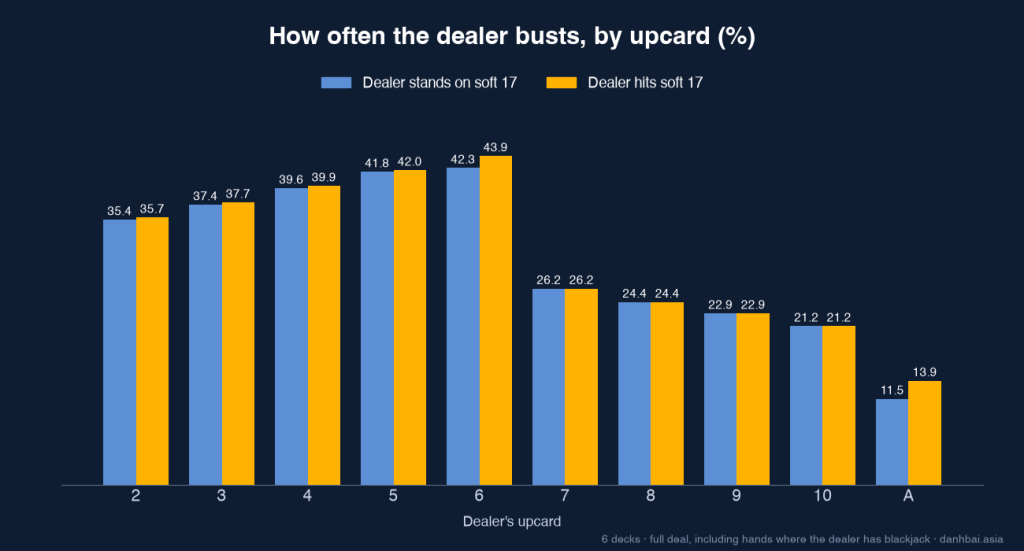
The calculator shows the bust rate for the upcard you choose, with your cards removed from the shoe. For a dealer ace or 10 at a table where the dealer checks for blackjack, it shows the rate after the check, which is higher (about 23% for a 10 and 17% for an ace) because a natural is no longer possible.
What a blackjack calculator cannot do
- It cannot change the house edge of the rules you play. It shows you the play that costs the least on each hand, so you lose as little as the rules allow. Over a session, the result still swings with the cards.
- It does not count cards. It removes only the cards in the current hand. Most online RNG games reshuffle after every round, so there is nothing to count.
- It does not cover insurance or side bets. Insurance pays 2 to 1 on a bet that wins less than one time in three; our blackjack insurance guide explains why it costs more than it returns.
- Some variants need their own strategy. Double exposure and Blackjack Switch change the payouts and ties in ways a standard calculator does not model.
For the full chart in one image, see our blackjack basic strategy chart, and for the table itself, how to play blackjack at a casino. Treat blackjack as entertainment with a cost, and set a limit before you play.

22bet
Blackjack calculator FAQ
What is a blackjack calculator?
A tool that works out the best move for a blackjack hand. You enter the table rules, the dealer’s upcard and your cards, and it calculates the expected return of hitting, standing, doubling, splitting and surrendering, then shows the best one.
Should you hit 16 against a dealer 10?
With two cards, yes: in a six-deck game hitting returns −53.5 per 100 bet and standing −54.2. With three or more small cards making 16, standing is slightly better. Where late surrender is offered, surrendering hard 16 against a 10 (−50) beats both.
When should you double down in blackjack?
In a six-deck game where the dealer stands on soft 17: hard 11 against 2 to 10, hard 10 against 2 to 9, hard 9 against 3 to 6, soft 13 and 14 against 5 or 6, soft 15 and 16 against 4 to 6, and soft 17 and 18 against 3 to 6. The calculator shows the double’s value next to hitting for any hand and any rules.
Should you always split 8s and aces?
At tables where the dealer checks for blackjack, yes. At no-hole-card (European) tables, the calculator shows hitting a pair of 8s against a 10 or an ace, and hitting a pair of aces against an ace, because a dealer blackjack would take both split bets.
What is the house edge in blackjack?
It depends on the rules. For six decks, dealer standing on soft 17, double on any two cards and after a split, one split, a dealer peek and 3:2 blackjack, it is 0.46% with perfect play. A 6:5 blackjack payout raises it by about 1.36 percentage points. Set the rules in the calculator to see the edge of any table.
Does the calculator work for online blackjack?
Yes. RNG and live blackjack use the same rules as a casino table; read the game’s rules screen and set the calculator to match. RNG games that shuffle after every round, such as Red Rake’s, are exactly the situation the calculator assumes.
Does a blackjack calculator beat the house edge?
No. It shows the play that loses the least on average for each hand, which keeps the house edge as low as the rules allow. Short-term results still depend on the cards.