


Blackjack Switch: Rules, When to Switch, Strategy and House Edge
November 9, 2026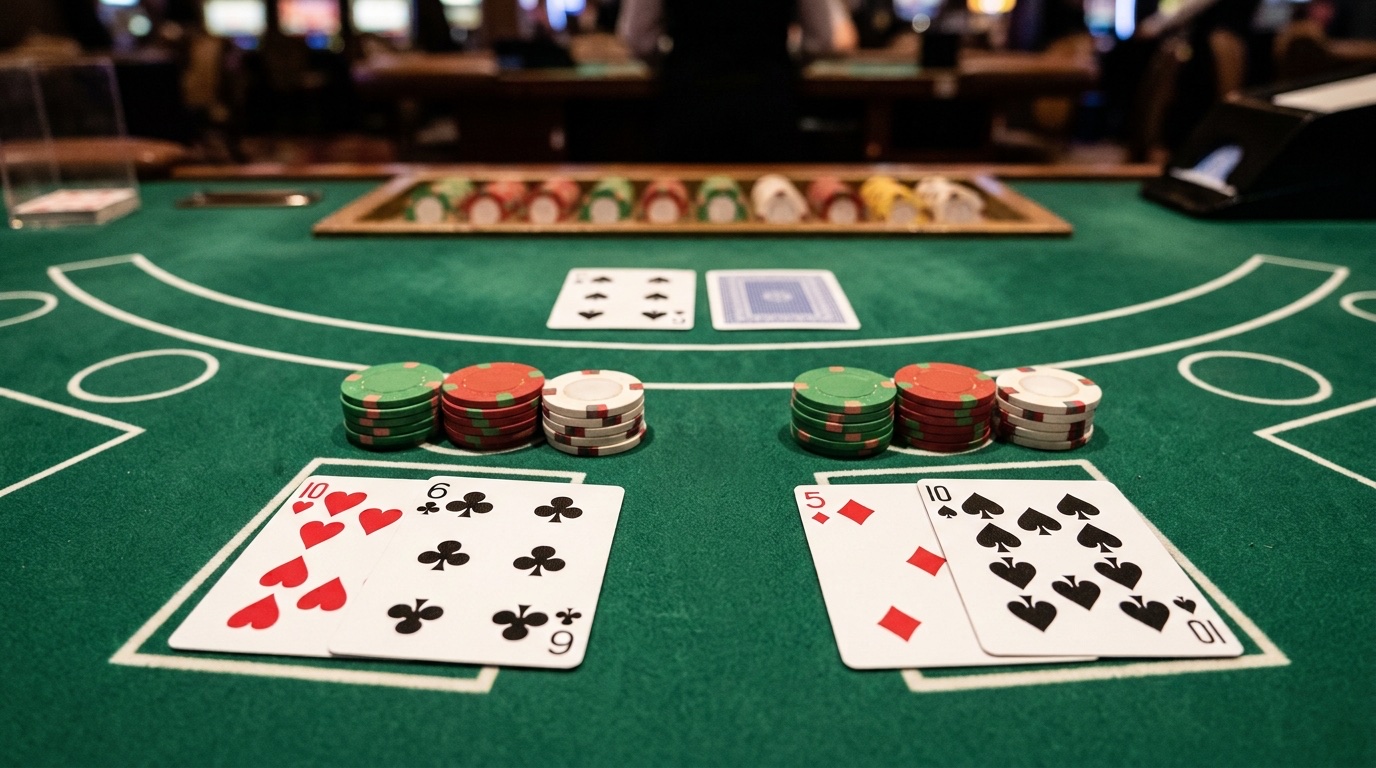
Blackjack Switch gives you two hands and lets you swap their second cards before you play them. Dealt 10-6 and 5-10 against a dealer 6, you can switch them into 10-10 and 5-6: a 20 and an 11. That option is worth a lot, so the game takes some of it back: a blackjack pays only 1 to 1, and a dealer total of 22 is a push instead of a bust. This guide covers the rules, when to switch, how to play your hands afterwards, the house edge and the Super Match side bet, with every figure worked out by our own blackjack calculator.
How to play Blackjack Switch
- Two equal bets. You place the same bet on two hands. You can also place the optional Super Match side bet.
- Two cards each. Both hands get two cards and the dealer gets one card face up and one face down. In a land casino the dealer checks for blackjack at this point.
- Switch or keep. You can swap the second card of the first hand with the second card of the second hand. It is one decision for both hands: you switch the pair of cards, or you keep both hands as dealt.
- Play each hand. Hit, stand, double down or split as in ordinary blackjack, one hand at a time.
- The dealer plays and bets are settled. A hand closer to 21 than the dealer’s wins 1 to 1, a tie pushes, and a dealer 22 pushes against every hand that is still standing, except a blackjack.
The rules that pay for the switch
These are the rules in a typical casino rule book (Pennsylvania’s blackjack rules, which set out Blackjack Switch as a variation), next to Red Rake’s online version:
| Rule | Casino rule book | Red Rake online |
|---|---|---|
| Blackjack pays | 1 to 1 | 1 to 1 |
| Dealer 22 | Push against any hand of 21 or less | Push against any hand except a winning blackjack |
| Ace and 10 made by switching | Counts as 21, not blackjack | The rules screen calls any ace and 10 in the first two cards a blackjack |
| Dealer checks for blackjack | Yes | No |
| Decks | 6 or 8 | 6, shuffled after every round |
| Soft 17 | Set by the casino | Dealer hits soft 17 |
| Doubling and splitting | Double on two cards, double after a split | Double on two cards, double after a split, split once |
A natural blackjack still beats a dealer 21 made with three or more cards, and it still wins against a dealer 22. A two-card 21 made by switching does neither in a casino that follows the rule book: it plays as an ordinary 21.
When to switch
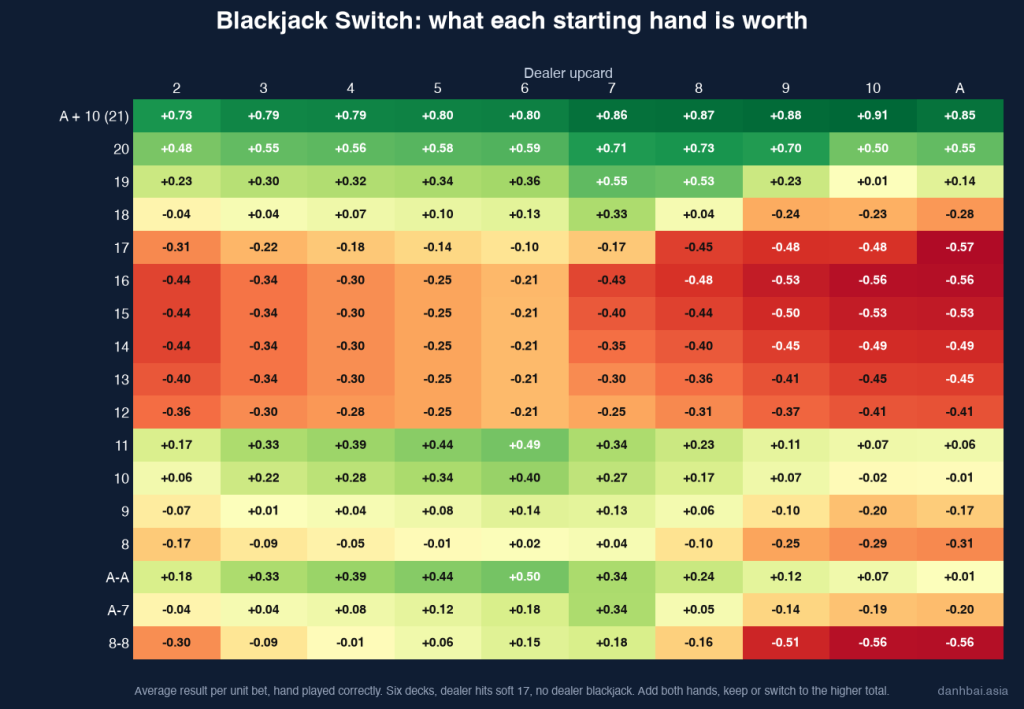
Switch whenever the two hands you would get are worth more together than the two you were dealt. This table gives the average result of each starting hand per unit bet, for each dealer upcard, with the hand then played the right way (six decks, dealer hits soft 17, dealer has already checked for blackjack). Add up the two hands as dealt, add up the two hands you would get by switching, and take the higher total.
| Your hand | 2 | 3 | 4 | 5 | 6 | 7 | 8 | 9 | 10 | A |
|---|---|---|---|---|---|---|---|---|---|---|
| A + 10 (21) | +0.73 | +0.79 | +0.79 | +0.80 | +0.80 | +0.86 | +0.87 | +0.88 | +0.91 | +0.85 |
| 20 | +0.48 | +0.55 | +0.56 | +0.58 | +0.59 | +0.71 | +0.73 | +0.70 | +0.50 | +0.55 |
| 19 | +0.23 | +0.30 | +0.32 | +0.34 | +0.36 | +0.55 | +0.53 | +0.23 | +0.01 | +0.14 |
| 18 | -0.04 | +0.04 | +0.07 | +0.10 | +0.13 | +0.33 | +0.04 | -0.24 | -0.23 | -0.28 |
| 17 | -0.31 | -0.22 | -0.18 | -0.14 | -0.10 | -0.17 | -0.45 | -0.48 | -0.48 | -0.57 |
| 16 | -0.44 | -0.34 | -0.30 | -0.25 | -0.21 | -0.43 | -0.48 | -0.53 | -0.56 | -0.56 |
| 15 | -0.44 | -0.34 | -0.30 | -0.25 | -0.21 | -0.40 | -0.44 | -0.50 | -0.53 | -0.53 |
| 14 | -0.44 | -0.34 | -0.30 | -0.25 | -0.21 | -0.35 | -0.40 | -0.45 | -0.49 | -0.49 |
| 13 | -0.40 | -0.34 | -0.30 | -0.25 | -0.21 | -0.30 | -0.36 | -0.41 | -0.45 | -0.45 |
| 12 | -0.36 | -0.30 | -0.28 | -0.25 | -0.21 | -0.25 | -0.31 | -0.37 | -0.41 | -0.41 |
| 11 | +0.17 | +0.33 | +0.39 | +0.44 | +0.49 | +0.34 | +0.23 | +0.11 | +0.07 | +0.06 |
| 10 | +0.06 | +0.22 | +0.28 | +0.34 | +0.40 | +0.27 | +0.17 | +0.07 | -0.02 | -0.01 |
| 9 | -0.07 | +0.01 | +0.04 | +0.08 | +0.14 | +0.13 | +0.06 | -0.10 | -0.20 | -0.17 |
| 8 | -0.17 | -0.09 | -0.05 | -0.01 | +0.02 | +0.04 | -0.10 | -0.25 | -0.29 | -0.31 |
| A-A | +0.18 | +0.33 | +0.39 | +0.44 | +0.50 | +0.34 | +0.24 | +0.12 | +0.07 | +0.01 |
| A-7 (soft 18) | -0.04 | +0.04 | +0.08 | +0.12 | +0.18 | +0.34 | +0.05 | -0.14 | -0.19 | -0.20 |
| 8-8 | -0.30 | -0.09 | -0.01 | +0.06 | +0.15 | +0.18 | -0.16 | -0.51 | -0.56 | -0.56 |
The first row is an ace and a 10 made by switching, which plays as a 21. A blackjack you were dealt is worth +1.00 against every upcard once the dealer has checked for blackjack.
Three examples:
- Dealer 6, hands 10-6 and 5-10. Keeping them gives a 16 and a 15, together worth -0.42. Switching gives 10-10 and 5-6, a 20 and an 11, worth +1.09. Switch.
- Dealer 10, hands 10-6 and A-7. Keeping: -0.74. Switching gives 10-7 and A-6: -0.72. Both are losing positions, but switching loses less.
- Dealer 9, hands 10-9 and A-10. Keeping gives a blackjack and a 19, worth +1.23. Switching gives 10-10 and A-9, two 20s, worth +1.40. Switch: with a blackjack paying only 1 to 1, breaking it up to turn a 19 into a 20 is worth it.
The patterns in the table are the ones to remember. A 20 or a 21 is worth a lot against every upcard. An 11 or a 10 is worth almost as much as a 19 against a dealer 2 to 8, because you can double it. A 12 to 16 is a losing hand against everything, so turning two stiff hands into one strong hand and one weak hand is usually right. With the switch played this way you switch in about 35% of rounds.
How to play your hands after the switch
A dealer 22 that pushes changes the classic strategy: standing on a stiff hand and hoping the dealer busts is worth less, so you hit more often and double less. The chart below is for six decks with the dealer hitting soft 17 and checking for blackjack. H = hit, S = stand, D = double (hit if you cannot), Ds = double (stand if you cannot), P = split.
Hard totals
| Your hand | 2 | 3 | 4 | 5 | 6 | 7 | 8 | 9 | 10 | A |
|---|---|---|---|---|---|---|---|---|---|---|
| 5 to 8 | H | H | H | H | H | H | H | H | H | H |
| 9 | H | H | H | D | D | H | H | H | H | H |
| 10 | D | D | D | D | D | D | D | H | H | H |
| 11 | D | D | D | D | D | D | D | H | H | H |
| 12 | H | H | H | H | S | H | H | H | H | H |
| 13 | H | S | S | S | S | H | H | H | H | H |
| 14 | S | S | S | S | S | H | H | H | H | H |
| 15 | S | S | S | S | S | H | H | H | H | H |
| 16 | S | S | S | S | S | H | H | H | H | H |
| 17 to 20 | S | S | S | S | S | S | S | S | S | S |
Soft totals
| Your hand | 2 | 3 | 4 | 5 | 6 | 7 | 8 | 9 | 10 | A |
|---|---|---|---|---|---|---|---|---|---|---|
| A-2 to A-4 | H | H | H | H | H | H | H | H | H | H |
| A-5 | H | H | H | H | D | H | H | H | H | H |
| A-6 | H | H | H | D | D | H | H | H | H | H |
| A-7 | S | S | S | Ds | Ds | S | S | H | H | H |
| A-8, A-9 | S | S | S | S | S | S | S | S | S | S |
Pairs
| Your pair | 2 | 3 | 4 | 5 | 6 | 7 | 8 | 9 | 10 | A |
|---|---|---|---|---|---|---|---|---|---|---|
| A-A | P | P | P | P | P | P | P | P | P | P |
| 2-2 | H | H | H | P | P | P | H | H | H | H |
| 3-3 | H | H | H | P | P | P | H | H | H | H |
| 4-4 | H | H | H | H | H | H | H | H | H | H |
| 6-6 | H | H | P | P | P | H | H | H | H | H |
| 7-7 | S | P | P | P | P | P | H | H | H | H |
| 8-8 | P | P | P | P | P | P | P | P | H | H |
| 9-9 | S | S | P | P | P | S | P | P | S | S |
Never split 5-5 or 10-10: play 5-5 as a hard 10 and stand on 20. In Red Rake’s online version, where the dealer does not check for blackjack first and you can split only once, the chart is the same except for one hand: hit A-A against a dealer ace instead of splitting.
Blackjack Switch house edge
With the switch and the hands played as above, the house edge is about 0.57% of each hand’s bet with six decks, the dealer hitting soft 17 and the rule-book treatment of a switched blackjack, by our calculation. If the dealer stands on soft 17 it drops to about 0.17%; with eight decks it is about 0.60%.
The switch carries the game. Play the same rules without it — blackjack at 1 to 1, a dealer 22 that pushes — and the house edge would be about 9.8%. Red Rake states a theoretical return of 99.92% for its online Blackjack Switch, a house edge of 0.08%; most of the difference from the casino figure comes from counting a switched ace and 10 as a blackjack.
The Super Match side bet
Super Match pays on the first four cards of your two hands. It is decided by the four cards as they are dealt, before any switch, so how you play the hands does not change it.
| Your four cards | How often (6 decks) | 6 decks | 8 decks | Red Rake online |
|---|---|---|---|---|
| Four of a kind | 1 in 2,804 | 40 to 1 | 50 to 1 | 10 to 1 |
| Two pairs | 1.53% | 8 to 1 | 7 to 1 | 8 to 1 |
| Three of a kind | 1.96% | 5 to 1 | 5 to 1 | 5 to 1 |
| One pair | 35.2% | 1 to 1 | 1 to 1 | 1 to 1 |
| House edge | 2.55% | 2.64% | 3.62% |
The four cards hold no pair 61.3% of the time, so the bet loses more often than it wins. The casino tables are the two in Pennsylvania’s rules; the figures are exact for the number of decks shown.
Blackjack Switch vs other blackjack games
Switch is one of several games that change the classic rules in both directions. In Free Bet Blackjack the casino pays for some doubles and splits and a dealer 22 also pushes; in Spanish 21 the 10s are removed and the player gets bonus payouts. Our blackjack variants guide compares them side by side, and the blackjack calculator works out the house edge for classic rules.
Where to play Blackjack Switch online
22bet’s casino carries Red Rake’s Blackjack Switch, a computer-dealt game with the rules in the table above, two hands at a time and the Super Match bet at 10, 8, 5 and 1 to 1. Before you play, open the game’s rules screen to check the payouts and the stated return. Casino games are for players aged 18 and over; play with money you can afford to lose.

22bet
Blackjack Switch: FAQ
How does Blackjack Switch work?
You play two hands with equal bets. After the deal you may swap the second card of one hand with the second card of the other, then play both hands as in ordinary blackjack. In return, a blackjack pays 1 to 1 and a dealer 22 pushes against every hand except a blackjack.
When should you switch in Blackjack Switch?
When the two hands you would get are worth more together than the two you were dealt. Making a 20 or 21 is almost always worth it, a 10 or 11 is strong against a dealer 2 to 8, and turning two hands of 12 to 16 into one strong and one weak hand is usually right.
What is the house edge in Blackjack Switch?
About 0.57% with six decks and the dealer hitting soft 17, and about 0.17% if the dealer stands on soft 17, by our calculation. Red Rake states a return of 99.92% for its online version.
Does a switched ace and 10 count as blackjack?
Not under a typical casino rule book: an ace and 10 made by switching counts as 21, loses to a dealer blackjack and pushes against a dealer 21 or 22. Red Rake’s online rules screen calls any ace and 10 in the first two cards a blackjack.
What happens when the dealer gets 22?
Every hand that has not busted pushes and gets its bet back, except a blackjack, which still wins. That rule is why you hit and double less often than in ordinary blackjack.
What is the Super Match bet?
A side bet on the first four cards of your two hands: a pair pays 1 to 1, three of a kind 5 to 1, two pairs 8 to 1 and four of a kind 40 to 1 with six decks. Its house edge is 2.55% with six decks and 2.64% with eight; Red Rake’s version pays 10 to 1 for four of a kind, a house edge of 3.62%.
Where can I play Blackjack Switch online?
22bet’s casino carries Red Rake’s Blackjack Switch, a computer-dealt game with six decks, the dealer hitting soft 17 and the Super Match side bet.