


Poker Equity Calculator: Texas Hold'em Odds for Any Hands and Board
November 1, 2026
This poker equity calculator shows how often each Texas Hold’em hand wins, ties and what share of the pot it takes on average. Enter two to six hands, add a flop, turn or river if you have one, and press Calculate. When every hand is known, the calculator deals every possible remaining board — all 1,712,304 of them for two hands before the flop — so the result is exact. A second tab turns the result into a call-or-fold check with pot odds.
The calculator needs JavaScript. The tables below cover the most common matchups.
How to use the equity calculator
- Enter the hands. Tap a card slot, then pick the card from the deck under the table. Each player needs two cards. Add players up to six, or remove them down to two.
- Use a random hand for an unknown opponent. Press Random on a player to give them any two cards. The calculator then deals 200,000 random hands and boards and reports the average, so the figures can move by a few tenths of a point between runs.
- Add the board if there is one. Leave the board empty for preflop, or enter the flop (three cards), the turn (four) or the river (five).
- Read the result. Each player’s row shows the equity in large type, with the win and tie percentages under it. The table below lists what each player ends up with by the river — how often each hand finishes with a pair, two pair, a flush and so on.
- Check the call. The Pot odds tab takes the pot, the bet you face and your equity (filled in from Player 1’s last result) and shows the equity you need to call and the average result of calling.
What poker equity means
Equity is the share of the pot a hand takes on average if all the cards are dealt out with no more betting. It counts each win in full and splits each tie between the hands that share it. If two hands are all-in and one wins 46.02% of the boards, loses 53.59% and ties the other 0.39%, its equity is 46.02% + 0.39% ÷ 2 = 46.21%. That is A♠ K♠ against Q♥ Q♦ before the flop.
The calculator gives three figures for each hand:
- Win — the share of boards where the hand alone has the best five cards.
- Tie — the share of boards where it shares the best hand with at least one other player.
- Equity — win plus its share of the ties. Equity across all players always adds up to 100%.
Equity is not the same as how often a hand wins: hands that tie often (A-K against A-Q, for example) have equity above their win rate. And equity assumes every card is dealt. In a real hand players can still bet and fold, which is why a hand’s equity and its value at the table are not the same thing.
Preflop all-in matchups
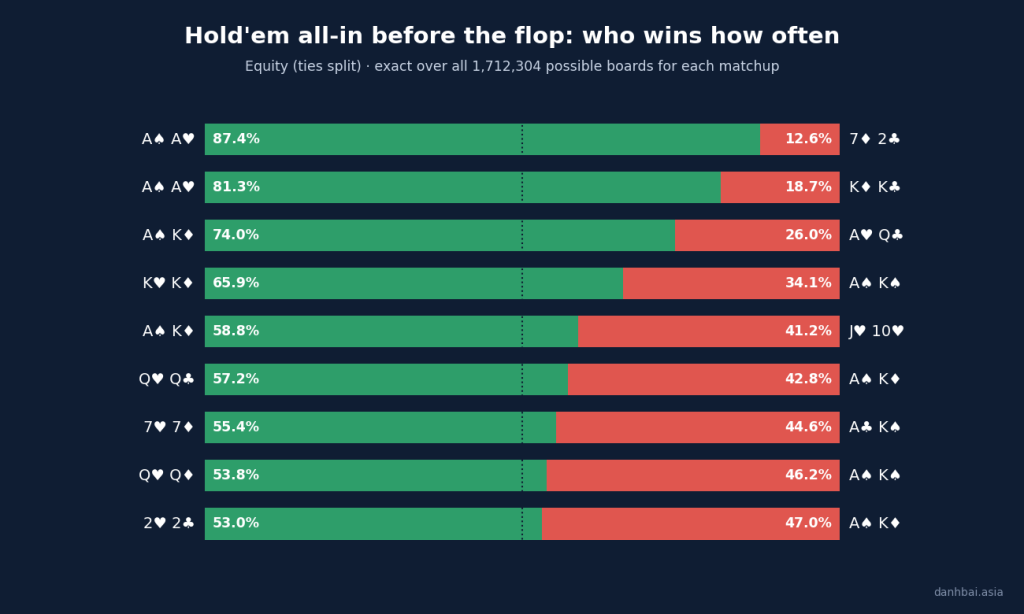
When two players are all-in before the flop, the five board cards decide the hand. These are the exact figures for the most common matchups, worked out over every one of the 1,712,304 possible boards. Suits matter a little, so the cards are given exactly:
| Hand | Against | Type of matchup | Wins | Ties | Equity |
|---|---|---|---|---|---|
| A♠ A♥ | 7♦ 2♣ | Best hand against the worst | 87.24% | 0.36% | 87.42% |
| A♠ A♥ | K♠ K♥ | Higher pair, same suits | 82.36% | 0.54% | 82.64% |
| A♠ A♥ | K♦ K♣ | Higher pair, different suits | 81.06% | 0.38% | 81.26% |
| A♠ K♦ | A♥ Q♣ | Dominated kicker | 71.72% | 4.59% | 74.02% |
| K♥ K♦ | A♠ K♠ | Pair against a higher card and its own rank | 65.48% | 0.82% | 65.89% |
| A♠ K♦ | J♥ 10♥ | Two higher cards against two lower | 58.61% | 0.42% | 58.82% |
| Q♥ Q♣ | A♠ K♦ | Pair against two higher cards | 56.99% | 0.34% | 57.16% |
| 7♥ 7♦ | A♣ K♠ | Pair against two higher cards | 55.25% | 0.28% | 55.39% |
| Q♥ Q♦ | A♠ K♠ | Pair against two higher suited cards | 53.59% | 0.39% | 53.79% |
| 2♥ 2♣ | A♠ K♦ | Lowest pair against two higher cards | 52.75% | 0.58% | 53.04% |
- A pair against two higher cards is close to even. Against A-K offsuit every pair from deuces to queens has between 53.04% (2-2) and 57.28% (10-10); against A-K suited, between 49.92% (2-2) and 53.89%. This is the matchup players call a coin flip.
- A dominated hand is in much worse shape. A-Q against A-K shares the ace, so the queen has to pair without the king pairing too. A-Q’s equity is 25.98% — about one pot in four.
- Suits shift the figure by about a point. A♠ A♥ has 82.64% against K♠ K♥ but 81.26% against K♦ K♣: when the kings share the aces’ suits, every flush the kings make is also a flush for the aces, usually a higher one.
- Three-way pots spread the equity. With A♠ A♥, K♠ K♥ and Q♠ Q♥ all-in, the aces have 67.67%, the kings 17.23% and the queens 15.10%.
Equity against a random hand
Against one opponent whose cards you do not know, a hand’s equity is its average over all 1,225 hands the opponent could hold and every board for each — 2,097,572,400 combinations in all. The calculator estimates the same figure by simulation when you press Random; these are the exact values:
| Starting hand | Wins | Ties | Equity against one random hand |
|---|---|---|---|
| A-A | 84.93% | 0.54% | 85.20% |
| K-K | 82.12% | 0.56% | 82.40% |
| Q-Q | 79.63% | 0.59% | 79.93% |
| A-K suited | 66.22% | 1.65% | 67.04% |
| A-K offsuit | 64.47% | 1.70% | 65.32% |
| J-10 suited | 56.15% | 2.75% | 57.53% |
| 2-2 | 49.39% | 1.90% | 50.33% |
| 7-2 offsuit | 31.71% | 5.75% | 34.58% |
A-K suited is worth 1.72 points more than A-K offsuit against a random hand. A pair of deuces is barely above half, because any two higher cards are close to even against it. Against several opponents every one of these figures falls; enter the number of players with Random hands in the calculator to see by how much.
Equity on the flop and turn
After the flop there are 990 possible turn-and-river pairs left for two known hands, and after the turn 44 river cards, so these figures come straight from counting them:
| Hand | Against | Board | Situation | Equity |
|---|---|---|---|---|
| 2♠ 2♦ | A♥ K♥ | 9♥ 8♥ 2♣ | Set against a flush draw with two overcards | 75.35% / 24.65% |
| Q♠ J♠ | 10♥ 9♥ | Q♥ 8♥ 4♣ | Top pair against a flush draw with an inside straight draw | 56.06% / 43.94% |
| A♠ Q♠ | J♥ 10♦ | 9♣ 8♠ 2♥ | Two overcards against an open-ended straight draw | 55.15% / 44.85% |
| A♥ K♥ | Q♠ J♠ | Q♥ 7♥ 2♣ | Flush draw with two overcards against top pair | 53.43% / 46.57% |
| A♥ K♥ | Q♠ J♠ | Q♥ 7♥ 2♣ 5♦ | Same hand on the turn, one card to come | 34.09% / 65.91% |
The last two rows show how much the turn matters. With two cards to come, the flush draw with an ace and a king is ahead of top pair. A blank on the turn leaves 15 cards out of 44 that win the hand — nine hearts, three aces and three kings — so its equity falls to 15 ÷ 44 = 34.09%.
Outs and the rule of 4 and 2
An out is a card that makes your hand the best one. With a known number of clean outs you can work out your equity without the calculator: after the flop 47 cards are unseen, after the turn 46. The shortcut is to multiply the outs by 4 with two cards to come and by 2 with one:
| Outs | Typical draw | By the river, from the flop | Rule of 4 | On the river, from the turn | Rule of 2 |
|---|---|---|---|---|---|
| 2 | Pocket pair to a set | 8.4% | 8% | 4.3% | 4% |
| 4 | Inside straight draw | 16.5% | 16% | 8.7% | 8% |
| 8 | Open-ended straight draw | 31.5% | 32% | 17.4% | 16% |
| 9 | Flush draw | 35.0% | 36% | 19.6% | 18% |
| 12 | Flush draw with one overcard | 45.0% | 48% | 26.1% | 24% |
| 15 | Flush and straight draw | 54.1% | 60% | 32.6% | 30% |
The rule is close up to about 9 outs and then overstates the draw, by six points at 15 outs. It also counts only clean outs: a card that completes your flush but pairs the board can give the other player a full house. The calculator counts every card exactly, which is why its figure for a draw can sit below the rule’s. The poker guide has the full outs table and how often each hand ranking comes up.
Pot odds: is the call worth it?
Pot odds compare the bet you have to call with the pot you would take. The equity you need to call is the call divided by the pot after your call:
Equity needed = bet to call ÷ (pot before your call + bet to call)
“Pot before your call” includes the bet you are facing. With 100 in the middle and an opponent’s bet of 50, the pot is 150 and you call 50: 50 ÷ 200 = 25%. The same applies to any bet size:
| Opponent bets | Pot odds | Equity needed to call |
|---|---|---|
| 1/4 of the pot | 5 to 1 | 16.7% |
| 1/3 of the pot | 4 to 1 | 20.0% |
| 1/2 of the pot | 3 to 1 | 25.0% |
| 2/3 of the pot | 2.5 to 1 | 28.6% |
| 3/4 of the pot | 2.33 to 1 | 30.0% |
| The size of the pot | 2 to 1 | 33.3% |
| Twice the pot | 1.5 to 1 | 40.0% |
Put the two together. On the Q♥ 7♥ 2♣ flop above, if the player with Q♠ J♠ moves all-in for the size of the pot, A♥ K♥ needs 33.3% and has 53.43%. The average result of calling is 0.5343 × 3 − 1 = +0.60 of the bet. One card later the same hand has 34.09%, and against another pot-sized bet it needs 33.3% — still above the line, but only just. The Pot odds tab does this sum for any pot and bet.
Pot odds only count the money already in the pot. When more betting can follow, players also weigh what they can win on later streets (implied odds) and what a call can cost them later; the calculator leaves both out.
For how to put opponents on a range of hands rather than one exact hand, see the guide to poker ranges; for position, starting hands and reading bets, see poker techniques.
How the calculator works
Each player’s best five-card hand is found from their two cards and the five on the board, and the hands are compared to settle the pot. With every hand known, the calculator deals every remaining board in turn: 1,712,304 boards before the flop for two players (C(48,5)), 990 after the flop, 44 after the turn. With a random hand in the deal, it draws 200,000 random deals instead.
The hand evaluator matches an independent brute-force evaluator on 60,000 random deals and gives the known count of every hand category over all 133,784,560 possible seven-card hands. The figures on this page come from the same code that runs the calculator.
Where to play Texas Hold’em online
22bet has a Poker section on its site. Poker is played against other players rather than against the house, so the equity of your hand and your decisions shape the result of each hand.
Poker is for adults 18 and over. Set a budget and a time limit before you play, and only play with money you can afford to lose.

22bet
Poker equity calculator FAQ
What is equity in poker?
Equity is the share of the pot a hand takes on average if all the remaining cards are dealt with no more betting. Wins count in full and ties are split, so the equity of all the hands in a pot adds up to 100%.
How do you calculate poker equity?
Deal every possible remaining board, find the best hand on each, and count how often each player wins and ties. Equity is the win share plus each player’s share of the ties. Before the flop that is 1,712,304 boards for two known hands, which is what the calculator on this page does. With a hand you do not know, it averages 200,000 random deals.
What is the equity of A-A against K-K?
81.26% for the aces when the kings are of different suits (A♠ A♥ against K♦ K♣), and 82.64% when the kings share both of the aces’ suits (A♠ A♥ against K♠ K♥).
Is a pair against A-K really a coin flip?
Close to it. Before the flop a pair from deuces to queens has 53.04% to 57.28% against A-K offsuit (2-2 53.04%, 7-7 55.39%, Q-Q 57.16%) and 49.92% to 53.89% against A-K suited.
What is A-A's equity against a random hand?
85.20%, counting every hand the opponent could hold and every board. K-K has 82.40%, A-K suited 67.04%, A-K offsuit 65.32% and 7-2 offsuit 34.58%.
How accurate is the rule of 4 and 2?
Close up to about 9 outs. A flush draw (9 outs) completes by the river 35.0% of the time from the flop, against the rule’s 36%. With 15 outs the true figure is 54.1% and the rule says 60%.
How much equity do I need to call?
Divide the bet you have to call by the pot after your call. Facing a half-pot bet you need 25%, a pot-sized bet 33.3%, a bet of twice the pot 40%.