


High Card Flush: Rules, Strategy, House Edge and Side Bets
November 9, 2026
High Card Flush is a casino table game where only flushes count. You and the dealer each get seven cards, and the hand with the most cards of one suit wins. There are no pairs, straights or full houses in the main game: a four-card flush beats any three-card flush, and if the flushes are the same length the highest card decides. You decide only one thing: fold, or raise. This guide covers the rules, how hands are compared, the strategy, the house edge and the two side bets, with every figure worked out from all 133,784,560 hands a player can hold against every dealer hand.
How to play High Card Flush
The game uses one standard 52-card deck. A round goes like this, under the rules in a typical casino rule book (Pennsylvania’s table-game rules for High Card Flush):
- Place an Ante. You can also place the optional Flush Bonus and Straight Flush Bonus side bets.
- Seven cards each. Every player and the dealer receive seven cards face down.
- Fold or raise. Look at your cards and find your longest flush. If you fold, you lose the Ante. If you play, you place a Raise, and how much you may raise depends on your flush.
- The dealer shows. The dealer turns over seven cards and forms the best flush.
- Does the dealer qualify? The dealer needs at least a three-card flush with a 9 or higher. If not, your Ante pays 1 to 1 and your Raise is returned.
- Compare. If the dealer qualifies and your hand is higher, the Ante and Raise both pay 1 to 1. If the dealer’s hand is higher, you lose both. If the hands are equal, both bets push.
| Your longest flush | Raise allowed |
|---|---|
| Two, three or four cards | Equal to the Ante |
| Five cards | Up to 2 times the Ante |
| Six or seven cards | Up to 3 times the Ante |
Seven cards in four suits always give at least two cards of one suit, so every hand holds at least a two-card flush. The dealer qualifies 75.4% of the time.
How hands are compared
Only the longest flush in each hand matters. The other cards play no part.
- More cards wins. A five-card flush beats a four-card flush, whatever the ranks.
- Same length: highest card. Two four-card flushes are compared by their highest card, then the next, and so on. Ace is high, and suits are all equal.
- Two flushes of the same length in one hand. If you hold, say, three spades and three hearts, the higher of the two is your hand.
- A tie needs both flushes to have the same length and the same ranks, which is rare: it happens in 0.08% of all deals.
How often each hand comes up, and what it is worth on average for each unit of Ante when you follow the strategy below:
| Your hand | How often | Play | Average result per Ante |
|---|---|---|---|
| Two-card flush | 18.4% | Fold | -1.00 |
| Three-card flush | 59.0% | Raise 1x with 10-8-6 or better, otherwise fold | -0.27 |
| Four-card flush | 19.5% | Raise 1x | +1.23 |
| Five-card flush | 2.85% | Raise 2x | +2.42 |
| Six-card flush | 0.20% | Raise 3x | +3.34 |
| Seven-card flush | 0.0051% | Raise 3x | +3.40 |
A seven-card flush comes up about 1 in 19,491 hands, a six-card flush about 1 in 500. Most of the time you will hold a three-card flush (59.0% of hands).
High Card Flush strategy
The strategy fits in four lines:
- Two-card flush: always fold.
- Three-card flush: raise with 10-8-6 or better, fold anything lower. That means raise every three-card flush with a jack, queen, king or ace in it; with a 10 as the top card, raise 10-9-x, 10-8-7 and 10-8-6; fold 10-8-5 and below, 10-7-x and lower, and every 9-high flush.
- Four-card flush: raise (the Raise equals the Ante).
- Five, six or seven cards: raise the maximum, 2 times the Ante with five cards and 3 times with six or seven.
To see where a three-card flush stands, compare it card by card with 10-8-6: first the top card, then the second, then the third. Q-3-2 is higher than 10-8-6 because the queen beats the 10. 10-8-5 is lower because the third card is lower.
The cards outside your flush change the odds slightly, because they are cards the dealer cannot have. Playing each hand perfectly with that taken into account brings the house edge down from 2.71% to 2.66% of the Ante, so the four lines above are within 0.05 points of perfect play.
High Card Flush odds and house edge
With the strategy above the house edge is 2.71% of the Ante. Because you raise on most hands you play, the average total bet is 1.71 times the Ante, and the house edge measured against everything you put on the table is 1.58%.
Across all deals, this is how a hand ends:
- You fold: 32.1%
- You raise and the dealer does not qualify (Ante wins, Raise pushes): 16.7%
- You raise and win both bets: 28.1%
- You raise and lose both bets: 23.0%
- You raise and tie: 0.08%
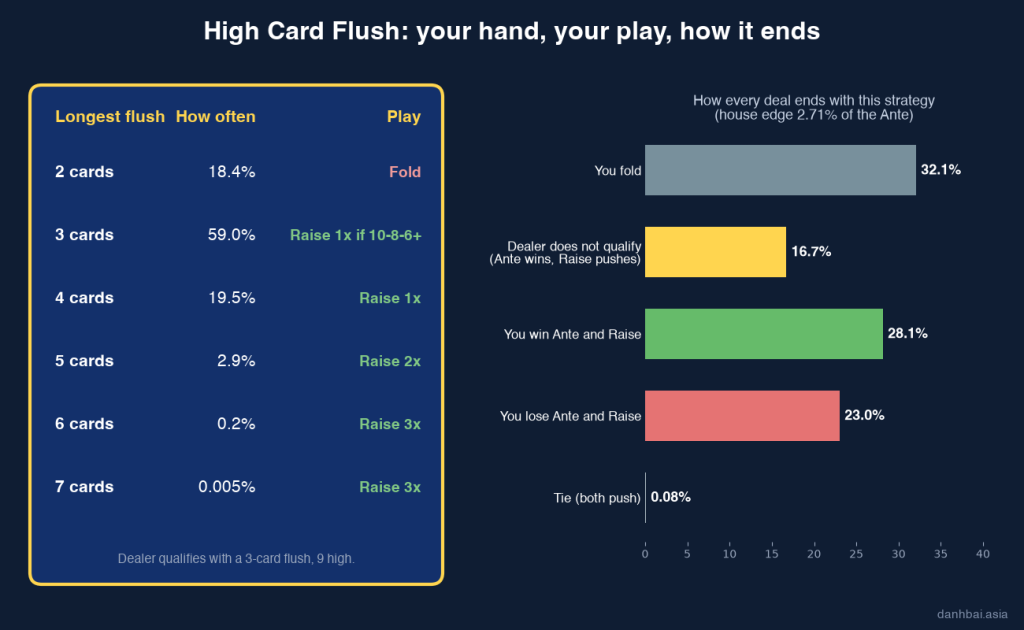
Folding a third of your hands looks like a lot, but those are hands that would lose more by playing than the one Ante you give up.
The Flush Bonus side bet
The Flush Bonus pays on your own seven cards, whatever the dealer has and whether or not you fold. It needs at least a four-card flush. The casino picks its pay table; these are the eight tables in Pennsylvania’s rules, with the house edge of each:
| Table | 7-card flush | 6-card flush | 5-card flush | 4-card flush | House edge |
|---|---|---|---|---|---|
| B | 100 to 1 | 20 to 1 | 10 to 1 | 2 to 1 | 5.30% |
| G | 500 to 1 | 100 to 1 | 10 to 1 | 1 to 1 | 6.78% |
| F | 400 to 1 | 100 to 1 | 10 to 1 | 1 to 1 | 7.29% |
| A | 300 to 1 | 100 to 1 | 10 to 1 | 1 to 1 | 7.81% |
| H | 250 to 1 | 100 to 1 | 10 to 1 | 1 to 1 | 8.06% |
| E | 400 to 1 | 60 to 1 | 12 to 1 | 1 to 1 | 9.60% |
| C | 200 to 1 | 60 to 1 | 12 to 1 | 1 to 1 | 10.62% |
| D | 500 to 1 | 50 to 1 | 12 to 1 | 1 to 1 | 11.08% |
A four-card flush or better comes up in 22.6% of hands, so the bet loses about three times in four. The house edge runs from 5.30% to 11.08%, higher than the main game whichever table is used.
The Straight Flush Bonus side bet
The Straight Flush Bonus pays when your seven cards hold at least three cards of one suit in sequence. An ace can count high or low. Your longest straight flush comes up this often:
| Straight flush | How often |
|---|---|
| Seven cards | 1 in 4,180,768 |
| Six cards | 1 in 84,036 |
| Five cards | 1 in 3,348 |
| Four cards | 1 in 198 |
| Three cards | 6.5% |
| Table | 7 cards | 6 cards | 5 cards | 4 cards | 3 cards | House edge |
|---|---|---|---|---|---|---|
| B | 1,000 to 1 | 500 to 1 | 100 to 1 | 75 to 1 | 7 to 1 | 6.27% |
| D | 1,000 to 1 | 500 to 1 | 100 to 1 | 60 to 1 | 8 to 1 | 7.39% |
| C | 500 to 1 | 200 to 1 | 100 to 1 | 60 to 1 | 8 to 1 | 7.76% |
| A | 8,000 to 1 | 1,000 to 1 | 100 to 1 | 60 to 1 | 7 to 1 | 13.09% |
Only the longest straight flush is paid. Some casinos add a progressive jackpot version of this bet, paid from a meter; its return depends on the size of the meter.
An example hand
You hold A♠ 9♠ 4♠ K♥ 7♦ 6♣ 2♥. Your longest flush is the three spades, A-9-4. That is higher than 10-8-6, so you raise 1 times the Ante.
The dealer turns over A♦ 8♦ 5♦ Q♣ J♣ 5♥ 3♠: three diamonds, A-8-5. The dealer qualifies (a three-card flush with a 9 or higher; the ace counts). Both hands are three-card flushes with an ace, so the second card decides: your 9 beats the dealer’s 8. Your Ante and Raise both pay 1 to 1.
Had the dealer shown 8♥ 6♥ 3♥ K♣ Q♦ 5♠ 2♦, the best flush would be the three hearts 8-6-3. That is a three-card flush below 9-high, so the dealer does not qualify: your Ante pays 1 to 1 and your Raise comes back.
High Card Flush vs Three Card Poker and Mississippi Stud
| High Card Flush | Three Card Poker | Mississippi Stud | |
|---|---|---|---|
| Cards | 7 each, you and the dealer | 3 each, you and the dealer | 2 of yours + 3 shared |
| What counts | Only the longest flush | Three-card poker hands | Five-card poker hands |
| Your decision | Fold, or raise 1x to 3x | Fold, or play 1x | Fold, or bet 1x or 3x on three streets |
| Dealer qualifies with | 3-card flush, 9 high | Queen high | No dealer hand |
| House edge (main game) | 2.71% of the Ante | 3.37% of the Ante | 4.91% of the Ante |
For the other two, see our Three Card Poker guide and Mississippi Stud guide.
Playing similar games online
High Card Flush is mostly found in land-based casinos. For a fold-or-raise game against the dealer online, 20Bet runs live Three Card Poker tables with a real dealer on a video stream, and 22bet runs Evolution’s live Caribbean Stud Poker; our Caribbean Stud guide covers its rules and strategy. Before you play any table game, check the pay table in the game’s help screen, because the house edge depends on it. Casino games are for players aged 18 and over; play with money you can afford to lose.

20Bet
High Card Flush: FAQ
How do you play High Card Flush?
Place an Ante and get seven cards, as does the dealer. Find your longest flush, then fold or raise: 1 times the Ante with a two-, three- or four-card flush, up to 2 times with five cards, up to 3 times with six or seven. The longer flush wins; if both are the same length, the highest card decides.
When does the dealer qualify in High Card Flush?
With a three-card flush with a 9 or higher, or any longer flush. If the dealer does not qualify, your Ante pays 1 to 1 and your Raise is returned. The dealer qualifies about 75% of the time.
What is the best High Card Flush strategy?
Fold every two-card flush. Raise a three-card flush of 10-8-6 or better and fold anything lower. Raise every four-card flush, and raise the maximum with five, six or seven cards.
What is the house edge in High Card Flush?
2.71% of the Ante with the simple strategy, and 2.66% if every hand is played perfectly, by our calculation over every possible deal. Measured against the total amount bet it is about 1.58%.
Does a straight count in High Card Flush?
Not in the main game, where only the length of the flush and its cards count. Straight flushes matter only for the optional Straight Flush Bonus side bet, which pays from a three-card straight flush up.
Is the Flush Bonus worth playing?
It pays on a four-card flush or better from your own seven cards. Depending on the pay table the casino uses, its house edge is between 5.30% and 11.08%, higher than the main game.