


F1 Betting: How to Bet on Formula 1, Markets and Race Stats
October 21, 2026
F1 betting is betting on Formula 1: who wins a Grand Prix, who finishes on the podium or in the points, who sets the fastest lap, which team comes out ahead, and longer bets on the championship. A race has around 20 drivers and no draw, so the main market is a list of prices rather than two sides. This guide covers every market you will see on a Grand Prix line and the race statistics from 2000 to 2025 behind each one.
How an F1 weekend works for betting
- Practice sessions come first.
- Qualifying sets the starting grid, and has its own market: who sets the fastest time (pole position).
- The Grand Prix on Sunday is what nearly every market is about. Some weekends add a Sprint, a shorter race on Saturday; a bet on the Grand Prix is not settled on the Sprint.
Results can change after the flag when stewards hand out time penalties or disqualify a car. Whether a sportsbook settles on the result at the podium ceremony or on a later amended result is set out in its rules, so check them before betting on a close finish.
F1 betting markets
A single Grand Prix on 22bet carries more than 300 selections across the race itself, plus separate events for qualifying and for special bets. These are the markets you will find:
| Market | What the bet is on |
|---|---|
| Race winner | Which driver wins the Grand Prix. Also offered as a yes/no bet on each driver. |
| Finishing position | A driver to finish exactly 2nd or exactly 3rd. |
| Top 2, top 3 (podium), top 6, top 10 (points) | A driver to finish in that range, yes or no. |
| Fastest lap | Which driver sets the fastest lap of the race; also which team. |
| Team to win | Whether either driver of a team wins the race. |
| Both drivers’ placings | Both cars of a team to finish in the top 3, top 6 or top 10. |
| One of the drivers in a place | At least one car of a team in the top 3 or the top 10. |
| Winning margin | The winner’s gap to 2nd place in seconds: under 5 or 5 and over, under 10 or 10 and over. |
| Fastest pit stop | Which team makes the quickest pit stop. |
| Qualifying winner | Who sets the fastest time in qualifying. |
| Specials | Number of drivers classified (over or under a line such as 17.5), a red flag to be shown, fastest lap and win, fastest in qualifying and win. |
Prices are decimal odds. A price converts into the chance it implies by dividing 1 by it: 2.26 implies 44.2%, 1.08 implies 92.6%. The odds formats guide converts them into American and Asian formats.
Where F1 winners start
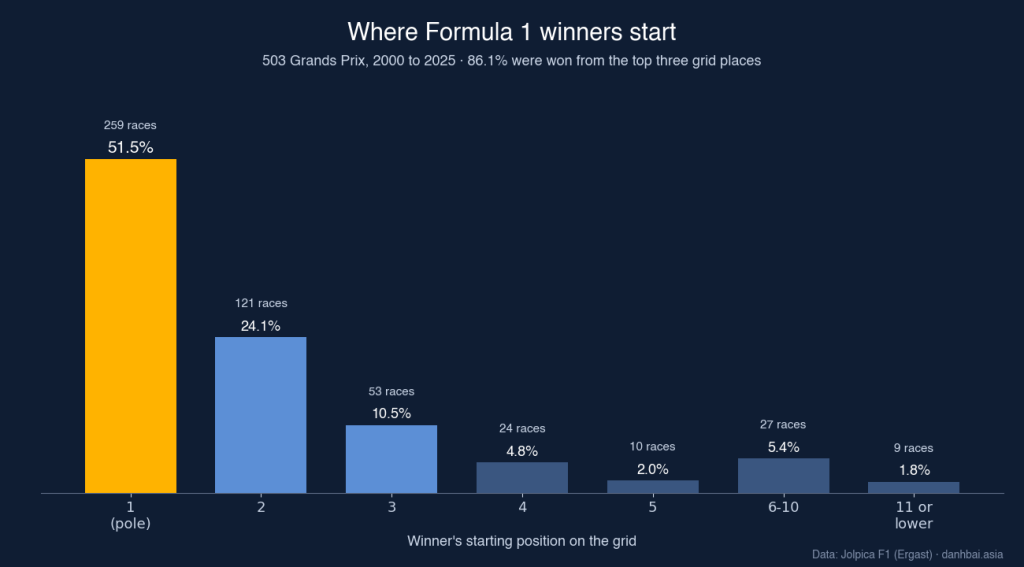
Qualifying decides a large part of the race. Of 503 Grands Prix from 2000 to 2025, the driver starting from pole won 51.5%, and 86.1% were won from the top three grid places. Only 9 races (1.8%) were won from 11th or lower.
| Seasons | Races | Won from pole | Won from the front row | Won from the top 3 | Pole-sitter on the podium |
|---|---|---|---|---|---|
| 2000–2025 | 503 | 51.5% | 75.5% | 86.1% | 78.5% |
| 2014–2025 | 252 | 53.6% | 77.0% | 87.7% | 81.0% |
| 2022–2025 | 92 | 55.4% | 76.1% | 87.0% | 80.4% |
That is why the qualifying result moves the race-winner prices so much, and why “fastest in qualifying and win” is offered as a single bet. Starting from pole is the single strongest position, but not a certainty: the pole-sitter failed to win nearly half of these races and missed the podium in about one in five.
Winning margin
Winning-margin bets split races by the gap between 1st and 2nd at the flag. Over the same seasons:
| Seasons | Under 5 seconds | 5 to 9.999 seconds | 10 seconds or more |
|---|---|---|---|
| 2000–2025 | 44.3% | 20.9% | 34.8% |
| 2022–2025 | 41.3% | 23.9% | 34.8% |
A late safety car is one way a big lead disappears: the field bunches up behind it, and the gap at the flag can end up a second or two.
How many cars finish: the classified market
A driver is classified if they finish the race, or complete enough of the distance (90% of the winner’s laps) before retiring. “Number of drivers classified” is an over/under on that count.
| Seasons | Average starters | Average classified | 18 or more classified | Every car classified |
|---|---|---|---|---|
| 2000–2025 | 21.0 | 16.6 | 41.0% | 4.6% |
| 2014–2025 | 20.3 | 17.2 | 46.8% | 7.9% |
| 2022–2025 | 20.0 | 17.6 | 56.5% | 13.0% |
Cars have become more reliable, so more of the field reaches the flag: in 2022–2025 an average of 17.6 of 20 cars were classified, which is why the line sits around 17.5 or 18.
Fastest lap and team-mates
- Fastest lap: the race winner set the fastest lap in 31.0% of Grands Prix from 2004 to 2025. A driver further back can stop for fresh tyres late in the race and set the fastest lap on them, so the fastest-lap market is priced separately from the race winner.
- 1-2 finishes: both cars of the winning team finished first and second in 31.2% of races from 2000 to 2025, and in 29.3% from 2022 to 2025.
Formula 1 brought in new car and engine rules for 2026, and these figures cover the seasons before them. They show the long-run pattern of the sport, not how any single race will go.
Before you bet on F1
- Wait for qualifying if you are betting on the race: the grid changes most race prices, and the statistics above show why.
- Check which session a market is for. Qualifying, Sprint and Grand Prix markets are separate events.
- Read the settlement rules for post-race penalties and for a race that is stopped and not restarted.
- For bets placed while the race is running, see the in-play betting guide.
- For American stock car racing, see NASCAR betting.
Sports betting is for adults 18 and over. Set a budget before you bet and stop when it is used up.

22bet

20Bet
F1 Betting FAQ
Can you bet on F1?
Yes. Sportsbooks such as 22bet and 20Bet list Formula 1 with markets on the race winner, podium and points finishes, fastest lap, teams, qualifying and specials for each Grand Prix.
How often does the pole-sitter win in F1?
In 51.5% of the 503 Grands Prix from 2000 to 2025, and in 55.4% from 2022 to 2025. 86.1% of races in that period were won from the top three grid places.
What does top 6 or top 10 mean in F1 betting?
The driver has to finish in that range. Top 3 is a podium finish and top 10 is a points finish.
What is the winning margin market?
A bet on the gap between the winner and 2nd place at the flag, usually split at 5 and 10 seconds. From 2000 to 2025, 44.3% of races were won by less than 5 seconds and 34.8% by 10 seconds or more.
What does "number of drivers classified" mean?
The number of drivers who finish or complete at least 90% of the winner’s distance. From 2022 to 2025 an average of 17.6 of 20 cars were classified.
How often does the race winner set the fastest lap?
In 31.0% of Grands Prix from 2004 to 2025.
Is a bet on the Grand Prix settled on the Sprint?
No. The Sprint is a separate, shorter race on Saturday with its own markets; Grand Prix markets are settled on Sunday’s race.
Do post-race penalties count for F1 bets?
It depends on the sportsbook. Some settle on the result at the podium ceremony, others on the official result after penalties. Check the rules before betting on a close finish.