


Back and Lay in Betting: Meaning, Lay Liability and Worked Examples
October 17, 2026
Back and lay are the two sides of a bet on a betting exchange. To back is to bet that something will happen, exactly as you would at a bookmaker. To lay is to bet that it will not: you take the bookmaker’s role and accept another customer’s back bet. Every matched bet on an exchange has a backer on one side and a layer on the other. This guide explains what each term means, how to work out lay liability, how back and lay prices are shown, how back-to-lay trading works, and how to take a lay position at a bookmaker that only lets you back.
What does back mean in betting?
Backing a selection means betting for it. If it wins, your profit is your stake times the decimal odds minus one; if it does not, you lose your stake.
Example: you back India to win a match with 1,000 at odds of 2.50. If India win, you make 1,000 × (2.50 − 1) = 1,500 profit and get 2,500 back in total. If India do not win, you lose the 1,000.
What does lay mean in betting?
Laying a selection means betting against it. You are paid the backer’s stake if the selection does not win, and you pay the backer’s profit if it does.
Example: you lay India with a 1,000 stake at 2.50. If India do not win, you win the 1,000. If India win, you pay out 1,500. “Not win” includes every other result: in a market with a draw, a lay of India wins if the match is drawn too.
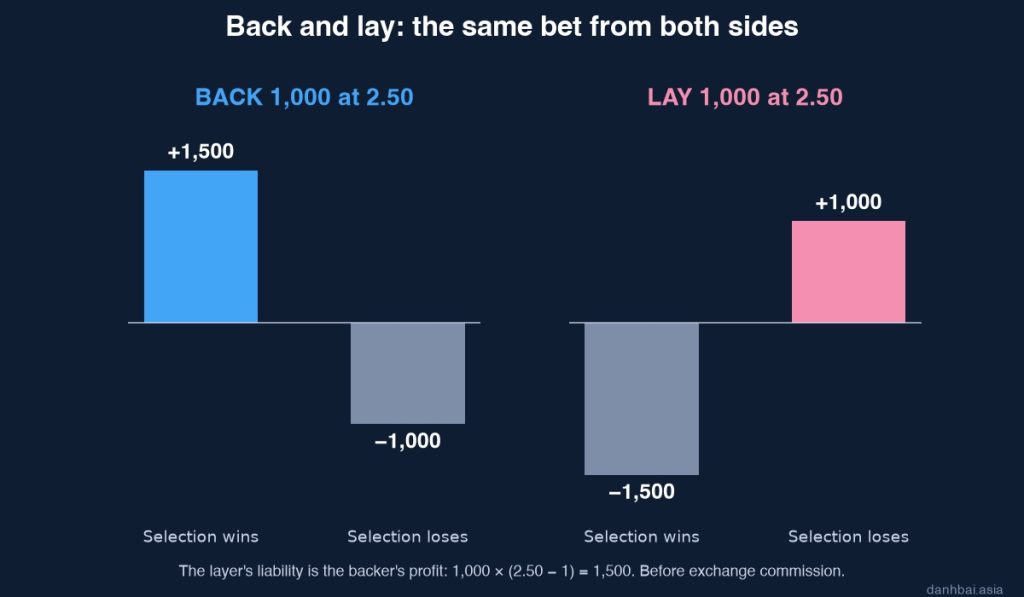
Lay liability: how much a lay bet can lose
The amount you stand to lose on a lay bet is its liability:
Liability = lay stake × (odds − 1)
The exchange sets the liability aside from your balance until the market is settled. The higher the odds, the larger it gets, which is why laying an outsider can risk many times the stake you win:
| Lay stake | Odds | You win if it loses | Your liability if it wins |
|---|---|---|---|
| 1,000 | 1.50 | 1,000 | 500 |
| 1,000 | 2.00 | 1,000 | 1,000 |
| 1,000 | 2.50 | 1,000 | 1,500 |
| 1,000 | 4.00 | 1,000 | 3,000 |
| 1,000 | 10.00 | 1,000 | 9,000 |
Many exchanges let you enter the liability you are prepared to risk instead of the stake; the stake is then liability ÷ (odds − 1).
Back odds and lay odds on an exchange
Each selection on an exchange shows two sets of prices. The back column (blue on most exchanges) lists the odds you can back at right now, offered by people who want to lay. The lay column (pink) lists the odds you can lay at, offered by people who want to back. The best lay price is always at least as high as the best back price, and the small gap between them is the spread; on a busy market it is often a single tick.
Exchanges do not build a margin into the odds the way a bookmaker does. Instead they charge a commission on your net winnings in each market, at the rate set out in the exchange’s rules, so every result in this guide is before commission. The odds themselves translate into a probability in the usual way: 2.50 means 1 ÷ 2.50 = 40%.
Back-to-lay and lay-to-back trading
Because you can both back and lay the same selection, you can close a position before the match ends. If the odds have moved, the result is then the same whichever side wins. The stake for the closing bet is:
Closing stake = original stake × original odds ÷ current odds
| Position | Odds move | Closing bet | If the selection wins | If it does not |
|---|---|---|---|---|
| Back 1,000 at 3.00 | Shorten to 2.00 | Lay 1,500 at 2.00 (liability 1,500) | +2,000 − 1,500 = +500 | −1,000 + 1,500 = +500 |
| Lay 1,000 at 2.00 | Drift to 3.00 | Back 666.67 at 3.00 | −1,000 + 1,333.33 = +333.33 | +1,000 − 666.67 = +333.33 |
| Back 1,000 at 2.00 | Drift to 3.00 | Lay 666.67 at 3.00 | +1,000 − 1,333.33 = −333.33 | −1,000 + 666.67 = −333.33 |
The last row is the same calculation with the price moving against you: closing the position fixes the loss instead of a profit. Trading does not change the odds of the match itself; it only fixes the result at whatever price movement has already happened. Prices move fastest during play, which our in-play betting guide covers.
How to lay a bet at a bookmaker
A traditional bookmaker only lets you back, but you can take the same position by backing every other outcome:
- Two-way markets, such as most limited-overs cricket match-winner markets or a tennis match: laying one side is the same as backing the other. If India are 2.50 (40%), a fair price for their opponents would be 1 ÷ 0.60 = 1.67; a bookmaker’s price will be a little lower, because its margin is built into the odds.
- Three-way markets, such as football or a Test match with a possible draw: laying a team is the same as backing the other two results together, which is what a double-chance bet does. Our 1X2 betting guide explains double chance and its prices.
Back and lay in cricket betting
On cricket exchanges the busiest market is Match Odds, the match winner, and its prices move with almost every ball, which is why back-to-lay trading is so common during play. At a bookmaker, the same match is priced in the match-winner market alongside totals, top batter and innings markets. 22bet carries cricket among the main sports in its sportsbook, and MegaPari gives cricket its own top-level tab.
Bet responsibly
Betting is for adults aged 18 and over. Laying in particular can lose more than the stake you stand to win, so check the liability before you confirm a lay bet, and set a budget you are comfortable losing.

22bet

MegaPari
Back and Lay FAQ
What is back and lay in betting?
Backing is betting that an outcome will happen; laying is betting that it will not. On a betting exchange every matched bet has a backer and a layer, so the layer takes the role a bookmaker would normally play.
What does lay mean in betting?
Betting against a selection. You win the backer’s stake if the selection does not win, and pay the backer’s profit if it does.
What is lay liability?
The most a lay bet can lose: lay stake × (odds − 1). Laying 1,000 at 2.50 has a liability of 1,500.
How do you calculate a lay bet?
If the selection loses, you win the lay stake. If it wins, you lose stake × (odds − 1). Both are before the exchange’s commission, which is charged on net winnings in the market.
What is the difference between back odds and lay odds?
Back odds are the prices you can back at, offered by layers; lay odds are the prices you can lay at, offered by backers. The best lay price is at least as high as the best back price, and the gap is the spread.
What is back-to-lay trading?
Backing at one price and laying the same selection later at a lower price, so the result is the same whichever side wins. The lay stake is the back stake × back odds ÷ lay odds. If the price moves the other way, the same calculation fixes a loss.
Can you lay a bet at a bookmaker?
Not directly, but you can take the same position by backing every other outcome: the opponent in a two-way market, or a double chance on the other two results in a three-way market.