


Red Dog Card Game: Rules, Payouts, When to Raise and House Edge
November 7, 2026
Red Dog is a card game built on one question: will the next card fall between the two already on the table? Two cards are dealt face up, the gap between them sets the payout, and you can double your bet before the third card is turned. This guide covers the rules, the payouts, when to raise, and the exact house edge, worked out over the eight-deck shoe of Betsoft’s online version.
How to play Red Dog
- Place your bet. Put your chips on the betting spot and deal.
- Two cards are dealt face up, with a space between them. Aces are high and twos are low; suits do not count.
- The spread is set. The spread is the number of ranks that sit between the two cards. A 5 and a 9 have a spread of 3 (6, 7 and 8).
- Raise or stand. You can raise (the game calls it RIDE), which doubles your bet, or stand and keep it as it is.
- The third card. If it falls strictly between the first two, you win at the odds for that spread. If it matches one of them or lands outside, you lose your bet.
Two hands skip the raise. If the first two cards are consecutive, like a 7 and an 8, no card can fall between them and the hand is a push: your bet comes back. If they are a pair, a third card is dealt. If it makes three of a kind you win 11 to 1; otherwise the hand is a push.
Red Dog payouts and odds
The smaller the spread, the less likely the third card is to land inside, so the bigger the payout. The table shows the standard pay table, which is the one Betsoft’s online Red Dog uses, with how often each spread comes up and the chance the third card lands inside it, using eight decks:
| Spread | Pays | How often the spread comes up | Chance the third card lands inside | Best play |
|---|---|---|---|---|
| 1 | 5 to 1 | 13.0% | 7.7% | Do not raise |
| 2 | 4 to 1 | 11.9% | 15.5% | Do not raise |
| 3 | 2 to 1 | 10.7% | 23.2% | Do not raise |
| 4 | 1 to 1 | 9.5% | 30.9% | Do not raise |
| 5 | 1 to 1 | 8.3% | 38.6% | Do not raise |
| 6 | 1 to 1 | 7.1% | 46.4% | Do not raise |
| 7 | 1 to 1 | 5.9% | 54.1% | Raise |
| 8 | 1 to 1 | 4.7% | 61.8% | Raise |
| 9 | 1 to 1 | 3.6% | 69.6% | Raise |
| 10 | 1 to 1 | 2.4% | 77.3% | Raise |
| 11 | 1 to 1 | 1.2% | 85.0% | Raise |
| Consecutive cards | Push | 14.2% | – | – |
| Pair | 11 to 1 on three of a kind, otherwise push | 7.5% | 7.2% for three of a kind | – |
Spreads of 4 or more all pay even money, while the chance of winning grows with every extra rank. A spread of 4 wins only 30.9% of the time, so most even-money hands are still more likely to lose than win. A spread of 11 (a 2 and an ace) wins 85.0% of the time.
When to raise in Red Dog
The whole strategy is one rule: raise when the spread is 7 or more, stand when it is 6 or less.
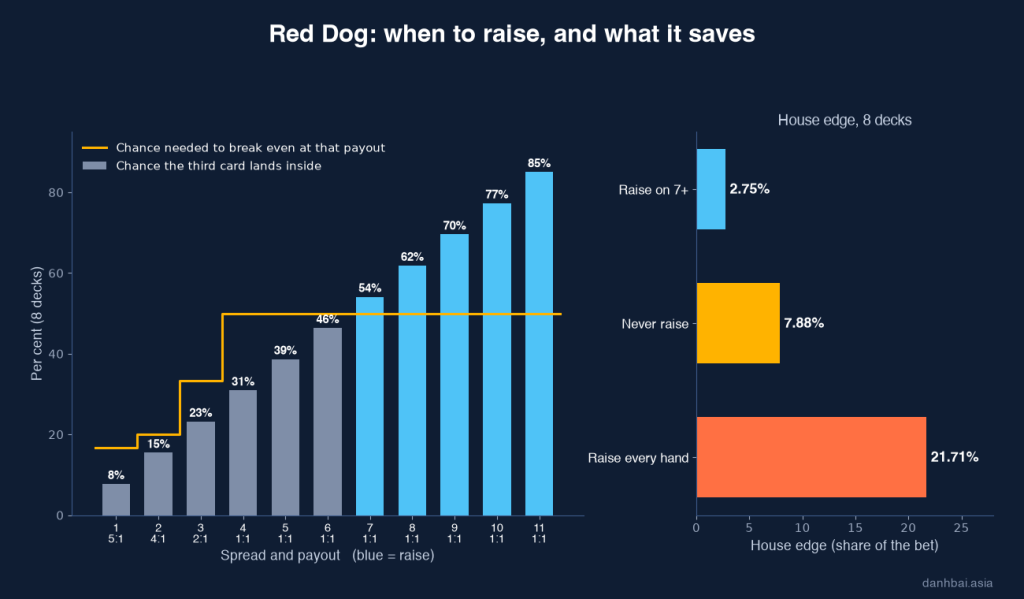
At a spread of 7 the third card lands inside 54.1% of the time at even money, so the hand has a positive expected value, and raising doubles it. At a spread of 6 the chance drops to 46.4%, below the 50% that an even-money bet needs, so raising would only double a losing bet. The small spreads pay more but are not good enough either: a spread of 1 needs a one-in-six chance to break even at 5 to 1, and wins only 7.7% of the time.
A spread of 7 or more comes up in 17.8% of hands, so you raise about once every 5.6 hands. That rule is what keeps the game cheap. With eight decks:
- Raising on 7 or more: house edge 2.75% of your original bet.
- Never raising: 7.88%.
- Raising on every hand: 21.71%.
Red Dog house edge by number of decks
The house edge falls slightly as decks are added. These figures assume you raise on 7 or more:
| Decks | House edge | Return to player |
|---|---|---|
| 1 | 3.16% | 96.84% |
| 2 | 3.08% | 96.92% |
| 4 | 2.88% | 97.12% |
| 6 | 2.80% | 97.20% |
| 8 | 2.75% | 97.25% |
Betsoft’s Red Dog deals from eight decks and Betsoft lists its RTP as 97.20%. Measured against all the money you put on the table, original bets and raises together, the eight-deck edge is 2.34%, because you raise on 17.8% of hands.
What 100 hands of Red Dog look like
Playing the raise-on-7 rule with eight decks, out of 100 hands you can expect about:
- 46 losses of your bet without a raise, and 6 losses of a raised, doubled bet;
- 21 pushes (consecutive cards, or a pair with no third match);
- 9 even-money wins, 14 wins of two units (raised even-money hands and spreads of 3), 3 wins at 4 or 5 to 1, and a three of a kind at 11 to 1 about once every 185 hands.
You lose more hands than you win, about 52% against 27%, and the raised hands and the long-odds payouts are what bring the overall cost down to 2.75% of your bet.
An example hand
You bet 10. The dealer turns a 4 and a queen. The ranks between them are 5 to jack, a spread of 7, so you raise to 20. The third card is a 9: it falls inside, and a spread of 7 pays even money, so you win 20. Had the third card been a king, a 4 or a queen, you would have lost the 20.
Next hand you bet 10 again, and the dealer turns an 8 and a jack: a spread of 2, paying 4 to 1. You stand, because a spread that small lands inside only 15.5% of the time. A 10 comes and you win 40.
Red Dog, Acey Deucey and In Between
Home games called Acey Deucey or In Between use the same idea, betting on a card falling between two others, but players usually bet against a shared pot rather than a pay table, and the rules change from table to table. Casino Red Dog has fixed payouts and no other players to beat, which is why its house edge can be worked out exactly. For other quick games against the house, see Casino War, where one card each decides the round, and Three Card Poker.
Where to play Red Dog
22bet has two computer versions of Red Dog in its casino lobby: Betsoft’s, which uses the rules and pay table above with eight decks, and Platipus’. Open the game’s paytable before you play: the stake range and payouts are set in the game, and the Betsoft demo table takes €1 to €100 a hand.
Red Dog hands are quick, so set a budget before you start. Our guide to the house edge explains how the percentages above turn into what a session costs.

22bet
Red Dog: FAQ
How do you play Red Dog?
You bet, two cards are dealt face up, and you win if a third card falls strictly between them. The gap between the two cards, the spread, sets the payout. Before the third card you can raise, doubling your bet, or stand.
When should you raise in Red Dog?
Raise when the spread is 7 or more and stand when it is 6 or less. With eight decks a spread of 7 wins 54.1% of the time at even money, while a spread of 6 wins only 46.4%.
What are the Red Dog payouts?
A spread of 1 pays 5 to 1, a spread of 2 pays 4 to 1, a spread of 3 pays 2 to 1, and a spread of 4 to 11 pays even money. Consecutive cards are a push, and a pair is a push unless the third card makes three of a kind, which pays 11 to 1.
What is the house edge in Red Dog?
With eight decks and the raise-on-7 rule, 2.75% of your original bet. It is 3.16% with one deck. Never raising costs 7.88% with eight decks, and raising on every hand 21.71%.
What happens if the first two cards are a pair?
A third card is dealt straight away. If it matches the pair you win 11 to 1; if not, your bet is returned. With eight decks the third card makes three of a kind 7.2% of the time.
Is Red Dog the same as Acey Deucey or In Between?
They share the idea of betting on a card landing between two others, but those home games usually have players betting against a shared pot. Casino Red Dog has a fixed pay table.
Where can I play Red Dog online?
22bet has two computer versions in its casino lobby, from Betsoft and Platipus. Betsoft’s uses eight decks and the standard pay table.