


Keno Calculator: Odds, Payouts and RTP for Any Ticket
November 3, 2026
This keno calculator works out the exact odds of every result on a keno ticket: how likely you are to catch each number of your picks, the chance of catching at least that many, and, once you add a pay table, what each catch pays, the return to player (RTP) and the house edge. It handles classic 80-number keno, the 40-number layout used by many crypto-casino originals, Vietnam’s Vietlott Keno pay table, or any format and pay table you enter yourself.
Keno odds calculator
Choose the format, how many numbers you pick and a pay table. The table shows every possible catch. Pick “Your own multipliers” to type in the pay table printed in any keno game’s rules.
The calculator needs JavaScript. The tables below use the same maths.
How keno odds are calculated
In classic keno, 20 numbers are drawn from 80. If you pick 5, the question is how many of your 5 are among the 20 drawn. Each draw is a fixed set of numbers taken without replacement, so the odds follow the hypergeometric formula:
P(catch k) = C(5, k) × C(75, 20 − k) ÷ C(80, 20)
C(n, k) is the number of ways to choose k items from n. An equivalent way to write it, and the one most keno tables use, counts from the draw’s side: C(20, k) × C(60, 5 − k) ÷ C(80, 5). For a catch of 3 on a 5-number ticket that is 1,140 × 1,770 ÷ 24,040,016 = 8.39%, about 1 in 12. Catching all five is 15,504 ÷ 24,040,016 = 0.0645%, or 1 in 1,551.
The same formula covers any layout. Change 80 and 20 to 40 and 10 and you have the format many crypto casinos use for their own keno games.
Odds of catching every number
| Numbers picked | 80 numbers, 20 drawn | 40 numbers, 10 drawn |
|---|---|---|
| 1 | 1 in 4 | 1 in 4 |
| 2 | 1 in 17 | 1 in 17 |
| 3 | 1 in 72 | 1 in 82 |
| 4 | 1 in 326 | 1 in 435 |
| 5 | 1 in 1,551 | 1 in 2,611 |
| 6 | 1 in 7,753 | 1 in 18,278 |
| 7 | 1 in 40,979 | 1 in 155,363 |
| 8 | 1 in 230,115 | 1 in 1,708,993 |
| 9 | 1 in 1,380,688 | 1 in 27,343,888 |
| 10 | 1 in 8,911,711 | 1 in 847,660,528 |
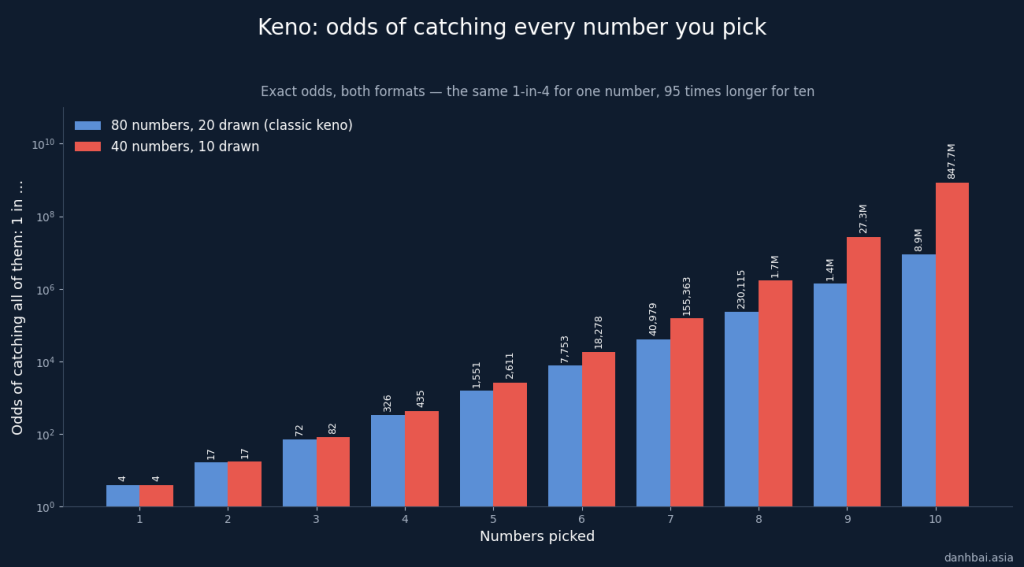
Both formats draw a quarter of the board, so a single number is 1 in 4 either way. The difference grows with every extra pick: a full 10-number catch is about 95 times rarer when only 10 of 40 are drawn, because each number you add has to come from a smaller draw. That is why 40-number games pay much larger multiples at the top of the table for the same number of picks.
What the pay table decides
The odds above are fixed by the format. What you get back is set by the pay table, and that is where keno games differ most. Vietnam’s Vietlott Keno is a published example: 20 of 80 numbers, tickets of 1 to 10 numbers, and a fixed prize for each catch on a 10,000 VND ticket. Put through the calculator, each tier returns:
| Numbers picked | Top prize (10,000 VND ticket) | Chance of any prize | RTP |
|---|---|---|---|
| 1 | 20,000 VND | 25.00% | 50.00% |
| 2 | 90,000 VND | 6.01% | 54.11% |
| 3 | 200,000 VND | 15.26% | 55.50% |
| 4 | 400,000 VND | 25.89% | 55.14% |
| 5 | 4,400,000 VND | 9.67% | 54.91% |
| 6 | 12,500,000 VND | 16.16% | 54.45% |
| 7 | 40,000,000 VND | 23.66% | 55.12% |
| 8 | 200,000,000 VND | 19.06% | 54.68% |
| 9 | 800,000,000 VND | 21.68% | 54.73% |
| 10 | 2,000,000,000 VND | 11.05% | 57.75% |
Two details are worth knowing. Tickets of 8, 9 and 10 numbers pay 10,000 VND back for catching none, which is why their chance of a prize is higher than you might expect: missing all 10 on a 10-number ticket happens 4.58% of the time. And the top prize on each of those three tiers is capped at 10 billion VND in total per draw: if more than 50, 12 or 5 tickets respectively hit it in the same draw, the 10 billion is split between them. The RTP figures above assume the full prize.
A state lottery keeps a large share of every ticket, which is why these returns sit between 50% and 58%. Online keno games set their own pay tables, and the RTP printed in a game’s rules is the number to compare; type that game’s pay table into the calculator to check it, or to see how the return changes with the number of picks. How the house edge works across casino games is covered in our house edge guide.
Reading a keno pay table
- Pays are usually “for 1”. A 4x prize returns four times the stake in total, stake included. Enter that 4 in the calculator.
- More picks do not mean better odds. They spread the same draw over more numbers, so the chance of a full catch falls fast while the top prize rises.
- Some tables pay on zero. A catch of 0 on a large ticket is rarer than it sounds, which is why some games pay it.
- Every draw is independent. “Hot” and “cold” numbers describe the past and have no effect on the next draw.
Where to play keno online
Casino Days runs a lottery row with keno, Fast Keno and Lucky 6 drawing around the clock, alongside its live tables. 20Bet has a Keno & Lotto section in its lobby, on the same balance as its sportsbook and slots. More on the game itself, from the rules to keno variants, is in our keno guide, and bingo, the hall game closest to it, is explained in how to play bingo.
Keno is a game of chance and the house keeps an edge on every ticket. Set a budget before you play and stop when it is spent. 18+ only. Read more about playing safely.

Casino Days

20Bet
Keno calculator FAQ
How do you calculate keno odds?
With the hypergeometric formula. If you pick p numbers and 20 of 80 are drawn, the chance of catching exactly k is C(20, k) × C(60, p − k) ÷ C(80, p). For 3 out of 5 that is 8.39%, about 1 in 12.
What are the odds of hitting all 10 numbers in keno?
1 in 8,911,711 in classic keno, where 20 of 80 numbers are drawn. In a 40-number game that draws 10, it is 1 in 847,660,528.
What are the odds of catching 7 out of 7 in keno?
1 in 40,979 when 20 of 80 numbers are drawn, and 1 in 155,363 when 10 of 40 are drawn.
What is the RTP of keno?
It depends entirely on the pay table. Vietlott Keno returns between 50% and 58% depending on how many numbers you pick; online keno games set their own pay tables and print the RTP in their rules. Enter any pay table into the calculator to work it out.
How many numbers should I pick in keno?
No number of picks changes the house edge in your favour. Fewer picks mean frequent small prizes; more picks mean rarer, larger ones. Compare tickets in the calculator by the RTP and by how often any prize lands.
Are keno draws random?
Yes. Each draw is independent, so numbers that came up often (or rarely) in past draws are no more or less likely to come up in the next one.