


How to Read a Baccarat Scoreboard: Bead Plate, Big Road and Derived Roads
October 18, 2026
Every live baccarat table shows a scoreboard, often called the roads or the baccarat board: grids of red and blue marks that record the results of the shoe so far. There are usually five. The Bead Plate and the Big Road record who won each hand. The three derived roads, the Big Eye Boy, Small Road and Cockroach Pig, are worked out from the Big Road and record something else entirely. This guide explains how each one is drawn, using one example shoe drawn on all five, and what the scoreboard can and cannot tell you. The rules follow the game description that the table-game maker Interblock filed with the Washington State Gambling Commission; live dealer studios draw the roads the same way.
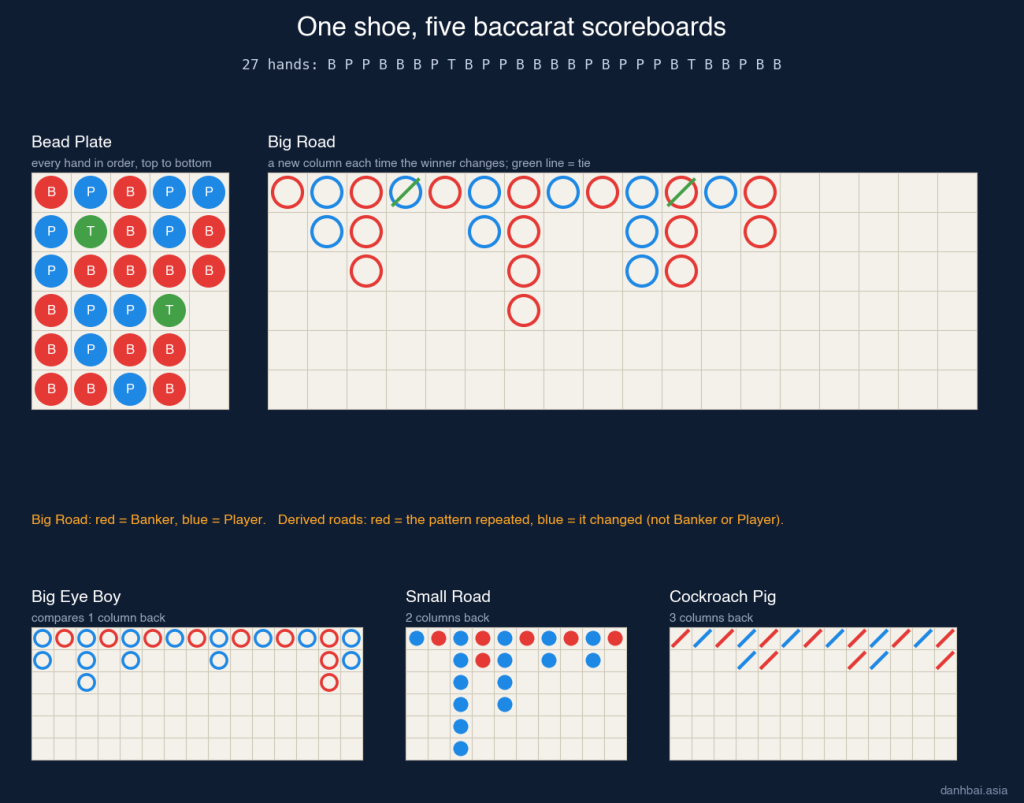
Bead Plate
The Bead Plate is the simplest road: one cell per hand, in the order the hands were played. It fills from the top left, down the first column, then continues at the top of the next column, six cells to a column. Banker wins are red, Player wins blue and ties green; many tables print B, P or T (or the Chinese characters) inside the circle. Read it like a list. In the example, the first column says Banker, Player, Player, Banker, Banker, Banker.
Big Road
The Big Road (also called the Main Road) is the board most players mean by “the baccarat board”. It groups results into streaks:
- A hollow red circle is a Banker win and a hollow blue circle a Player win.
- The marks go down the same column while the same side keeps winning. When the winner changes, the next mark starts a new column at the top.
- Ties do not get a cell. A tie is a green slash through the last mark, with a number beside it when there are several ties in a row. A tie on the very first hand of the shoe is drawn in the first cell, and the next win is placed over it.
- Pairs are small dots on the mark: red at the top left for a Banker pair, blue at the bottom right for a Player pair.
- Some tables show naturals by writing the 8 or 9 inside the circle.
- When a streak is longer than six, the seventh mark and the ones after it turn right and run along the bottom row. This is the dragon’s tail, and a long streak is called a dragon.
In the example, the 27 hands make 13 columns: Banker, then Player twice, then Banker three times, and so on. The tie after hand 7 is the green slash on the single Player in column 4, and the tie in hand 22 is the slash on the first mark of column 11. Because ties never get a cell, the Big Road has 25 marks for 27 hands.
The derived roads
The Big Eye Boy, Small Road and Cockroach Pig are the roads players find confusing, because their red and blue do not mean Banker and Player. They ask one question about the Big Road: is it repeating its own shape, or changing it?
- Red: the Big Road is following its earlier pattern (columns of the same depth, or a streak that behaves like the one before it).
- Blue: the pattern changed.
Each derived road compares the Big Road with a column further back: the Big Eye Boy with 1 column back, the Small Road with 2 and the Cockroach Pig with 3. They are drawn with different marks so they can be told apart: hollow circles, solid dots and short slashes.
How each mark is decided
Every new Big Road mark (not a tie) adds one mark to each derived road that has started. For the Big Eye Boy:
- If the new mark starts a new column on the Big Road, compare the depths of the two columns before it. Same depth: red. Different: blue.
- If the new mark continues a column, look at the cell one column to its left and the cell directly above that one. If both are filled, or both are empty: red. If one is filled and the other empty: blue.
The Small Road uses exactly the same two steps with the columns two to the left (for a new column: compare the first and third columns to its left), and the Cockroach Pig with the columns three to the left (the first and fourth).
Where each road starts
- Big Eye Boy: at the second mark of the Big Road’s second column, or the first mark of the third column if the second column has only one mark.
- Small Road: at the second mark of the third column (or the top of the fourth).
- Cockroach Pig: at the second mark of the fourth column (or the top of the fifth).
The derived roads are drawn like the Big Road: same colour goes down the column, a change starts a new column, and a run longer than six turns along the bottom.
The example, worked through
The first three Big Eye Boy marks in the example come from the Big Road like this:
- Hand 3 is the second Player in column 2. One column to the left, column 1 has no second mark, but it does have the mark above it: one filled and one empty, so blue.
- Hand 4 starts column 3. The two columns before it are 2 deep and 1 deep: different, so blue.
- Hand 5 is the second Banker in column 3. Column 2 has both a second mark and a first mark: both filled, so red.
The Cockroach Pig shows the starting rule at work: column 4 of the Big Road holds a single Player, so there is no second mark to start from, and the road begins at the top of column 5 instead. That is why it has 18 marks while the Big Eye Boy has 23 and the Small Road 21.
What the scoreboard can and cannot tell you
The roads are a record. They let you see at a glance how the shoe has gone, check what has happened since you sat down and follow the game without watching every hand. They do not predict the next hand. Each round is dealt from the shoe by fixed drawing rules, and the chances stay close to 45.86% Banker, 44.62% Player and 9.52% Tie whatever the board looks like. The cards already used shift those numbers only very slightly, and the roads do not record which cards those were. A long dragon does not make the next hand more or less likely to continue it, and a blue column on the Big Eye Boy does not mean a change is “due”.
Staking systems built on the roads change how your results are spread, not what each bet costs. For what each bet does cost, see every baccarat bet, priced; for the side bets on the same tables, including the Dragon Bonus, see our baccarat side bets guide.
Scoreboards at live baccarat tables
Live dealer baccarat shows all five roads beside the video, and they update after every hand; the lobby often shows each table’s Big Road so you can see the shoe before you join. Tables differ in small details, such as whether naturals are marked and how many columns fit on screen, so check the help screen if a symbol is unfamiliar. 22bet‘s live casino runs baccarat tables from Evolution, Pragmatic Play, Ezugi and SA Gaming, including speed and squeeze versions. Our live baccarat guide covers the tables themselves, and the baccarat rules guide covers the drawing rules.
Play responsibly
Baccarat is for players aged 18 and over. Following the roads can make a session feel like it is building towards something; it is not, so set a budget before you play and stop when it is spent.

22bet
Baccarat Scoreboard FAQ
How do you read a baccarat scoreboard?
On the Big Road, red is a Banker win and blue a Player win. Marks go down a column while the same side keeps winning, and a new column starts when the winner changes. Ties are green slashes on the last mark. The Bead Plate lists every hand in order, one cell each.
What do red and blue mean on the Big Eye Boy?
Not Banker and Player. Red means the Big Road is repeating its earlier pattern and blue means the pattern changed. The same applies on the Small Road and the Cockroach Pig.
What is the Big Road in baccarat?
The main scoreboard. It groups results into streaks: each column is a run of Banker or Player wins, and a new column starts when the winner changes. Ties are marked on the previous result instead of getting their own cell.
What is a dragon tail in baccarat?
When a streak on the Big Road is longer than six, the extra marks turn right and run along the bottom row. That bend is the dragon’s tail, and a long streak is called a dragon.
How are ties shown on the baccarat board?
As a green slash through the last Banker or Player mark, with a number when there are several ties in a row. On the Bead Plate a tie gets its own green cell.
Can the baccarat scoreboard predict the next hand?
No. The roads record past results. The next hand is close to 45.86% Banker, 44.62% Player and 9.52% Tie whatever the board shows.
What is the difference between the Big Eye Boy, Small Road and Cockroach Pig?
They use the same rule but compare the Big Road with a different column: 1 column back for the Big Eye Boy, 2 for the Small Road and 3 for the Cockroach Pig. They start later in the shoe for the same reason.